WhatsApp: +86 16626708626
 Email:
  Phone: +86 16626708626
Description
Key Technical Specifications
- Manufacturer: FMS Force Measuring Systems AG
- Model: EMGZ306A (EMGZ 306A)
- Device Type: Single-channel analog tension measuring amplifier
- Number of Channels: 1
- Supported Force Sensors: 1 or 2 strain-gauge force sensors, 350 Ω each
- Sensor Excitation: 5 VDC, max 30 mA (high precision); 10 VDC option on some variants
- Input Signal Range: ±9 mV (max ±11.25 mV to ±12.4 mV depending on variant)
- Gain Factor Range: 500–5000 (adjustable via 20-turn trimmers)
- Offset Range: ±9 mV (adjustable)
- Voltage Output: ±10 VDC, min load 1 kΩ
- Current Output: 0–20 mA or 4–20 mA, max load 500 Ω (jumper-selectable)
- Lowpass Filter: Adjustable cutoff, approx. 1–1000 Hz
- Power Supply: 24 VDC (18–36 VDC), max 0.1 A
- Power Consumption: max 2.5 W
- Linearity Error: < 0.1%
- Temperature Drift (Offset): < 0.01% / K (< 0.006% / °F)
- Operating Temperature: −10 to +60 °C (14 to 140 °F)
- Mounting: DIN-rail (TS35), compact plastic housing
- Protection Class: IP20
- Connections: Screw terminals (all signals to terminal block)
- Variants:
- EMGZ306A: standard 5 V sensor supply
- EMGZ306A.10V: 10 V sensor supply option
- EMGZ306A.CAL: calibration without weight feature
- EMGZ306A.581820: compound-filled for high-vibration/rotating applications
Product Introduction
The FMS EMGZ306A is a single-channel analog tension measuring amplifier used in web handling, wire, cable, and converting lines to condition signals from FMS force sensors (load cells, measuring rollers, or journals). It converts the low-level mV output of 350 Ω strain-gauge sensors into standardized ±10 V and 0/4–20 mA signals for PLCs, drives, or tension controllers.
This amplifier is chosen for its simple analog setup (20-turn trimmers for gain/offset and filter), support for one or two force sensors per channel, and proven use in legacy FMS-based tension systems. Variants like .CAL (weightless calibration) and compound-filled versions extend its use to specialized applications without changing the basic wiring concept.
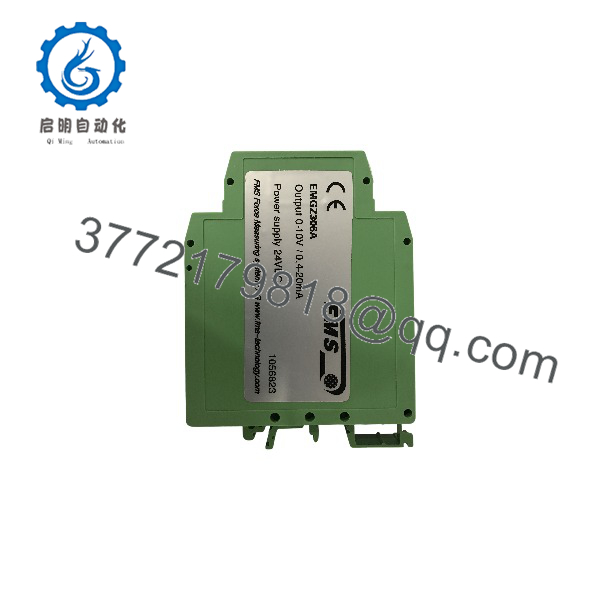
EMGZ306A
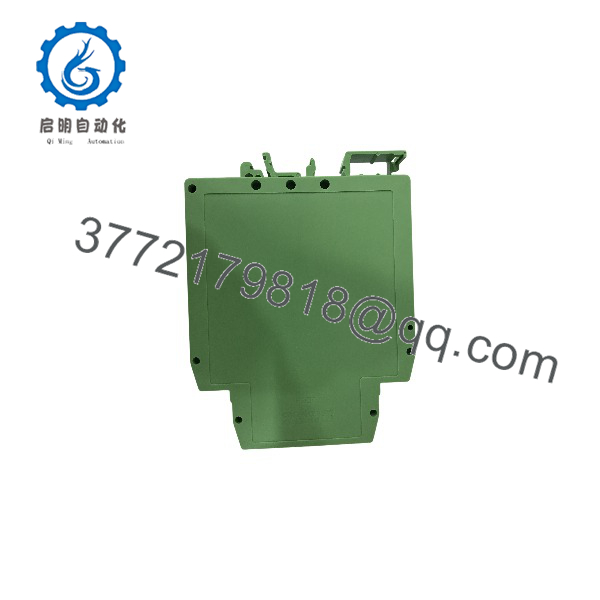
EMGZ306A
Troubleshooting Quick Reference
| Symptom | Possible Cause | Relevance to this Part | Quick Check Method | Recommendation |
|---|---|---|---|---|
| No output, amplifier appears dead | 24 VDC missing, reversed polarity, or blown fuse | ✅ High | Measure 18–36 VDC at power terminals; verify polarity and upstream fuse/breaker | Restore correct 24 VDC supply before adjusting gain/offset |
| Output stuck at min or max | Gain/offset misadjusted, sensor open/short, or wrong sensor count | ✅ High | Check sensor resistance (should be ~350 Ω per sensor); verify 1 or 2 sensors connected as intended | Re-adjust gain/offset with trimmers; replace faulty sensor if resistance is out of range |
| Noisy or unstable tension signal | Mechanical vibration, incorrect lowpass setting, or EMI | ✅ Medium | Observe output while adjusting lowpass cutoff (1–1000 Hz); check cable routing and shielding | Increase filtering, improve sensor mounting, and separate signal cables from VFDs/motor leads |
| Output does not match expected tension | Wrong sensor excitation (5 V vs 10 V), incorrect gain, or drift | ✅ High | Verify variant ( vs .10V); check 5 V/10 V excitation at sensor terminals | Recalibrate gain/offset using known load or calibration procedure; confirm correct variant |
| Different behavior after replacement | Different variant (CAL, 10V, compound-filled) or trimmer settings | ✅ Medium | Compare nameplate and variant code; photograph trimmer positions on old unit | Mirror trimmer settings and wiring from old amplifier; if different variant, recalibrate |
If you are unsure, photograph the nameplate ( and variant), wiring, and trimmer positions, then share sensor type and PLC input range with technical support.
Frequently Asked Questions (FAQ)
Q: What exactly is the used for?
A: It is an analog tension measuring amplifier for FMS force sensors in web, wire, and strand lines. It does not control tension by itself; it conditions the sensor signal so a PLC, drive, or dedicated tension controller can use it.
Q: How many force sensors can I connect to one ?
A: One channel, but you can wire either 1 or 2 × 350 Ω force sensors to that channel. The amplifier sums/conditions their combined mV signal. Do not exceed two 350 Ω sensors per unit.
Q: Does it output 0–10 V, 4–20 mA, or both?
A: It provides both a ±10 V voltage output and a 0/4–20 mA current output. The current mode (0–20 mA or 4–20 mA) is selected by jumpers; voltage output is always available in parallel.
Q: What power supply does it need?
A: 24 VDC nominal, acceptable range 18–36 VDC, max 0.1 A. Power consumption is under 2.5 W. Do not connect 12 VDC or 115/230 VAC directly to the amplifier terminals.
Q: What is the difference between , .10V, and .CAL?
A: is the standard 5 V sensor-excitation version. .10V uses 10 V excitation for certain sensors. .CAL adds calibration-without-weight functionality. Mechanically they are similar; electrically and functionally they differ in sensor supply and calibration features.
Q: Is this still a current-production product?
A: The series is a legacy analog platform from FMS. Newer digital amplifiers and controllers exist, but remains in service on older lines. Treat procurement as a legacy-parts purchase and confirm the exact variant.
Q: Can I replace a failed with any other FMS amplifier?
A: Not automatically. You must match sensor excitation (5 V vs 10 V), output type, and calibration method. In many cases, an identical (same variant) is the lowest-risk swap to avoid re-engineering the tension loop.
Q: What condition are available units in?
A: Listings vary between new surplus, new old stock, and refurbished/tested. For critical tension loops, request test details (gain/offset range check, output verification) and confirm the exact variant code before installation.