WhatsApp: +86 16626708626
 Email:
  Phone: +86 16626708626
Description
3. Key Technical Specifications
| Parameter | Value |
|---|---|
| Input Channels | 8 group-isolated |
| Input Signal | 4–20 mA analog or HART FSK superimposed on 4–20 mA |
| HART Protocol | Version 6 |
| Communication | Point-to-point, master/slave, half-duplex, 1200 baud |
| Message Rate | 2 messages per second |
| Accuracy (incl. nonlinearity) | ±0.03 % of full scale |
| Resolution | 15 bits |
| Update Rate | 100 ms per channel |
| Integration Time | 500 ms |
| Sense Resistor | 61.9 Ω nominal |
| Total Input Resistance | 280 Ω minimum |
| Compliance Voltage | 18 V DC minimum at 20.5 mA |
| Isolation | Group isolation from ground and module logic |
| Power Supply | 24 V DC +5 % / –10 % (redundant) |
| Power Consumption | 7 W maximum |
| Operating Temperature | –20 to +70 °C (module) |
| Relative Humidity | 5 to 95 % non-condensing |
| Weight | Approx. 284 g |
| Mounting | Modular baseplate (DIN rail or rack) |
4. Product Introduction
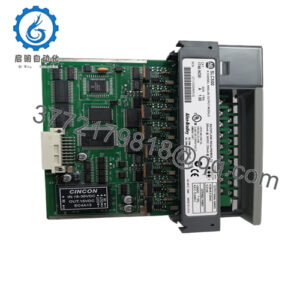
The Foxboro FBM214 is an 8-channel HART Communication Input Interface Module for the I/A Series DCS. Each channel accepts a standard 4–20 mA analog signal or a HART Frequency Shift Keying signal superimposed on the analog current loop. It functions as a HART host, enabling the control system to request and receive digital data from field devices at two messages per second.
Engineers choose the FBM214 when they need simultaneous analog process variables and HART diagnostic or configuration data from transmitters without adding separate multiplexers. Group isolation, sigma-delta conversion, and support for universal HART commands make it a direct, field-proven interface for both conventional and smart instruments.
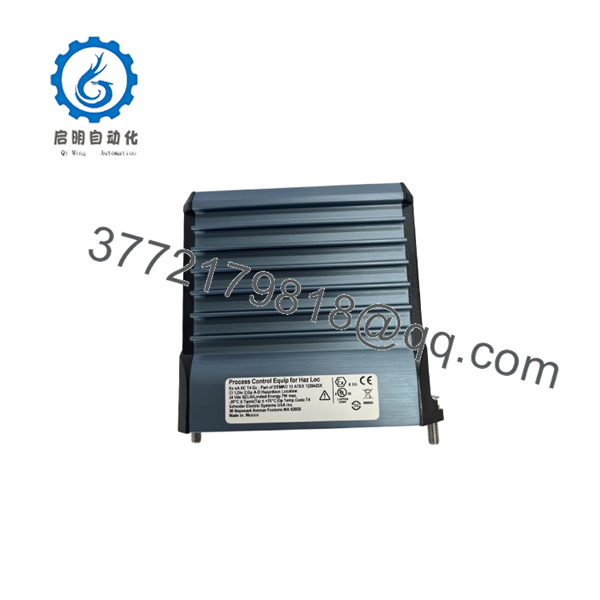
- FBM214
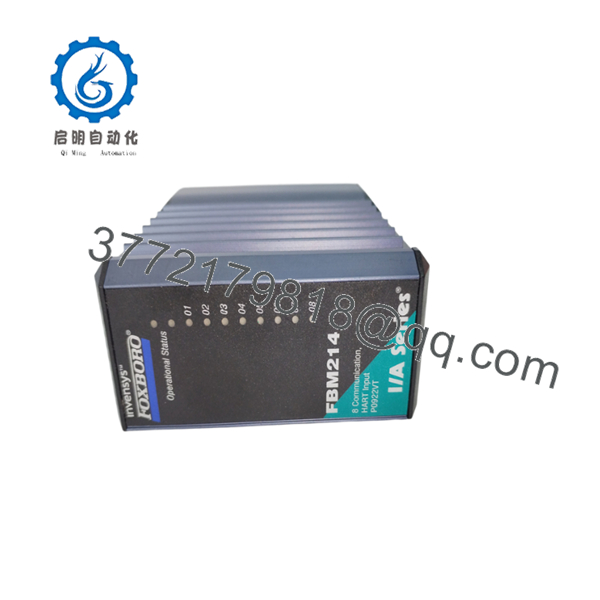
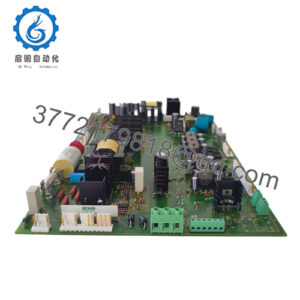
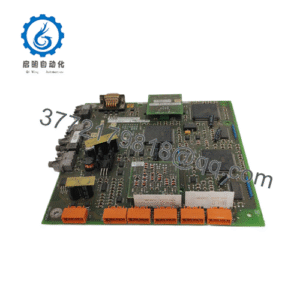
- FBM214
5. Troubleshooting Quick Reference
| Symptom | Possible Cause | Relevance to this Part | Quick Check Method | Recommendation |
|---|---|---|---|---|
| No analog reading / channel at 0 mA | Open field wiring, blown fuse, or missing loop power | ✅ High | Measure loop current at TA terminals with multimeter; verify 24 V DC presence | Check field device power and wiring before replacing module |
| Analog OK but no HART communication | Wrong HART device address, cable capacitance too high, or missing balun on shared external power | ✅ High | Confirm device is HART-capable and set to address 0 (point-to-point); check cable length vs. HART limit | Add Cable Balun if multiple loops share external supply; verify device polling in system software |
| All channels read high or saturated | External power polarity reversed or shorted sense resistor path | ✅ Medium | Measure voltage polarity and current at TA; compare to known-good channel | Correct field wiring polarity; inspect TA for damage |
| Intermittent HART timeouts | Excessive noise, poor shielding, or ECB block period set too fast | ✅ Medium | Check shield grounding (single-point preferred); review diagnostic buffer for CRC errors | Increase ECB period to ≥500 ms; improve cable routing and grounding |
| Module status LED red / Fieldbus fault | Baseplate power or Fieldbus communication problem | ❌ Low | Verify 24 V DC at baseplate and redundant Fieldbus path integrity | Check power supply and adjacent modules before condemning FBM214 |
| Reading offset or drift | Temperature coefficient or calibration not needed (module is factory calibrated) | ❌ Low | Compare reading against calibrated 4–20 mA source at TA | Module itself requires no field calibration; investigate transmitter or wiring resistance |
If these checks do not resolve the issue, capture photos of the module front, TA terminals, and a system diagnostic log, then contact technical support.
6. Frequently Asked Questions (FAQ)
Q: What is the difference between FBM214 and FBM214b? A: uses group isolation for the eight channels. FBM214b provides individual channel isolation. Use FBM214b when channel-to-channel isolation is required by the application or safety assessment.
Q: Can the power the field transmitters? A: Yes. It supplies a common isolated 24 V DC to all eight channels (one device per channel). External power is also supported; when a single external supply feeds multiple channels, a Cable Balun module is required to prevent crosstalk.
Q: Does it support HART burst mode? A: No. The supports universal, common-practice, and device-specific commands in point-to-point mode only. Burst mode is not used.
Q: What termination assembly do I need? A: Passive compression or ring-lug TAs such as the P0916BX family are typically used. Confirm the exact TA part number against your existing installation and the PSS for the .
Q: Is this module still supported on current Foxboro Evo systems? A: Yes. It is compatible with I/A Series software (appropriate versions) and Foxboro Evo Control Core Services v9.0 and later. Always verify the exact system software revision before installation.
Q: Why are surplus units priced lower than factory new? A: Most available stock is New Surplus—never installed, from excess project inventory. Units are inspected for physical condition and basic functionality. A 1-year warranty is provided; original OEM warranty does not transfer.
Q: Can I hot-swap the ? A: The module can be removed and replaced without disconnecting field wiring or power to the baseplate in most configurations. Follow standard Foxboro I/A Series procedures and ensure the system is configured for the module type before insertion.