WhatsApp: +86 16626708626
 Email:
  Phone: +86 16626708626
Description
Key Technical Specifications
| Parameter | Specification |
|---|---|
| Manufacturer | GE Fanuc / Emerson |
| Part Number | 8810-HI-TX |
| Product Family | PAC8000 SafetyNet |
| Product Type | Safety analog input module |
| Number of Channels | 8 |
| Input Type | Single-ended analog input |
| Nominal Signal Range | 4–20 mA |
| Full Signal Range | 0.25–24 mA |
| Resolution | 16 bit |
| HART | Pass-through, acquisition, status reporting |
| Transmitter Wiring | 2-, 3-, or 4-wire |
| Field Circuit | Non-incendive |
| System Current | 70 mA |
| Field Current | 350 mA |
| Isolation | 250 VAC RMS, channel group to Railbus |
| Channel-to-Channel Isolation | None |
| Accuracy at 25 °C | ±0.1% of span |
| Temperature Coefficient | 38 ppm/°C |
| Repeatability | 0.05% of span |
| Data Format | 16-bit unsigned |
| HART Data Format | IEEE 754 floating point |
| Required Field Power | 24 VDC bussed field power |
| Operating Temperature | -40 to +70 °C |
| Safety Application | SIL 2 |
| Compatible System | PAC8000 Remote I/O |
The published SafetyNet documentation specifies eight single-ended 4–20 mA channels, 16-bit resolution, 25 ms signal processing, HART pass-through/acquisition/status reporting, and 24 VDC bussed field power. The technical sheet also specifies ±0.1% of span accuracy at 25 °C, 38 ppm/°C temperature coefficient, and 250 VAC RMS isolation between the module and Railbus.
The module is designed for installation in approved PAC8000 I/O system apparatus and must be used with compatible PAC8000 field terminals. FM documentation specifically lists compatible field-terminal families including 8601-FT-NI, 8603-FT-FU, 8615-FT-4W, 8616-FT-FU, 8618-FT-MT, and 8619-FT-MT.
Product Introduction
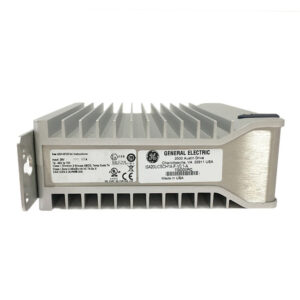
The GE 8810-HI-TX is an eight-channel SafetyNet analog input module for PAC8000 remote I/O. It receives 4–20 mA signals from process transmitters and makes the measurements available to the control and safety system. The module supports 2-, 3-, and 4-wire transmitters and provides HART pass-through, acquisition, and status reporting.
The module is intended for safety-related process instrumentation where analog transmitter signals must be acquired with defined diagnostic and isolation characteristics. Its 16-bit conversion, 0.1% span accuracy at 25 °C, and SIL 2 application certification make the exact module and field-terminal combination important when replacing an installed unit.
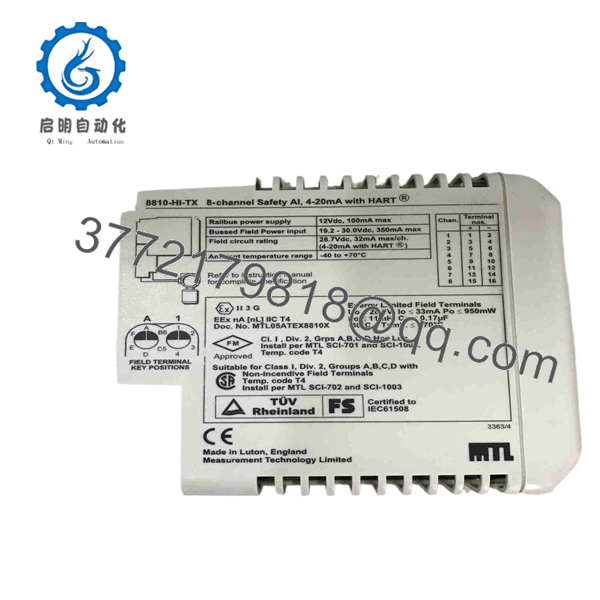
8810-HI-TX
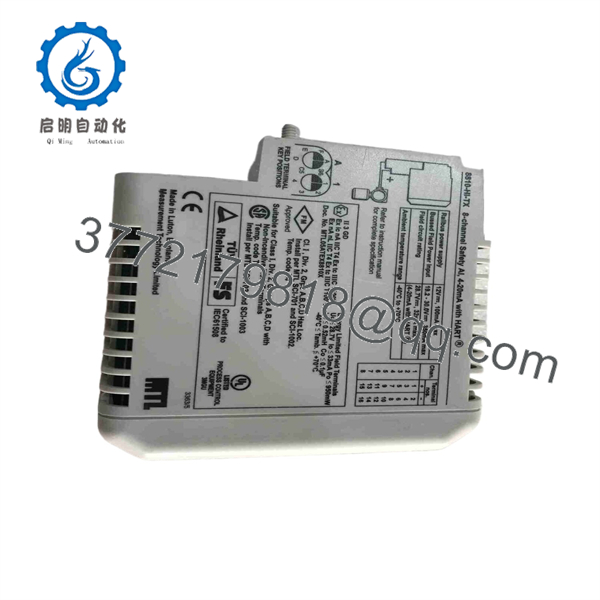
8810-HI-TX
Installation & Configuration Guide
Stage 1 — Pre-Installation Preparation
Estimated time: 15–20 minutes
- Notify operations and place the associated process loop in a safe maintenance state.
- Apply LOTO to the applicable field circuit and PAC8000 equipment.
- Verify the 24 VDC bussed field supply is isolated before removing the module.
- Allow connected equipment to discharge for at least 5 minutes where applicable.
- Wear an ESD wrist strap before handling the 8810-HI-TX.
- Prepare a multimeter, PH1 screwdriver where applicable, wire labels, smartphone/camera, and the current I/O configuration.
- Photograph the module, field terminal, wiring, channel assignments, and carrier position.
- Record the transmitter type and whether each loop uses 2-, 3-, or 4-wire wiring.
- Confirm that the replacement is 8810-HI-TX, not the similarly marketed 8810-HI-TX-01 variant.
⚠️ Do not assume the field-terminal arrangement from the module part number alone. documentation specifies particular field-terminal combinations for this module.
Stage 2 — Removing the Old Module
Estimated time: 10–15 minutes
- Verify the field circuit is de-energized.
- Label each transmitter loop before disconnecting any conductors.
- Record channel-to-transmitter assignments.
- Disconnect the field wiring from the approved terminal assembly.
- Release the module from the carrier according to the hardware procedure.
- Remove the 8810-HI-TX without forcing the connector or backplane interface.
- Inspect the carrier and field-terminal contacts for contamination or mechanical damage.
- Retain the original module until the replacement passes functional testing.
Stage 3 — Installing the New Module
Estimated time: 15–20 minutes
- Confirm the replacement nameplate reads 8810-HI-TX.
- Verify the module is being installed in an approved I/O system.
- Confirm the installed field terminal is compatible with the 8810-HI-TX.
- Seat the module firmly on the carrier.
- Reconnect the field wiring according to the recorded channel assignments.
- Verify transmitter polarity and loop wiring.
- Confirm the 24 VDC field-power arrangement is correct.
- Check every channel against the plant I/O drawing before applying power.
- Inspect the module seating and terminal connections one final time.
⚠️ The 8810-HI-TX has no channel-to-channel isolation according to the published specification. Review field-grounding and transmitter wiring carefully when multiple process loops share the same module.
Stage 4 — Power-On & Testing
Estimated time: 20–40 minutes
- Use a multimeter to verify the expected 24 VDC supply and check for unintended shorts.
- Energize the I/O system.
- Confirm the module is recognized by the controller.
- Verify all eight channels are correctly assigned.
- Apply a known 4–20 mA test signal or use the installed transmitter under controlled conditions.
- Compare the module reading against a calibrated reference.
- Verify the configured engineering-unit scaling in the control system.
- Check HART communication where the transmitter and system configuration require it.
- Confirm diagnostic status for open-loop, over-range, or abnormal input conditions.
- Perform a controlled process-loop test before returning the system to normal operation.
Troubleshooting note: If a channel reads incorrectly, check field-terminal compatibility, transmitter loop power, polarity, channel assignment, scaling, grounding, and HART configuration before replacing the I/O module. A healthy 8810-HI-TX cannot compensate for an incorrect field-terminal or loop configuration.
Frequently Asked Questions (FAQ)
1. What is GE 8810-HI-TX?
The 8810-HI-TX is a SafetyNet 8-channel safety analog input module. It accepts single-ended 4–20 mA signals and supports HART pass-through, acquisition, and status reporting.
2. How many analog inputs does 8810-HI-TX provide?
It provides 8 single-ended analog input channels. The nominal input range is 4–20 mA, with a documented full signal range of 0.25–24 mA.
3. Does 8810-HI-TX support HART?
Yes. The module supports HART pass-through, HART acquisition, and status reporting.
4. Is 8810-HI-TX suitable for safety applications?
Yes. SafetyNet documentation identifies the module for SIL 2 safety applications. The complete installation still has to comply with the applicable safety-system architecture, approved field terminals, wiring requirements, and certification conditions.
5. What transmitter wiring does it support?
The module supports 2-wire, 3-wire, and 4-wire transmitters. The field-terminal selection must match the wiring arrangement and the installation documentation.
6. What is the difference between 8810-HI-TX and 8810-HI-TX-01?
The exact relationship between these two ordering references should be verified against the equipment nameplate and the applicable manufacturer documentation before substitution. Market listings frequently append -01 to the base 8810-HI-TX designation, but the published SafetyNet technical documentation identifies the module itself as 8810-HI-TX.
7. What should I verify before purchasing a replacement?
Verify the exact part number, revision, carrier, field-terminal type, transmitter wiring, and safety certification requirements. For a safety-system spare, matching only the number printed in a supplier listing is not sufficient; the installed hardware configuration should be checked against the approved system documentation.