 WhatsApp: +86 16626708626
 Email:
  Phone: +86 16626708626
Description
3. Key Technical Specifications
| Parameter | Specification |
| Input Type | Analog (Current Loop / Voltage) |
| Signal Ranges | 4-20 mA, +/- 5 V DC, 0-10 V DC |
| Number of Channels | Multiple high-speed differential inputs |
| A/D Resolution | High-precision bit conversion for sensor accuracy |
| Board Series | HAI (High-level Analog Input) |
| Connection | Gold-plated edge connector for backplane interface |
| Compatibility | GE Mark IV Speedtronic Turbine Control |
| Revision | A1E1D (Latest hardware enhancement level) |
| Isolation | Input-to-logic galvanic isolation |
4. Product Introduction & Supply Chain Strategy
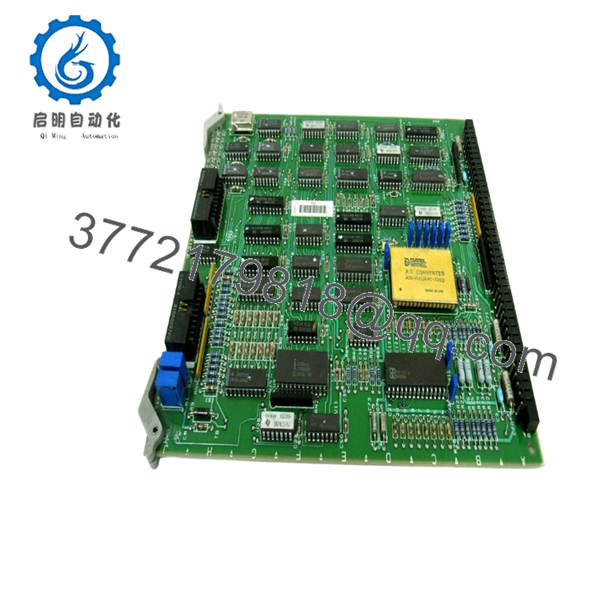
The GE DS3800HAIA1E1D is a critical High-level Analog Input (HAI) board utilized in the Speedtronic Mark IV turbine control system. It acts as the primary translator for field instrumentation, converting raw analog signals from pressure transducers, thermocouples (via transmitters), and flow meters into digital data for the system’s processors. Precision in these inputs is vital; even a 1% drift in signal processing can result in improper fuel-to-air ratios or false temperature trips.
From a supply chain perspective, the HAI board is a high-wear component due to its constant exposure to signal noise and electrical transients. While refurbished boards are often available, they carry significant risk: the precision resistors and operational amplifiers (Op-Amps) on analog boards drift as they age. A refurbished board may “test okay” but fail to provide the accuracy needed for stable turbine operation under load. Procuring New Surplus DS3800HAIA1E1D units ensures you are starting with factory-fresh components with zero thermal degradation, providing a predictable 10-15 year service life and preventing the “Total Cost of Ownership” (TCO) spikes associated with sensor calibration errors.
5. Installation & Configuration Guide
Stage 1: Pre-Installation (Prep & Safety)
Initiate a full Lock-out/Tag-out (LOTO) of the control cabinet. Wear an ESD wrist strap to prevent static discharge to the sensitive Op-Amps. Take high-resolution photos of all DIP switches and jumper headers on the current board. These settings define the gain and offset for each analog channel and must be replicated exactly to avoid sensor scaling errors.
Stage 2: Removal
Using card pullers, extract the original board straight out from the Mark IV rack. Inspect the edge connector for any signs of “pitting” or carbon on the backplane side. Ensure the field wiring at the terminal board (usually a separate T-type board) is secure and labeled before proceeding.
Stage 3: Installation (Clone & Seat)
Mirror the configuration of the old board onto the new DS3800HAIA1E1D. Check that the “E1D” revision jumpers are positioned correctly for your specific system revision. Slide the board into the designated slot, applying firm, even pressure until the gold-plated connectors are fully seated.
Stage 4: Power-On & Testing
Energize the system and monitor the HMI for analog input alarms. Perform a “Point Calibration” or loop check for at least one channel to verify that the 4-20 mA signal from the field matches the value displayed in the control logic. If values are erratic, re-verify the jumper settings for that specific channel’s input range.

- DS3800HAIA1E1D
6. Firmware/Software Versions & Upgrade Notes
The DS3800HAIA1E1D is a hardware-configured analog board, but its integration depends on the E1D revision state.
- Revision Level: The “E1D” suffix indicates a later-stage revision with improved noise filtering and signal stability compared to early “A1A” models.
- Hardware Compatibility: Ensure your Mark IV system software (Executive) recognizes the hardware revision. In rare cases, a jump from a very early revision to the E1D may require minor gain adjustments within the control constants.
- Warning: Do not adjust the onboard potentiometers (if present) unless you are performing a full laboratory calibration with a certified signal generator. These are factory-set to precision standards.
7. Frequently Asked Questions (FAQ)
Is this board compatible with both Gas and Steam turbine controls?
Yes, the DS3800HAIA1E1D is a universal analog input board used across the Mark IV platform, regardless of the turbine type, provided the HAI series is specified in your cabinet’s BOM.
How do I know this board isn’t a refurbished unit?
New Surplus boards feature pristine gold-plated edge connectors without “insertion tracks” and show zero discoloration around high-heat components like voltage regulators. We provide a full QC report with every shipment to verify its New Surplus status.
What happens if my jumpers are set incorrectly?
Incorrect jumper settings will lead to “Signal Out of Range” or “Bad Sensor” alarms. It can also lead to incorrect turbine behavior if the scaling is off (e.g., the system thinks temperature is lower than it actually is). Always mirror your original board.
Does this board require a software download?
No, the DS3800HAIA1E1D is a “transparent” interface board. It conditions the signals for the master processor. As long as the hardware configuration matches, no software change is required.
Can I keep this as a spare for 5 years?
Yes. Because it is New Surplus with no used electrolytic capacitors, it has a very long shelf life. Keep it in its original ESD-safe packaging in a climate-controlled environment to ensure it is ready for immediate emergency use.