 WhatsApp: +86 16626708626
 Email:
  Phone: +86 16626708626
Description
3. Key Technical Specifications
| Parameter | Value |
| Manufacturer | General Electric (GE) |
| Part Number | DS3800NSFE1B1A |
| Control System Series | Speedtronic Mark IV Gas/Steam Turbine Control |
| Module Type | Synchronization Field Exciter Module (SFEM) |
| Number of Channels | 12 independent control channels |
| Functionality | Automatic Voltage Regulation (AVR) & Reactive Power Control |
| Operating Temperature | −30 to +65°C |
| Current Limiting Protection | Built-in Field Current Limiting |
| Diagnostics | On-board hardware fault diagnostics |
| Form Factor | Standard Mark IV rack-mounted multi-layer printed circuit board |
| Dimensions | 8.25 cm H x 4.18 cm W |
| Weight | 2.00 lbs (0.91 kg) |
4. Product Introduction & Supply Chain Strategy
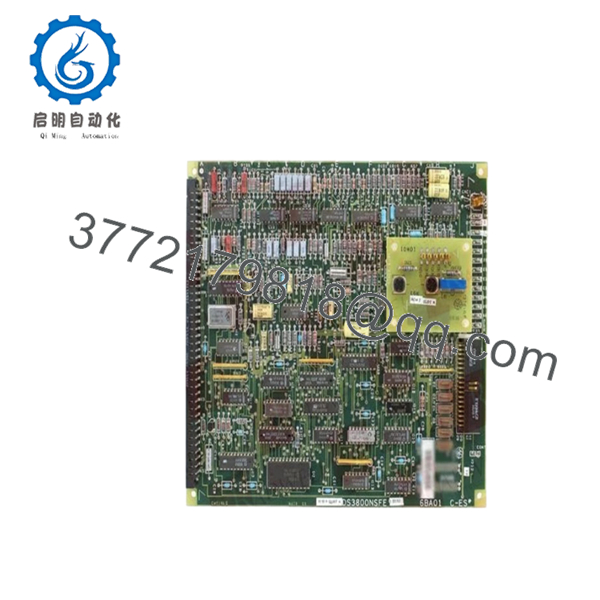
The GE DS3800NSFE1B1A is a Synchronization Field Exciter Module engineered for the legacy Speedtronic Mark IV gas and steam turbine control systems. It acts as the primary governor for generator stability, providing precise automatic voltage regulation (AVR) and managing reactive power output by adjusting the excitation field strength. In power generation and industrial turbomachinery configurations, this card ensures that the synchronous generator stays perfectly locked to the grid frequency and phase before and during active power distribution.
From a procurement perspective, safeguarding this specific module as a New Surplus unit is a critical risk-mitigation strategy. Because the Mark IV series is an obsolete legacy platform, waiting for a breakdown to source a replacement risks catastrophic lead times or forcing an expensive, unplanned control system migration. Opting for a New Surplus card eliminates the hidden failure points typical of degraded capacitors in third-party refurbished components. This strategic insurance policy maintains a low Total Cost of Ownership (TCO) and prevents a localized component failure from ballooning into a multi-day emergency plant shutdown.
5. Installation & Configuration Guide
Stage 1: Pre-Installation (Prep & Safety)
- Execute full lock-out/tag-out (LOTO) procedures on the active turbine control panel and relevant exciter power sub-panels.
- Put on a grounded static-dissipative wrist strap connected to the cabinet frame to prevent ESD damage.
- Use a high-resolution camera to take clear reference photos of the existing module’s physical jumper positions and any multi-position DIP switch configurations. Record any specific wiring markings on the front faceplate.
Stage 2: Removal
- Disconnect any front-facing terminal ribbon cables or wiring harnesses by loosening the retaining screws or releasing the side clips.
- Unfasten the top and bottom faceplate thumb screws securing the module into the chassis rack.
- Firmly grasp the board handles and pull the card straight out along its guide rails. Avoid rocking the module side-to-side during extraction to prevent bending or breaking the backplane pins.
Stage 3: Installation (Clone & Seat)
- Place the old card and the New Surplus DS3800NSFE1B1A card side-by-side on an ESD-safe mat.
- Verify that all jumpers and DIP switch configurations on the new module are manually configured to mirror the original card exactly.
- Align the new card into the correct rack slot guide rails. Push the card smooth and straight into the slot until the backplane connectors seat completely. Tighten the faceplate retaining screws.
Stage 4: Power-On & Testing
- Reattach all front wiring harnesses and terminal connections securely.
- Verify the 24 V power rail continuity and check for low-impedance short circuits prior to turning on control power.
- Apply power and observe the front-panel diagnostic LEDs. Ensure the module transitions smoothly into a normal “RUN” or active state without throwing an “ERR” or system fault code. Verify correct field current feedback on the central HMI.
6. Firmware/Software Versions & Upgrade Notes
The GE DS3800NSFE1B1A relies on firmware embedded within its onboard EPROM chips to communicate deterministically across the Mark IV control loop. The “1B1A” suffix designates the exact hardware build revision and factory firmware baseline.
When replacing this card, matching the exact suffix is necessary because field excitation algorithms require precise synchronization timing. A mismatch between older control system software layers and a newer hardware revision can trigger immediate communication protocol timeouts or erratic excitation control loop behaviors.
Avoid attempting field firmware updates or downgrades on these legacy modules without specialized OEM programming fixtures. Interrupted firmware burns can permanently corrupt the EEPROM or EPROM sectors, rendering the board unusable. Always document the hardware suffix of your adjacent operational boards to ensure complete backplane compatibility.

- DS3800NSFE1B1A
7. Frequently Asked Questions (FAQ)
Q: Why should we buy New Surplus instead of a cheaper refurbished card?
A: Refurbished cards are typically pulled from decommissioned plants, repaired down to the component level, and cosmetically cleaned. However, internal degradation—especially in older capacitors and isolation amplifiers—remains invisible. A refurbished card might save upfront budget but can cost tens of thousands of dollars in unplanned downtime if it fails prematurely. Our New Surplus inventory offers original OEM manufacturing reliability, uncompromised backplane pins, and a full operational lifespan.
Q: Are these DS3800NSFE1B1A units guaranteed to be unused?
A: Yes. This product is a Brand New Surplus unit. It is not used, not pulled from a decommissioned plant, and not refurbished. All modules undergo rigorous quality verification and inbound testing to ensure they meet OEM-level reliability and have remained in anti-static storage conditions since manufacturing.
Q: How does this module factor into our plant’s ABC inventory analysis?
A: The DS3800NSFE1B1A is classified as an “A-Critical” spare because it directly impacts turbine synchronization and grid connectivity. While it is a slow-moving item with low usage frequency, a stock-out incident during an emergency shutdown halts power generation immediately. We recommend keeping 1-2 units on-site as buffer stock to serve as an insurance policy.
Q: Can this synchronization field exciter module be hot-swapped while the turbine is running?
A: No. Attempting to hot-swap the DS3800NSFE1B1A while the turbine control panel is energized will cause severe inductive voltage spikes across the backplane. This can damage adjacent cards, trip the generator field protection relays, and cause an immediate emergency turbine trip. Always power down the local card rack before removal.
Q: What step ensures our existing settings are preserved when installing the new card?
A: This hardware functions based on physical component layout, jumper positions, and DIP switch settings rather than volatile software memory profiles. Mirroring the original card’s physical DIP and jumper settings onto the new module before inserting it ensures that your node address, field current scaling factors, and communication baud rates match your existing system configuration exactly.
Q: What kind of warranty and quality documentation comes with this module?
A: Every New Surplus module comes backed by a comprehensive 1-year warranty. To ensure complete transparency, we provide verifiable serial numbers, inbound traceability logs, and a signed QC Test Report certifying that the module has passed physical, electrical, and functional inspections.