WhatsApp: +86 16626708626
 Email:
 Phone: +86 16626708626
Description
Core Product Summary
The GE Fanuc PMC422FP (also referenced as PMC422/FP) is an eight-port serial controller implemented in PMC (PCI Mezzanine Card) form factor. It provides independent asynchronous serial channels for integration into VMEbus, CompactPCI, or other single-board computers equipped with a PMC site.
Each channel uses a 16C550-compatible UART with 64-byte FIFO and supports configurable RS-232, RS-422, or RS-485 signaling. The PMC422FP routes all eight ports to a front-panel 68-pin SCSI-style connector while also supporting rear I/O via the PMC J4 connector. Baud rates are programmable across a wide range, and the card supports byte, word, and double-word data transfers on a 32-bit/33 MHz PCI interface.
Key Technical Specifications
| Parameter | Specification |
|---|---|
| Product type | 8-port serial controller |
| Form factor | PMC (PCI Mezzanine Card) |
| Serial channels | 8 independent |
| UART | 16C550-compatible, 64-byte FIFO per channel |
| Signaling | RS-232 / RS-422 / RS-485 (full or half duplex), DIP-switch configurable per pair |
| Baud rate | Programmable; typically 150 bps to 6.2 Mbps (crystal-dependent; up to 921.6 kbps with standard 14.7456 MHz crystal) |
| PCI interface | 32-bit, 33 MHz, PCI 2.2 target |
| Data transfer | Byte, word, double-word; burst support |
| Front I/O | 8 ports via 68-pin SCSI-style connector |
| Rear I/O | All 8 ports via PMC J4 |
| Additional features | 8 general-purpose inputs; 16-bit general-purpose timer/counter |
Detailed Product Overview
The PMC422FP is a single-wide PMC module designed to add high-density asynchronous serial communications to host processors that provide a PMC expansion site. By concentrating eight independent serial channels on one mezzanine card, it conserves the limited number of PMC slots typically available on VMEbus or CompactPCI single-board computers.
Each of the eight channels is implemented with its own 16C550-compatible UART and dedicated 64-byte receive and transmit FIFOs. This architecture reduces host-processor interrupt overhead and supports efficient data handling. Line-driver characteristics for each channel pair are selected by onboard DIP switches, allowing any combination of RS-232, RS-422, or RS-485 (full-duplex or half-duplex, terminated or unterminated) without hardware redesign.
Baud rates are independently programmable for every port. With the default crystal, rates up to 921.6 kbps are supported; higher rates up to approximately 6.2 Mbps are possible depending on the installed crystal. The PCI interface operates as a 32-bit/33 MHz target and supports byte, word, and double-word transfers as well as burst operations, enabling efficient movement of serial data into host memory.
The front-panel configuration of the PMC422FP routes all eight ports to a single 68-pin SCSI-style connector, providing a compact front I/O solution. Simultaneously, all ports remain available on the rear PMC J4 connector for systems that prefer backplane or PIM-based cabling. An 8-bit general-purpose input register and a 16-bit timer/counter further extend utility for application-specific control or timing tasks.
Integration is straightforward on any host that supplies a standard PMC site and the corresponding PCI resources. Software drivers treat the channels as conventional 16C550 UARTs, simplifying porting of existing serial-port code. The module is intended for applications requiring multiple independent serial links—instrumentation, legacy device interfacing, multi-drop RS-485 networks, or concurrent RS-232 connections—within space-constrained embedded systems.
Dimensions, Mounting & Connection Notes
The PMC422FP occupies a single standard PMC site. Front-panel I/O is provided through a 68-pin SCSI-style connector that carries all eight serial ports. Rear I/O is available on the PMC J4 connector. Mounting follows the normal PMC retention method defined by the host board’s mechanical design. No additional torque, wire-size, or clearance values beyond standard PMC practice are documented for this model.
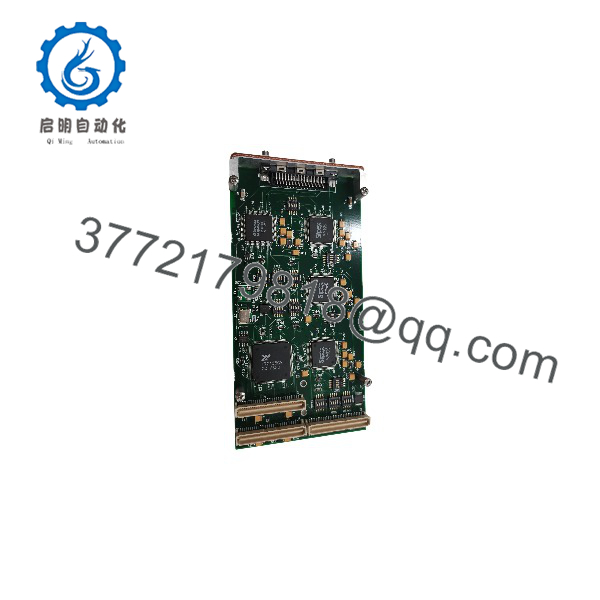
PMC422FP
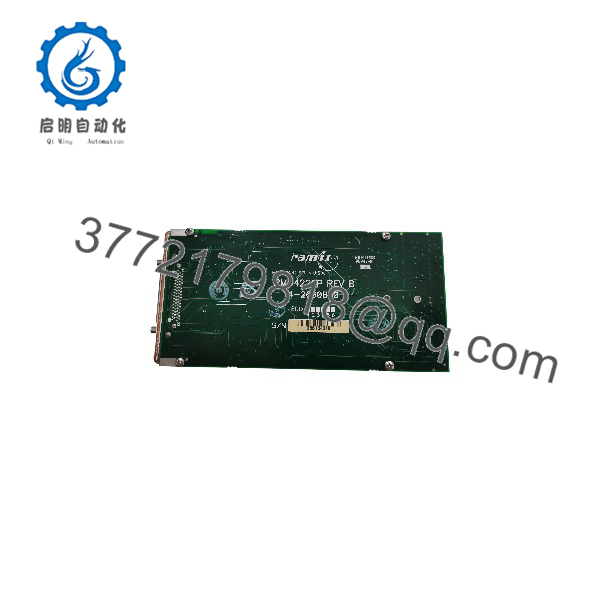
PMC422FP
System Compatibility & Integration Requirements
| Item / Dependency | Verified Compatibility or Requirement | Practical Note |
|---|---|---|
| Host form factor | Any board providing a standard PMC (IEEE 1386.1) site | Typical hosts: VMEbus or CompactPCI single-board computers |
| Bus interface | PCI 2.2 target, 32-bit / 33 MHz | Host must supply corresponding PCI resources |
| Front-panel connector | 68-pin SCSI-style | Used for all eight serial ports on the PMC422FP variant |
| Rear I/O | PMC J4 connector | All eight ports available; optional PIM422 module can bring signals to the backplane |
| Signaling configuration | Onboard DIP switches | Set RS-232 / RS-422 / RS-485 mode and termination per channel pair before installation |
| Software | Standard 16C550 UART register set | Compatible with conventional serial-port drivers |
FAQ
What is the GE Fanuc PMC422FP?
It is an eight-port asynchronous serial controller in PMC form factor that provides independent RS-232/RS-422/RS-485 channels for systems with a PMC expansion site.
Which systems can use the PMC422FP?
Any single-board computer or carrier that supplies a standard PMC (IEEE 1386.1) site and a 32-bit/33 MHz PCI interface, commonly found on VMEbus and CompactPCI platforms.
How many serial ports does it provide and what standards are supported?
Eight independent ports. Each channel pair can be configured via DIP switches for RS-232, RS-422, or RS-485 (full or half duplex, with or without termination).
What is the front-panel connection on the PMC422FP?
All eight serial ports are brought out on a single 68-pin SCSI-style connector.
What UART and FIFO resources are available?
Each of the eight channels uses a 16C550-compatible UART with a 64-byte FIFO for both receive and transmit.
What baud-rate range is supported?
Programmable rates typically span 150 bps to 6.2 Mbps, depending on the installed crystal; the standard crystal supports up to 921.6 kbps.
Is rear I/O available?
Yes. All eight ports are also routed to the PMC J4 connector for rear or PIM-based cabling.