WhatsApp: +86 16626708626
 Email:
 Phone: +86 16626708626
Description
Core Product Summary (Brand / Model / Key Attributes)
The GE Fanuc VMIVME-7750-466000 is a high-performance VMEbus single-board computer (SBC) designed for demanding industrial, defense, and embedded real-time control applications. Built on a single-slot 6U Eurocard form factor, this processor module integrates an Intel Pentium III processor running at 1 GHz with a 133 MHz front-side bus and 512 KB of advanced transfer cache. It utilizes the Intel 815E chipset to provide robust computing capability, featuring dual-ported SDRAM architecture and comprehensive system expansion options suited for legacy and modern hybrid automation architectures.
The module is equipped with 512 MB of PC133 SDRAM and includes integrated support for secondary IDE CompactFlash storage configurations. For system connectivity and peripherals, the unit features dual Intel Ethernet controllers (supporting 10BaseT and 100BaseTX via RJ45 connectors), dual 16550-compatible serial ports, a universal serial bus (USB) hub interface, and a combined PS/2 keyboard and mouse port. Interfacing with the VMEbus backbone is handled by the high-performance Tundra Universe IIB PCI-to-VME bridge supporting comprehensive master and slave data transfer modes. It also provides an IEEE P1386-compliant PCI Mezzanine Card (PMC) expansion site for custom front-panel or P2 I/O additions.
Key Technical Specifications
| Specification Category | Verified Exact Model Parameter |
| Product Type | VMEbus Single Board Computer (SBC) |
| System Architecture / Series | VMIVME-7750 Series (Intel 815E Chipset) |
| Processor | Intel Pentium III @ 1 GHz (133 MHz FSB, 512 KB Cache) |
| System Memory (DRAM) | 512 MB PC133 SDRAM (Single SODIMM slot) |
| Storage | Secondary IDE CompactFlash support |
| Bus Interface | VMEbus via Tundra Universe IIB PCI-to-VME bridge |
| VME Transfer Modes | A32/A24/A16, D32, BLT32, BLT64 (Master/Slave) |
| Ethernet Interfaces | Dual Ethernet (Intel 82559 and ICH2 internal), 10BaseT / 100BaseTX |
| Expansion Slot | One 5V PCI Mezzanine Card (PMC) site (IEEE P1386) |
| Serial Channels | Two front-panel 16550-compatible serial ports |
| USB Support | Dual-connection USB host controller hub |
| Graphics Controller | Integrated 815E AGP SVGA controller with 4 MB external SDRAM cache |
| Timers & Watchdog | Two 16-bit timers, two 32-bit timers, and a software-programmable watchdog timer |
| Nonvolatile Memory | 32 KB Nonvolatile SRAM |
| Physical Format | 6U Eurocard, Single Slot (Height: 9.2 in / 233.4 mm, Depth: 6.3 in / 160 mm) |
| Power Requirements | +5 VDC (6 A typ, 7 A max), +12 VDC (105 mA typ), -12 VDC (50 mA typ) |
| Operating Temperature | 0 °C to 50 °C (requires airflow >350 LFM) |
Detailed Product Overview
The GE Fanuc VMIVME-7750-466000 functions as an advanced central processing and communication hub within VMEbus-based industrial and embedded control racks. By merging standard PC architecture with the rugged deterministic structure of the VMEbus standard, it allows engineers to run complex operating systems and control software directly adjacent to high-speed data acquisition and industrial I/O cards.
Computationally driven by a 1 GHz Pentium III processor and backed by an Intel 815E core chipset, the module manages internal data routing via a high-speed 133 MHz system bus. Dual independent Ethernet ports provide network redundancy or segment separation for supervisory control systems, while local peripheral interaction is supported through onboard USB, serial channels, and a hardware graphics controller capable of high-resolution local operator displays.
System reliability is reinforced by integrated hardware features including a software-programmable watchdog timer capable of triggering system resets, nonmaskable interrupts (NMI), or VMEbus SYSFAIL signals upon application stalls. Furthermore, 32 KB of nonvolatile SRAM secures critical retentive parameter data during power loss scenarios. The inclusion of a PMC expansion site enables modular customization, allowing specialized communication or signal processing mezzanine cards to be added directly to the single-slot footprint without consuming extra chassis slots.
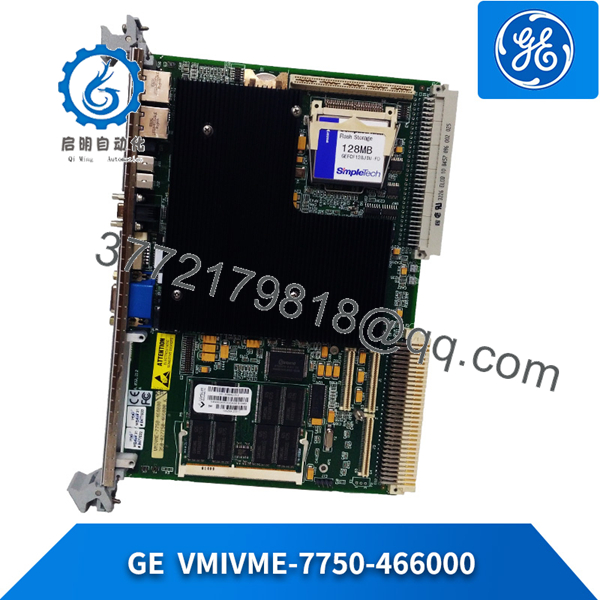
VMIVME-7750-466000
Engineering Selection Highlights
- Processor & Clock Speed: 1 GHz Pentium III CPU configuration ensures adequate processing headroom for real-time operating systems (RTOS) and legacy industrial software packages.
- VMEbus Master/Slave Capabilities: Powered by the Tundra Universe IIB bridge, supporting advanced data transfer protocols including 64-bit block transfers (BLT64) for high-speed multi-drop communication.
- Memory Allocation: Configured with 512 MB of PC133 SDRAM, matching standard software memory footprints required for mid-generation supervisory control applications.
- Chassis Slot Control: Operates either as a Slot 1 VMEbus system controller providing bus arbitration, or can have system controller functions disabled if an alternate master controller is present in the rack.
- Mezzanine Expansion: Features a standard 5V PCI Mezzanine Card (PMC) site enabling application-specific I/O card integration directly tied to the internal PCI bus structure.
- Thermal Management Constraint: Requires a minimum external airflow of 350 LFM across the heatsink structure to maintain safe operating temperatures within the specified 0 °C to 50 °C operational range.
System Compatibility & Integration Requirements
| Item / Dependency | Verified Compatibility or Requirement | Practical Note |
| Enclosure Format | VMEbus 6U Eurocard Backplane (Single Slot) | Occupies one physical slot width (0.8 inches / 20.3 mm) |
| Bus Master Support | Tundra Universe IIB PCI-to-VME interface | Supports A32/A24/A16 address spaces and D32/BLT32/BLT64 data widths |
| Serial Connectivity | Dual 16550-compatible front-panel channels | Requires specialized micro-DB-9 to standard DB-9 adapter cables (GE Fanuc P/N 360-010050-001) |
| Peripheral Breakout | Combined PS/2 keyboard and mouse port | Requires the supplied Y-splitter adapter cable for separate keyboard and mouse connection |
| Network Infrastructure | Dual RJ45 Ethernet ports (Intel 82559 / ICH2) | Supports 10BaseT and 100BaseTX physical layers with remote boot capability via BootWare |
Dimensions, Mounting & Connection Notes
- Physical Dimensions: Standard 6U VME format—height of 9.2 inches (233.4 mm), depth of 6.3 inches (160 mm), and thickness of 0.8 inches (20.3 mm).
- Power Distribution: Draws power primarily from the backplane +5 VDC rail (nominal 6 A, up to 7 A maximum), alongside minor draws on the +12 VDC and -12 VDC rails.
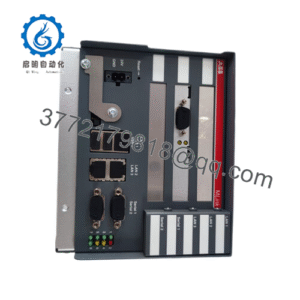
- Front Panel Access: Houses dual RJ45 Ethernet jacks, dual micro-DB-9 serial ports, a dual USB hub connection, a shared PS/2 connector, and status LED indicators.
- Cooling Requirements: Forced air cooling must ensure an airflow velocity greater than 350 LFM across the CPU heatsink to prevent thermal throttling or shutdown.
FAQ
What is the GE Fanuc VMIVME-7750-466000?
It is a single-slot 6U VMEbus single-board computer (SBC) powered by an Intel Pentium III processor, designed for embedded industrial control and real-time computing applications.
Which processor and clock speed does this exact model feature?
This specific configuration (-466000) features an Intel Pentium III processor running at 1 GHz with a 133 MHz front-side bus and 512 KB of L2 advanced transfer cache.
What is the onboard system memory capacity?
The board is equipped with 512 MB of PC133 SDRAM utilizing a single 144-pin SODIMM module.
What bus interface does the module use to communicate with the VME backplane?
It communicates via a high-performance Tundra Universe IIB PCI-to-VME bus interface chip, supporting comprehensive master and slave data transfers up to 64-bit block transfers (BLT64).
Does the board support expansion options?
Yes, it includes a single 5V PCI Mezzanine Card (PMC) expansion site adhering to the IEEE P1386 specification for adding modular front-panel or backplane I/O.
What network interfaces are available on the front panel?
It provides dual Ethernet connections (utilizing an Intel 82559 controller and an internal ICH2 chipset controller) supporting 10BaseT and 100BaseTX networks via RJ45 ports.
Verification & Troubleshooting Notes
- Status LED Indicators: Check front-panel LED indicators to verify board power status, IDE activity, and LAN link status during initial power-up sequences.
- Watchdog Timer Configuration: If the system experiences unexpected reboots, verify that software initialization routines correctly service the software-programmable watchdog timer within its programmed time window.
- Jumper Settings: Ensure that system configuration jumpers (such as VME system controller selection jumper E12/E13 and CMOS password clear jumper E3) are correctly set according to rack slot positioning prior to energizing the backplane.
- Airflow Verification: Confirm that rack fan trays are operational and delivering adequate airflow (>350 LFM) to prevent thermal overload of the 1 GHz Pentium III processor.