WhatsApp: +86 16626708626
 Email:
 Phone: +86 16626708626
Description
Core Product Summary
The GE HE700GEN200 is a dual-channel Genius interface module for a VME backplane. Manufactured by Horner APG as part of the uGENI VME interface-module family, it provides the interface between a VME-based control system and Genius I/O network channels.
The module provides two independent Genius channels, each configured through an on-board DIP switch. Its front panel provides Serial 1, Serial 2, Shield In, and Shield Out connections, allowing the module to participate in a Genius network with appropriate bus termination. The HE700GEN200 occupies one VME slot and is identified in Horner documentation as a single-slot generic VME module.
Key Technical Specifications
| Parameter | Verified information |
|---|---|
| Manufacturer | Horner APG, supplied for GE applications |
| Exact model | HE700GEN200 |
| Product type | uGENI VME Interface Module |
| Interface function | Dual-channel Genius interface |
| Genius channels | Two independent channels |
| VME form factor | Single-slot generic VME module |
| Configuration | One 8-position DIP switch per uGENI board |
| Front-panel connections | Serial 1, Serial 2, Shield In, Shield Out |
| Network addressing | Genius Bus Address range 0 to 31; up to 32 devices per network |
| Associated documentation | Horner APG uGENI VME Interface Module User Manual, MAN0105-02 |
Engineering Selection Highlights
- Dual Genius channels: The HE700GEN200 provides two independent Genius channels, allowing a VME-based control system to interface with two Genius network segments.
- VME backplane integration: It is a single-slot generic VME module, so it requires an available VME slot and must be installed in accordance with the VME interrupt-chain requirements.
- Hardware-based configuration: Each Genius channel is configured with its own 8-position DIP switch, making bus address and configuration settings a physical commissioning task rather than a software-only setting.
- Genius network capacity: The documentation describes networks of up to 32 devices, with Genius Bus Addresses from 0 through 31.
- Bus termination requirement: The Genius network must be terminated at each end with a resistor matched to the cable characteristic impedance; the manual identifies 120 ohm resistors when the cable impedance is unknown.
- Interrupt placement matters: If VME interrupt capability is used, the module must be placed in the interrupt chain; otherwise, it should be installed after modules that use VME interrupts.
System Compatibility & Integration Requirements
| Item / Dependency | Verified Compatibility or Requirement | Practical Note |
|---|---|---|
| Backplane | VME backplane | The module is a single-slot generic VME module. |
| Network interface | Genius I/O network | It provides two independent Genius channels. |
| Channel configuration | One 8-position DIP switch per uGENI board | DIP Switch 2 configures uGENI 1; DIP Switch 3 configures uGENI 2. |
| Network addressing | Genius Bus Address 0 to 31 | Up to 32 devices may be assigned on a Genius network. |
| Network termination | Terminating resistor at each end of the bus | The resistor value should match the cable characteristic impedance; 120 ohms is specified when impedance is unknown. |
| VME interrupt use | Interrupt-chain placement | If interrupts are used, the module must be placed in the interrupt chain. |
| Companion documentation | GE Fanuc GFK-0073 | The uGENI manual is intended to be used with GE Fanuc’s Genius I/O GENI Board User’s Manual. |
Dimensions, Mounting & Connection Notes
The HE700GEN200 is a single-slot generic VME module. It mounts in a VME backplane slot and provides front-panel connections for Serial 1, Serial 2, Shield In, and Shield Out.
The Genius network requires termination at both ends. The manual specifies that the terminating resistor should match the characteristic impedance of the selected cable; where that impedance is unknown, 120 ohm terminating resistors should be used. The module’s DIP switches set the Genius configuration for each of its two uGENI boards.
Detailed Product Overview
The GE HE700GEN200 is a dual-channel uGENI VME interface module from Horner APG. It is designed to provide a Genius I/O network interface for a VME-based control system, with two independent Genius channels available on one module.
Each channel is configured independently. The module includes one 8-position DIP switch for each uGENI board: DIP Switch 2 sets the Genius configuration for uGENI 1, while DIP Switch 3 sets the configuration for uGENI 2. This hardware-based arrangement means that commissioning requires attention to the physical switch settings as well as the VME installation position.
The module’s front panel carries four communication terminals: Serial 1, Serial 2, Shield In, and Shield Out. These connections form the physical interface to the Genius network. The network must be terminated at each end, and the terminating resistance should match the cable’s characteristic impedance. Where the impedance is not known, the manual directs the use of 120 ohm terminating resistors.
The Genius network supports up to 32 devices, with addresses from 0 through 31. Bus controllers are typically assigned address 31, while the backup controller in a redundant-bus-controller arrangement uses address 30. Address 0 is normally reserved for the Genius Hand Held Monitor. These addressing conventions are important when planning the module’s position and role on the Genius network.
Installation placement also has a functional consequence. The HE700GEN200 is a single-slot generic VME module. If its interrupt capability is used, it must be placed in the VME interrupt chain. If interrupts are not used, it should be installed after all modules that use VME interrupts. This requirement should be considered during cabinet layout, module insertion, and system commissioning.
The module’s operation is documented in the Horner APG uGENI VME Interface Module User Manual, MAN0105-02. That manual is intended to be used together with GE Fanuc publication GFK-0073, the Genius I/O GENI Board User’s Manual. For integration work, both documents should be treated as part of the required reference set because they cover the VME interface and Genius I/O network aspects respectively.
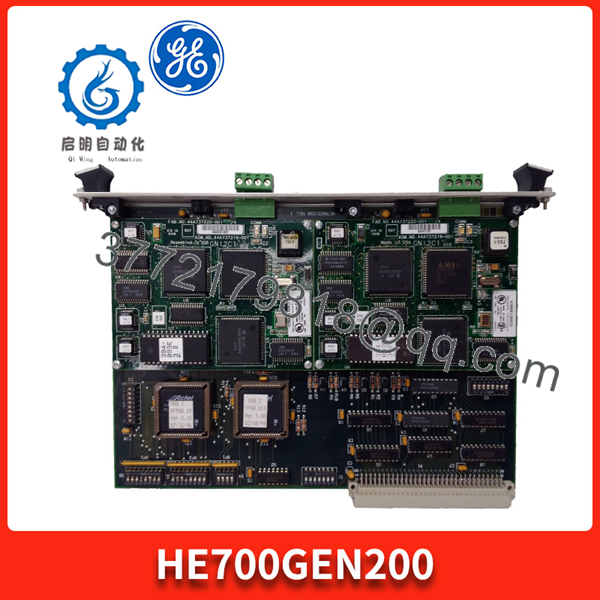
HE700GEN200
Applications & System Role
The HE700GEN200 sits between a VME-based control architecture and a Genius I/O network. Its two Genius channels provide the network interface through which the VME system can communicate with Genius I/O devices on the configured bus segments.
In a control-system architecture, the module performs the interface role rather than serving as a field I/O module itself. It connects the VME backplane to Genius network channels, supporting communication between the control system and Genius-based I/O devices. Its dual-channel design makes it applicable where two Genius network segments are required within the same VME-based system.
FAQ
What is the GE HE700GEN200?
It is a Horner APG uGENI dual-channel Genius interface module for a VME backplane.
How many Genius channels does the HE700GEN200 provide?
It provides two independent Genius channels.
What type of backplane does it use?
It is a single-slot generic VME module and installs in a VME backplane.
How is the module configured?
Each uGENI board is configured with its own 8-position DIP switch; DIP Switch 2 configures uGENI 1 and DIP Switch 3 configures uGENI 2.
Which front-panel connections does it provide?
It provides Serial 1, Serial 2, Shield In, and Shield Out terminals.
How many devices can a Genius network support?
A Genius network supports up to 32 devices, assigned Genius Bus Addresses 0 through 31.
What termination is required on the Genius network?
The bus must be terminated at each end with a resistor matched to the cable characteristic impedance; 120 ohm resistors are specified when the impedance is unknown.
Does the module’s VME position matter?
Yes. If its interrupt capability is used, it must be placed in the VME interrupt chain; otherwise, it should be installed after modules that use VME interrupts.