 WhatsApp: +86 16626708626
 Email:
  Phone: +86 16626708626
Description
3. Key Technical Specifications
| Parameter | Specification Value |
| Module Type | Simplex Turbine Complementary Control (YTCC) |
| Input Channels | Shaft voltage monitoring, shaft current monitoring, specialized speed inputs |
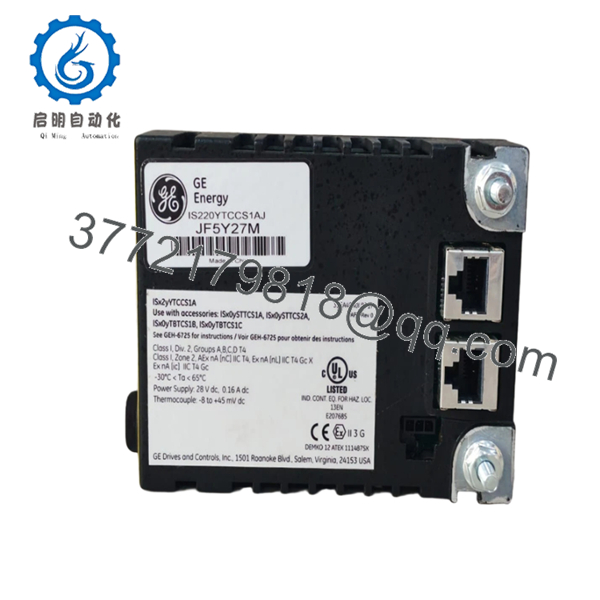
| Network Interfaces | 2 x 100Base-TX RJ45 Ethernet Ports (IONet Redundancy) |
| Nominal Supply Voltage | 28.0 VDC (Accepts 18.0 to 32.0 VDC) |
| Power Consumption | Maximum 415 mA at 28 VDC |
| A/D Conversion | 16-bit resolution with millisecond-level sampling |
| Compatible Terminal Board | STCCS1A, STCCS1B |
| Isolation Barrier | Galvanic isolation up to 1500 V RMS between field and logic |
| Operating Temperature | −30 to +65 °C (−22 to +149 °F) |
| Form Factor | Ruggedized cast metal envelope for direct terminal board mounting |
4. Product Introduction & Supply Chain Strategy
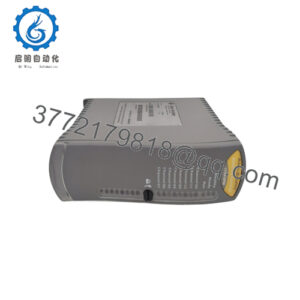
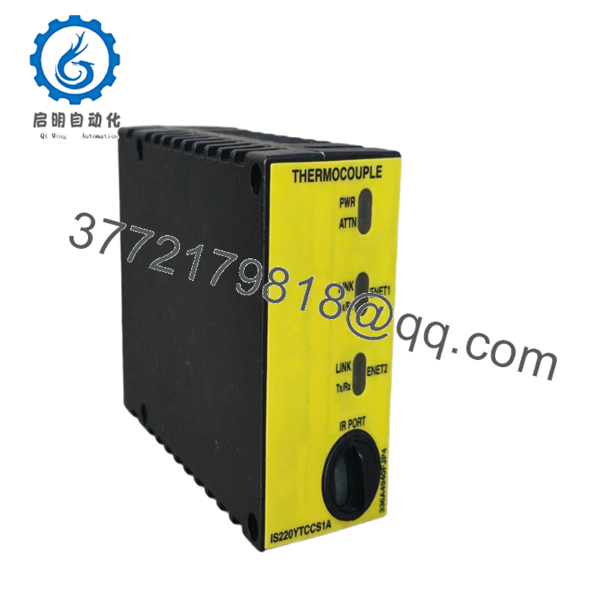
The GE IS220YTCCS1A is a highly specialized, simplex I/O pack developed for the Mark VIe platform to manage critical, complementary turbine health inputs. This processing block monitors auxiliary analog variables, specifically tracking shaft grounding voltage and shaft current fluctuations to diagnose degradation before bearing destruction occurs. By digitizing these sensitive measurements at the point of termination and broadcasting them across dual-redundant 100 Mbps IONet paths, the module gives controllers immediate visibility into generator and turbine rotor electrical stress.
Maintaining an unpowered, New Surplus IS220YTCCS1A on your warehouse shelves represents an essential asset-protection policy. Because this module directly monitors parameters tied to catastrophic mechanical wear, a hardware failure can paralyze your predictive protection system. Opting for a factory-sealed unit eliminates the latent defects, dried capacitors, and compromised calibration common to refurbished alternatives. This approach provides an immediate reduction in your plant’s Total Cost of Ownership (TCO) by bypassing long OEM production lead times and providing a guaranteed, zero-hour replacement for unexpected forced outages.
5. Installation & Configuration Guide
Stage 1: Pre-Installation (Prep & Safety)
- Verify that the turbine generator monitoring loop is placed in a supervised, stable state.
- Isolate the auxiliary power switches to ensure the 28 VDC distribution circuit feeding the target slot is dead.
- Secure a certified, grounded ESD wrist strap to your forearm and connect its terminal to the bare metal grounding lug of the system cabinet.
- Use a permanent marker to explicitly label the active network cables running to the IONet R and S ports to ensure identical reassignment.
Stage 2: Removal
- Unplug the dual RJ45 Ethernet communication cables from the top faceplate connectors.
- Using a standard flathead screwdriver, completely back out the two captive jack-screws built into the sides of the module housing.
- Pull the module perpendicular to the backplane, drawing it smoothly off the locating pins to prevent shearing or bending the high-density connection pins.
- Transfer the unseated pack into a static-shielding bag immediately to prevent environmental contamination of the back-side electronics.
Stage 3: Installation (Clone & Seat)
- Remove the New Surplus IS220YTCCS1A from its original factory ESD enclosure.
- Conduct a close visual inspection of the pin array at the base of the pack to confirm all contacts are straight and clean.
- Position the pack over the guide pins on the STCC terminal board, pushing firmly down until the connection block is fully seated.
- Tighten the two integrated jack-screws to lock the module envelope onto the terminal assembly, establishing a rigid, vibration-resistant connection.
Stage 4: Power-On & Testing
- Reattach the dedicated IONet network communication cables to their original RJ45 terminal jacks.
- Restore the primary 28 VDC power to the module’s supply line.
- Check the faceplate diagnostic LEDs: the green PWR lamp must remain stable, while the IONet link lamps should blink rapidly to show synchronization.
- Interface via the ToolboxST software environment to verify that the newly installed I/O pack has completed its boot sequence and is uploading data without error flags.

- IS220YTCCS1A
- IS220YTCCS1A
6. Firmware/Software Versions & Upgrade Notes
The IS220YTCCS1A utilizes dynamic onboard flash memory to run its specialized analog acquisition algorithms. The embedded firmware code must match the configuration baseline defined inside your facility’s active ToolboxST project file. Connecting a module with mismatched firmware will prompt the master controller to flag an invalid configuration block state, which blocks the module from scanning physical I/O.
When installing this New Surplus module, the Mark VIe master controller will attempt to analyze the board’s revision profile over the IONet fabric. If the board’s firmware is older than the project baseline, the master controller can push a targeted update automatically. You must ensure that network communications remain stable and unpowered interruptions do not occur during this programming phase. Interrupting a flash rewrite can brick the internal bootloader, requiring an off-site factory reset.
7. Frequently Asked Questions (FAQ)
Q: Why does this New Surplus pack cost more than a refurbished unit, and what makes it worth the investment?
A: The IS220YTCCS1A handles high-precision shaft monitoring where minor measurement drift can trigger a false turbine trip or miss a major grounding fault. Refurbished components carry a history of thermal stress and component aging that degrades analog accuracy. This New Surplus pack delivers zero-hour factory reliability, ensuring precise tracking without the risk of early failure common to used hardware.
Q: Is this module delivered in factory-sealed OEM packaging?
A: Yes. All our New Surplus components are stored and shipped in their original factory anti-static enclosures or premium ESD-safe equivalent boxes. Our engineering team conducts controlled open-box visual validation and electrical tracking audits only before final dispatch.
Q: What does the “S1A” suffix signify in the model number?
A: The “S1A” suffix denotes a Simplex hardware layout combined with a specific revision baseline for the internal board layout. This specific variant is designed to mount on a simplex terminal board structure, distinguishing it from dual or triple redundant configurations.
Q: Can I hot-swap this specific I/O pack while the turbine is online?
A: While the Mark VIe architecture supports the hot-swapping of packs, pulling an IS220YTCCS1A simplex module will instantly drop all active shaft voltage and current tracking loops. If your active control scheme treats a loss of shaft grounding telemetry as a trip condition, pulling the board will cause an immediate turbine shutdown. Always bypass these protection loops in the software before attempting a live swap.
Q: Does this I/O pack include the underlying STCC terminal board?
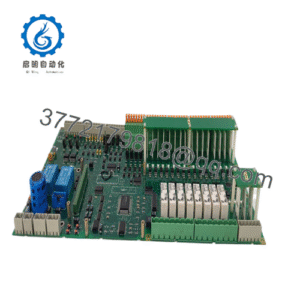
A: No. The IS220YTCCS1A represents the active processing pack housing the microprocessor, network layer, and A/D converters. The physical terminal board where your field sensors terminate (e.g., STCCS1A) is a separate hardware piece that remains permanently bolted to the cabinet rack.
Q: What type of warranty protection covers this New Surplus module?
A: We provide a comprehensive 1year replacement warranty on this module. This commitment matches or exceeds typical OEM new-equipment policies, offering complete financial and operational security for your plant maintenance strategy.