WhatsApp: +86 16626708626
 Email:
 Phone: +86 16626708626
Description
Core Product Summary
The GE VMIVME-7750 is a single-slot, 6U VMEbus single-board computer (SBC) based on the Intel Pentium III processor and Intel 815E chipset. It combines desktop-style PC functionality with a transparent PCI-to-VME bridge, allowing it to operate as either a VMEbus system controller or a peripheral CPU in multi-CPU systems.
The board supports up to 512 MB of PC133 SDRAM, dual 10/100 Mbit Ethernet ports, integrated SVGA graphics with 4 MB display cache, two RS-232 serial ports, dual USB ports, IDE and floppy-drive support, 32 KB of nonvolatile SRAM, four programmable timers, a watchdog timer, and one front-panel-accessible PMC expansion site. It is designed for embedded applications that require local processing, network connectivity, and VMEbus integration in a single VME slot.
Key Technical Specifications
| Parameter | GE VMIVME-7750 |
|---|---|
| Manufacturer | VMIC / GE Fanuc |
| Product type | VMEbus single-board computer (SBC) |
| Form factor | 6U, single-slot dual-height VME Eurocard |
| Processor | Intel Pentium III, Socket 370 |
| Chipset | Intel 815E |
| Front-side bus | 133 MHz |
| System memory | Up to 512 MB PC133 SDRAM through one SODIMM |
| Graphics | Integrated SVGA controller with 4 MB DRAM display cache |
| Ethernet | Dual 10/100 Mbit Ethernet interfaces |
| Serial ports | Two RS-232 ports |
| USB | Two USB ports |
| Storage interfaces | ATA-100 IDE and floppy-drive support |
| Optional storage | Up to 512 MB bootable CompactFlash |
| Nonvolatile memory | 32 KB nonvolatile SRAM |
| Timers | Four programmable timers: two 16-bit and two 32-bit |
| Watchdog timer | Software-selectable with reset function |
| VMEbus interface | Transparent PCI-to-VME bridge based on the Tundra Universe IIB |
| VMEbus compliance | VME Specification Revision C.1 |
| VMEbus role | System controller or peripheral CPU |
| Expansion | One PMC expansion site with front-panel access |
| Embedded interfaces | I²C bus support and remote Ethernet booting |
| Operating-system support | Windows 95, 98SE, NT 4.0, 2000, Linux, VxWorks, QNX, Solaris, and LynxOS |
| Power requirement | +5 VDC, +12 VDC, and -12 VDC from the VME backplane |
| Cooling | Passively cooled |
| Board format | 6U dual-height Eurocard |
Engineering Selection Highlights
- The VMIVME-7750 provides a Pentium III-based computing platform in a single VME slot, making processor performance, memory capacity, and VME integration available without a separate host computer.
- Its Intel 815E chipset supports a 133 MHz front-side bus and ATA-100 IDE, which affects storage and peripheral performance in the VME system.
- The transparent PCI-to-VME bridge allows the board to serve as either the VMEbus system controller or a peripheral CPU, so its role must be configured for the intended multi-CPU architecture.
- Dual 10/100 Ethernet ports support local networking and remote Ethernet booting; the exact use of both ports should be planned around the system network topology.
- The single PMC expansion site provides a defined path for application-specific I/O, communication, or interface expansion through a PCI Mezzanine Card.
- The board includes 32 KB of nonvolatile SRAM, four programmable timers, and a watchdog timer, which are relevant for embedded applications requiring retained data, timed events, and supervisory reset behavior.
- The exact processor speed, installed SDRAM capacity, CompactFlash configuration, and PMC module are configuration-dependent and should be confirmed from the complete board ordering number before replacement or system integration.
System Compatibility & Integration Requirements
| Item / Dependency | Verified Compatibility or Requirement | Practical Note |
|---|---|---|
| VMEbus system | VME Specification Revision C.1 | The board is designed for VMEbus-based systems. |
| VMEbus role | System controller or peripheral CPU | The transparent PCI-to-VME bridge supports both roles in multi-CPU systems. |
| System memory | Up to 512 MB PC133 SDRAM through one SODIMM | Installed memory capacity depends on the fitted SODIMM. |
| Ethernet network | Dual 10/100 Mbit Ethernet interfaces | Supports standard Ethernet networking and remote booting. |
| Display | Integrated SVGA controller with 4 MB display cache | Provides local graphics output for console or operator-interface use. |
| Storage | ATA-100 IDE, floppy drive, and optional CompactFlash | Storage configuration depends on the ordered board configuration. |
| Expansion | One PMC expansion site | PMC cards provide application-specific I/O or communication functions. |
| Operating system | Windows, Linux, VxWorks, QNX, Solaris, or LynxOS | The board requires an operating system or embedded runtime for application execution. |
| Power | +5 VDC, +12 VDC, and -12 VDC from the VME backplane | All three supplies must be available from the VME chassis. |
Dimensions, Mounting & Connection Notes
- The VMIVME-7750 conforms to the VMEbus physical specification for a single-slot, 6U dual-height Eurocard.
- It is passively cooled and does not require an onboard processor fan.
- The board interfaces with the VME chassis through P1 and P2 rear I/O/VMEbus connectors.
- Front-panel interfaces include two RS-232 serial ports on compact DB-9 connectors, dual Ethernet ports, dual USB ports, SVGA video output, and a keyboard/mouse port.
- The front panel includes a reset switch and status LEDs.
- The PMC expansion site is accessible from the front panel.
- The board supports a real-time clock/calendar, miniature speaker, and keyboard/mouse connectivity.
- The complete connector pinouts for VMEbus, serial, USB, Ethernet, video, keyboard/mouse, and PMC interfaces are defined in the VMIVME-7750 product manual.
Detailed Product Overview
The GE VMIVME-7750 is a full-featured Pentium III-compatible computer packaged as a single-slot, passively cooled 6U VME Eurocard. It uses the Intel 815E chipset and operates with a 133 MHz front-side bus, providing a desktop-class processing platform in a VMEbus form factor.
The board supports up to 512 MB of PC133 SDRAM through a single SODIMM. Its integrated SVGA controller includes 4 MB of DRAM display cache, allowing local video output for console, operator-interface, or diagnostic use. The board also provides dual 10/100 Mbit Ethernet ports, two RS-232 serial ports, dual USB ports, keyboard and mouse support, a real-time clock/calendar, IDE drive support, and floppy-drive support.
For VME integration, the VMIVME-7750 uses a transparent PCI-to-VME bridge based on the Tundra Universe IIB. This interface allows the board to operate as a VMEbus system controller or as a peripheral CPU in a multi-CPU system. The bridge provides the path between the board’s PCI-based PC architecture and the VMEbus, enabling data exchange with other VME modules.
Embedded-system features include I²C bus support, remote Ethernet booting, optional bootable CompactFlash storage up to 512 MB, 32 KB of nonvolatile SRAM, four programmable timers, and a software-selectable watchdog timer with reset capability. These functions support retained configuration data, timed control sequences, remote startup, and supervisory fault handling.
The board includes one PMC expansion site with front-panel access. A PMC card can add application-specific functions such as additional communication interfaces, specialized I/O, or other PCI Mezzanine Card-based capabilities without occupying another VME slot.
The VMIVME-7750 supports desktop operating systems including Windows 95, Windows 98SE, Windows NT 4.0, Windows 2000, and Linux-based systems. It also supports embedded operating systems including VxWorks, QNX, Solaris, LynxOS, and embedded Windows NT. The selected operating system, drivers, PMC module, storage configuration, and VMEbus role determine the final system behavior.
The board requires +5 VDC, +12 VDC, and -12 VDC from the VME backplane. It is passively cooled, so enclosure airflow, adjacent-module heat dissipation, and processor configuration remain important installation considerations even though the board does not use an onboard processor fan.
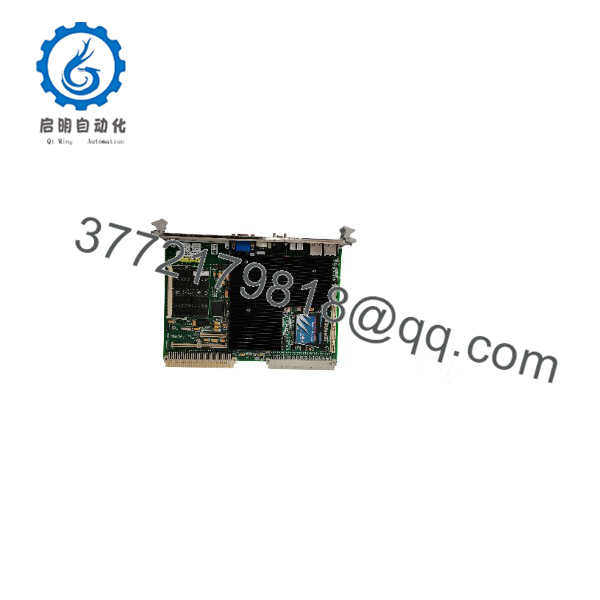
VMIVME-7750
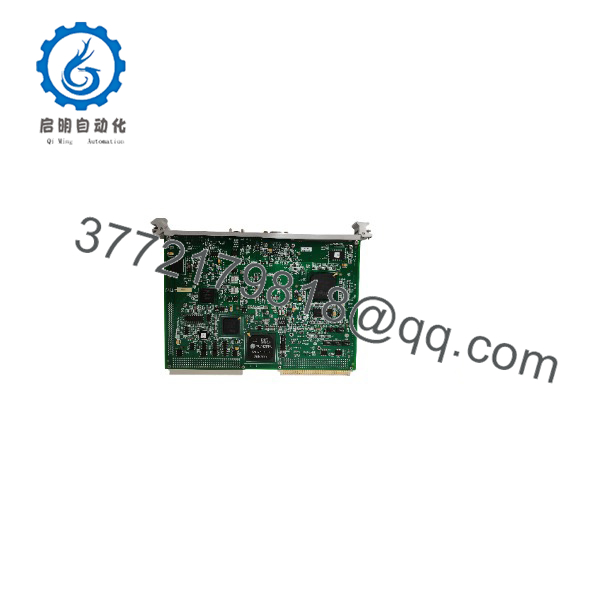
VMIVME-7750
Applications & System Role
The VMIVME-7750 functions as the processing and control node in a VMEbus-based embedded system. It executes the operating system and application software, communicates with Ethernet and serial devices, provides local graphics and USB interfaces, and exchanges data with other VME modules through its PCI-to-VME bridge.
The board is documented for telecommunications, simulation, instrumentation, industrial control, process control and monitoring, factory automation, automated test systems, and data-acquisition applications. In these systems, it can act as the primary system controller, a peripheral processor, or a host for PMC-based I/O expansion.
Its combination of PC-compatible interfaces and VMEbus integration makes it suitable for applications where a compact processor module must operate alongside VME I/O, data-acquisition, communication, or reflective-memory modules.
FAQ
What is the GE VMIVME-7750?
It is a 6U VMEbus single-board computer based on an Intel Pentium III processor and Intel 815E chipset.
How much memory does it support?
It supports up to 512 MB of PC133 SDRAM through a single SODIMM.
Which Ethernet capability does it include?
It includes dual 10/100 Mbit Ethernet interfaces.
Can it operate as a VMEbus system controller?
Yes. Its transparent PCI-to-VME bridge allows it to function as a system controller or peripheral CPU in multi-CPU VME systems.
What expansion capability does it provide?
It provides one PMC expansion site with front-panel access.
Which storage interfaces are supported?
It supports ATA-100 IDE, floppy-drive operation, and optional bootable CompactFlash storage up to 512 MB.
What nonvolatile memory does it include?
It includes 32 KB of nonvolatile SRAM.
What operating systems does it support?
It supports Windows 95, 98SE, NT 4.0, 2000, Linux, VxWorks, QNX, Solaris, and LynxOS.