WhatsApp: +86 16626708626
 Email:
  Phone: +86 16626708626
Description
Key Technical Specifications
| Parameter | Specification |
| Part Number | 51401497-100 |
| Alternate Part Numbers | 51401469-100, DNPS |
| CE Compliance | Non-CE (For CE variant, reference part number 51196655-100) |
| Input Voltage Range | 100–120 V AC / 200–240 V AC (Auto-Sensing / Switchable) |
| Compatible Platform | Honeywell TDC 3000, LCN Dual Node Chassis, Universal Stations |
| Form Factor | Single-slot Power Module Assembly |
| System Clock Jumper | Pin Header J1 for INT (Internal line frequency) vs. EXT (External clock / SOE master) |
| Dimensions & Weight | 5.5 \times 38.5 \times 18.0 cm; Approx 1.98 kg |
| Country of Origin | United States |
Product Introduction & Supply Chain Strategy
The Honeywell 51401497-100 is a dual-node power supply module engineered specifically for Honeywell TDC 3000 Local Control Network (LCN) dual-node chassis. It furnishes clean, regulated DC voltage independently to dual independent nodes—such as co-located Universal Stations or Network Interface Modules (NIMs)—within a single chassis frame to maintain maximum isolation and operational uptime.
Procuring this part as New Surplus provides an essential insurance policy for aging DCS control infrastructure. Used or improperly refurbished power supplies often suffer from degraded electrolytic filter capacitors and stressed transformer windings that cause rail ripple, leading to unprovoked node resets or processor faults. By sourcing factory-fresh New Surplus stock, plant engineers avoid high OEM list prices and long lead times while securing long-term reliability and protecting critical process nodes from unplanned downtime.
Installation & Configuration Guide
Stage 1: Pre-Installation (Prep & Safety)
- Safety & LOTO: Disconnect and lock out the AC feed breaker serving the target LCN chassis power supply slot.
- Clock Jumper Pinning: Inspect jumper J1 on the rear of the printed circuit board. Confirm whether the node requires internal line-frequency clock timing (INT) or external clock timing (EXT for Sequence of Events / SOE configurations) and mirror the old board exactly.
- ESD Precautions: Put on a grounded ESD wrist strap before handling the replacement module.
Stage 2: Removal
- Loosen the top and bottom captive retaining screws on the front panel of the existing 51401497-100 module.
- Carefully pull the power supply module straight out of the chassis using the front ejection handles to avoid damaging internal edge connectors.
Stage 3: Installation (Clone & Seat)
- Verify that jumper J1 matches the required system timing configuration (INT vs. EXT).
- Align the 51401497-100 board with the chassis guide rails and push the module firmly into the slot until the backplane connectors fully engage.
- Hand-tighten the top and bottom retaining screws to secure mechanical grounding.
Stage 4: Power-On & Testing
- Re-apply AC power to the chassis supply breaker.
- Check the front panel LED status indicators on the power supply and associated node processors to verify solid green DC power status.
- Check the DCS system diagnostic logs at the operator station to confirm that the node powered up without voltage out-of-tolerance alarms or clock synchronization faults.
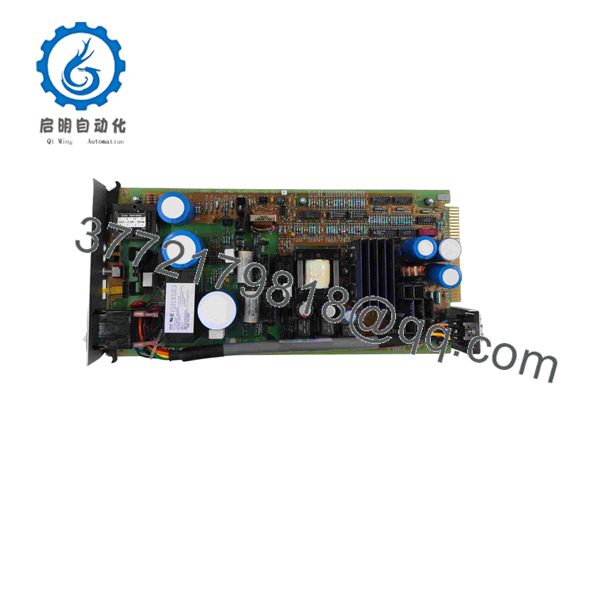
51401497-100
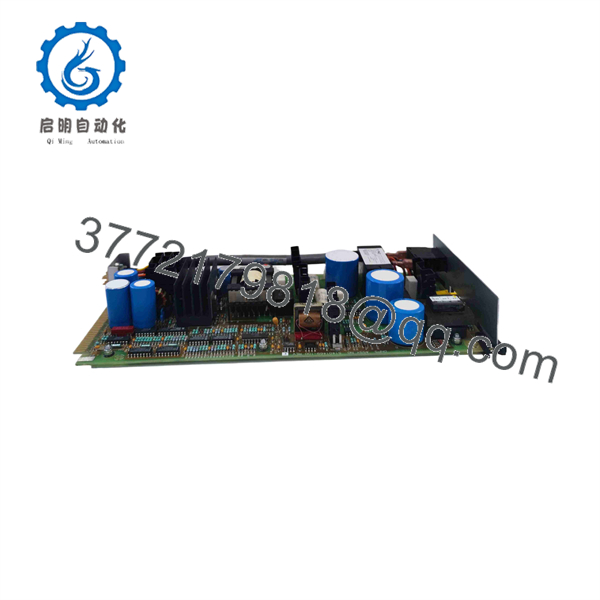
51401497-100
Firmware/Software Versions & Upgrade Notes
- Hardware Hardware-Level Operation: The 51401497-100 is a hardware-level power converter and clock distribution assembly; it does not contain flash firmware or programmable microcode.
- System Clock Synchronization: Pay close attention to jumper J1 on the back of the PCB. If Sequence of Events (SOE) functionality is enabled on a NIM, the clock master, clock slave, and all SOE NIMs must be jumper-pinned for external (EXT) clock. Standard nodes default to internal (INT) line-frequency clocking.
- CE Compliance Check: Ensure your facility specification does not mandate European CE conformity. The 51401497-100 is a non-CE power supply; for CE-rated cabinets, the equivalent unit is part number 51196655-100.
Frequently Asked Questions (FAQ)
Q: Is this Honeywell 51401497-100 unit brand new or refurbished?
A: This module is guaranteed New Surplus / Original New. It has never been installed in an operating plant, repaired, or pulled from a decommissioned cabinet. It is original factory stock stored in anti-static conditions.
Q: What is the primary difference between the 51401497-100 and the 51196655-100?
A: The 51401497-100 is the standard non-CE version of the dual-node power supply. Part number 51196655-100 is the CE-compliant variant built to meet European electromagnetic compatibility and safety standards.
Q: What happens if the clock jumper (J1) is set incorrectly?
A: If jumper J1 is improperly set to INT on an SOE-dependent node (or EXT on a non-SOE standalone node), the system may trigger clock synchronization alarms or fail to log event sequences in correct chronological order across nodes. Always verify the J1 jumper position before seating the card.
Q: Can I replace this power supply module while the chassis is live?
A: Because this power supply serves nodes directly within an LCN chassis, hot-swapping should only be performed if the node is off-line or redundant node power routing is configured. De-energizing AC input to the target supply slot prior to extraction is recommended for safety.
Q: What warranty is provided with this power supply?
A: We provide a full 1-year functional replacement warranty from the date of shipment on all New Surplus 51401497-100 units.