WhatsApp: +86 16626708626
 Email:
  Phone: +86 16626708626
Description
Key Technical Specifications
| Parameter | Value |
|---|---|
| Manufacturer | Honeywell |
| Model | CC-PAIH02 |
| Product Type | High-Level Analog Input with HART |
| System | Experion PKS Series C |
| Number of Channels | 16 |
| Input Type | Voltage and current |
| Current Input | 4-20 mA through 250 Ω |
| Voltage Ranges | 0-5 V, 1-5 V, 0.4-2 V |
| Transmitter Type | 2-wire or self-powered transmitters |
| A/D Resolution | 16 bits |
| Input Scan Rate | 50 ms |
| Common-Mode Rejection | 70 dB, DC to 60 Hz |
| Normal-Mode Rejection | 19 dB at 60 Hz |
| Voltage Input Impedance | >10 MΩ |
| Maximum Differential Input | ±30 V without damage |
| Hardware Accuracy | ±0.075% of full scale at 23.5 °C ±2 °C |
| Hardware Accuracy, 0-60 °C | ±0.15% of full scale |
| HART | Supported |
| Non-Redundant IOTA | CC-TAIX01 / CC-TAID01 |
| Redundant IOTA | CC-TAIX11 / CC-TAID11 |
Honeywell’s Series-C documentation confirms CC-PAIH02 as a HART-capable high-level analog input module. With CC-TAID01/11 IOTAs, differential inputs can be configured across all 16 channels; with CC-TAIX01/11, differential capability is limited to channels 13-16.
Product Introduction
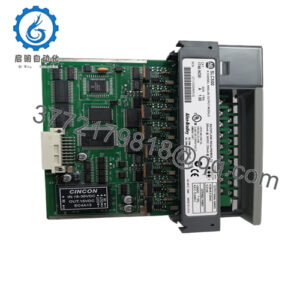
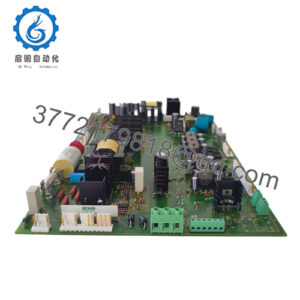
The Honeywell CC-PAIH02 is a 16-channel high-level analog input module for Experion PKS Series C systems. It accepts current and voltage signals from process transmitters and supports HART communication for smart-instrument configuration and status information. Honeywell specifies 16-bit A/D conversion, a 50 ms input scan rate, and multiple HART functions.
The important replacement detail is the IOTA configuration. CC-PAIH02 works with several IOTA options, including CC-TAIX01/11 and CC-TAID01/11. The selected IOTA determines the available differential-input arrangement, so replacing the IOM alone without checking the installed IOTA is a common procurement mistake.
Installation & Configuration Guide
Stage 1: Pre-Installation Preparation — 5–10 minutes
⚠️ Safety First: Put the process in an approved safe state, follow site lockout/tagout procedures, and isolate the applicable I/O equipment before removing the module.
Tools Required
- ESD wrist strap
- Appropriate screwdriver
- Digital multimeter
- Wire labels
- Smartphone or camera
- Existing Honeywell Series-C documentation
Data Backup
- Record the existing CC-PAIH02 part number and revision.
- Photograph the installed IOM and IOTA.
- Photograph all field wiring.
- Record the channel assignments used by the C300/Experion configuration.
- Document HART-enabled instruments and channel assignments.
- Confirm whether the installation uses a redundant or non-redundant IOTA.
Stage 2: Removing the Old Module — 5 minutes
- Verify the applicable I/O power has been isolated.
- Identify the CC-PAIH02 in the Series-C I/O assembly.
- Label field wiring before disconnecting anything.
- Disconnect the wiring carefully.
- Release the module’s mechanical retaining mechanism.
- Remove the IOM without stressing the backplane or IOTA connections.
- Inspect the IOTA and connectors for contamination or physical damage.
⚠️ Do not remove the IOTA simply because the IOM is being replaced. First confirm that the existing IOTA is one of the supported combinations for CC-.
Stage 3: Installing the New Module — 5–10 minutes
- Verify the exact model: CC-.
- Confirm the installed IOTA model.
- Check whether the application requires differential inputs on channels 1-16 or only channels 13-16.
- Inspect connectors before insertion.
- Seat the CC- correctly in the Series-C assembly.
- Reconnect field wiring according to the approved wiring documentation.
- Confirm channel polarity and shield/ground arrangements.
- Verify that no terminal has been forced or cross-wired.
Self-Checklist
- CC- model verified
- IOTA model verified
- Redundancy arrangement verified
- Channel wiring documented
- HART channels identified
- Connectors fully seated
- Field wiring checked
Stage 4: Power-On & Testing — 10–15 minutes
- Perform a final wiring inspection.
- Energize the I/O assembly according to the site’s approved procedure.
- Check module status indications.
- Verify the I/O module is recognized by the Experion PKS system.
- Confirm the expected I/O channel configuration.
- Verify analog values against calibrated field signals or a suitable simulator.
- Check 4-20 mA scaling.
- Test applicable voltage-input channels.
- Verify HART communication on configured smart transmitters.
- Check for bad-PV, open-wire, or communication diagnostics.
- Compare process values against the previous module.
- Return the loop to service after the I/O checks pass.
⚠️ Do not assume every CC- installation uses the same IOTA. Honeywell’s documentation explicitly lists different IOTA configurations and different differential-input capabilities.
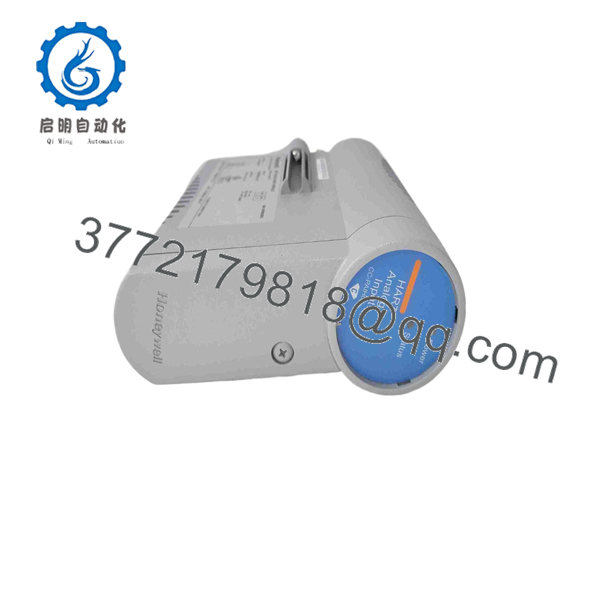
CC-PAIH02
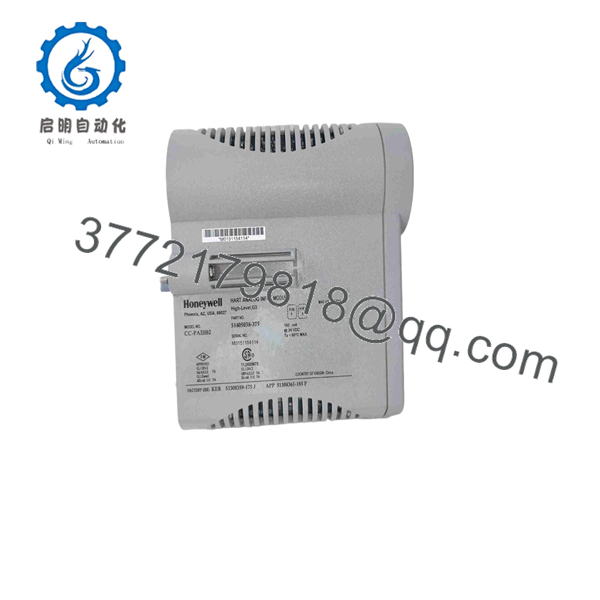
CC-PAIH02
Frequently Asked Questions (FAQ)
Can the CC- handle 4-20 mA HART signals?
Yes. Honeywell identifies CC- as a High-Level Analog Input with HART. The module supports 4-20 mA inputs and HART functions for compatible smart transmitters.
How many channels does CC- have?
It has 16 analog input channels. The differential-input capability depends on the IOTA configuration. CC-TAID01/11 provides differential configuration across channels 1-16, while CC-TAIX01/11 supports differential inputs on channels 13-16.
What IOTA should I use with CC-?
Honeywell’s compatibility documentation lists CC-TAIX01 / CC-TAIX11 and CC-TAID01 / CC-TAID11, depending on the required configuration. The correct choice depends on redundancy and differential-input requirements.
Is CC- a replacement for CC-PAIH01?
Yes. Honeywell’s Series-C user documentation states that CC-PAIH01 is superseded by CC-. However, verify the installed IOTA and the existing channel configuration before making the change.
Will replacing CC- erase the C300 control configuration?
The I/O module itself should not be treated as the permanent repository of the complete C300 control strategy. The important commissioning task is to verify that the replacement IOM is correctly recognized and that the Experion configuration matches the physical channels and HART assignments.
Is CC- suitable for differential inputs?
Yes, but the IOTA matters. Honeywell documents CC- with CC-TAID01/11 for differential inputs across channels 1-16. With CC-TAIX01/11, differential inputs are available on channels 13-16.
Is a surplus CC- the same as a factory-new unit?
Not necessarily. Ask the supplier to state the exact condition: Factory Sealed, New Original/New Surplus, or Refurbished/Tested. Also request a clear photo of the nameplate and part number. For a legacy Experion I/O component, those details matter more than a stock photograph.