WhatsApp: +86 16626708626
 Email:
  Phone: +86 16626708626
Description
Key Technical Specifications
| Parameter | Value |
|---|---|
| Manufacturer | Honeywell |
| Model | CC-PAIN01 |
| Product Type | High-Level Analog Input |
| System | Experion PKS Series C |
| IOM Function Block | AI-HL |
| Number of Channels | 16 |
| Channel Configuration | 16 single-ended |
| Input Type | Current |
| Transmitter Compatibility | 2-wire or self-powered transmitters |
| Input Range | 4-20 mA |
| Input Resistance | 200 Ω |
| A/D Resolution | 16 bits |
| Input Scan Rate | 50 ms |
| Common-Mode Rejection | 70 dB, DC to 60 Hz |
| Normal-Mode Rejection | 20 dB at 60 Hz |
| Normal-Mode Filter | Single-pole RC, -3 dB at 6.0 Hz |
| Maximum Normal-Mode Input | ±30 V |
| Channel-to-Channel Crosstalk | -60 dB, DC to 60 Hz |
| Hardware Accuracy | ±0.075% FS at 23.5 °C ±2 °C |
| Accuracy, 0-60 °C | ±0.15% FS |
| Non-Incendive Field Power | Individually protected current-limiting circuits |
| Non-Redundant IOTA | CC-TAIN01 |
| Redundant IOTA | CC-TAIN11 |
These specifications come directly from Honeywell’s Series-C I/O specification.
Product Introduction
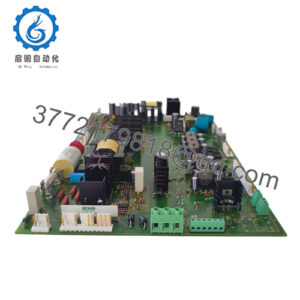
The Honeywell CC-PAIN01 is a 16-channel high-level analog input module for the Experion PKS Series C control platform. It accepts 4-20 mA signals from 2-wire or self-powered transmitters and converts the process signals through a 16-bit A/D converter. The module uses single-ended inputs and provides a 50 ms input scan rate.
The key distinction is that CC-PAIN01 is the non-HART high-level AI module. For HART applications, engineers should verify whether the system requires CC-PAIH-series hardware instead. CC-PAIN01 uses CC-TAIN01 for non-redundant installations and CC-TAIN11 for redundant installations.
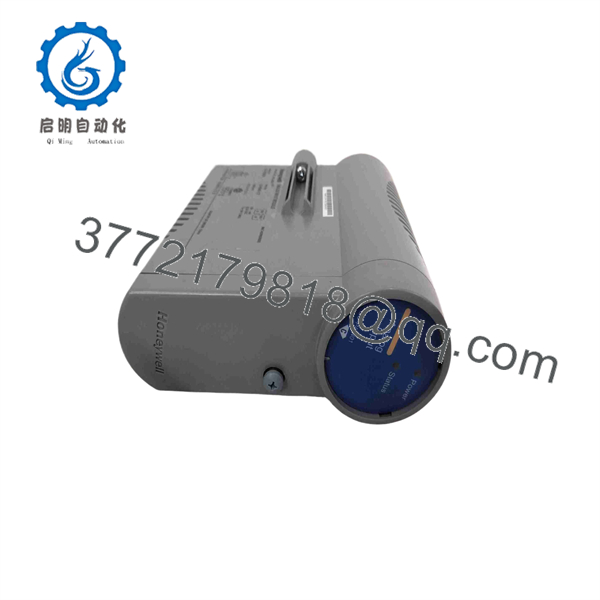
CC-PAIN01
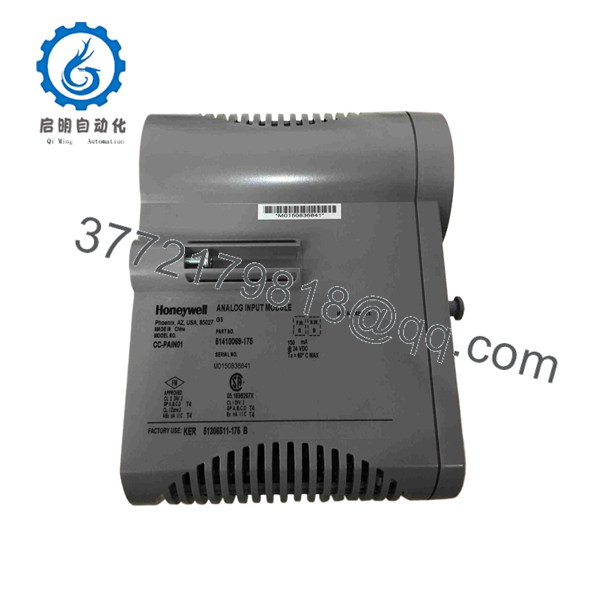
CC-PAIN01
Installation & Configuration Guide
Stage 1: Pre-Installation Preparation — 5–10 minutes
⚠️ Safety First: Put the affected process loop into its approved safe state. Follow the site’s lockout/tagout procedure before removing or handling the I/O hardware.
Tools Required
- ESD wrist strap
- Appropriate screwdriver
- Digital multimeter
- Wire labels
- Smartphone or camera
- Current Series-C configuration documentation
Data Backup
- Record the complete CC-PAIN01 part number and hardware revision.
- Photograph the installed IOM and IOTA.
- Photograph all field-terminal wiring.
- Record the channel-to-tag assignments.
- Record the transmitter type for each active channel.
- Confirm whether the IOTA is CC-TAIN01 or CC-TAIN11.
- Verify whether the application uses redundant I/O.
Stage 2: Removing the Old Module — 5 minutes
- Verify that the applicable I/O assembly is in the approved maintenance state.
- Identify the CC-PAIN01 and its associated IOTA.
- Label field wiring before disconnecting it.
- Disconnect the wiring without pulling on the conductors.
- Release the module retaining mechanism.
- Remove the IOM carefully.
- Inspect the IOTA and connectors for contamination, corrosion, or physical damage.
⚠️ Do not substitute the IOTA based solely on physical appearance. Honeywell specifies CC-TAIN01 and CC-TAIN11 for CC-, with different non-redundant and redundant applications.
Stage 3: Installing the New Module — 5–10 minutes
- Verify the replacement is CC-, not CC-PAIH01/02.
- Confirm the IOTA model.
- Inspect the connectors.
- Use ESD protection when handling the module.
- Seat the CC- correctly.
- Reconnect field wiring according to the approved Honeywell wiring documentation.
- Check current-loop polarity.
- Confirm each transmitter is connected to the intended channel.
- Verify shielding and grounding according to the site wiring standard.
Self-Checklist
- CC- verified
- CC-TAIN01/CC-TAIN11 verified
- 4-20 mA wiring verified
- Channel assignments documented
- Transmitter polarity checked
- Connectors fully seated
- Redundancy configuration checked
Stage 4: Power-On & Testing — 10–15 minutes
- Perform a final wiring inspection.
- Energize the I/O system according to the approved procedure.
- Check the module status indication.
- Confirm the Experion PKS system recognizes the IOM.
- Verify that the expected AI-HL configuration is associated with the module.
- Check representative 4-20 mA signals.
- Verify engineering-unit scaling.
- Compare process values with the field transmitter or calibrated loop source.
- Check for I/O diagnostic alarms.
- Verify all affected channels before returning the loops to normal service.
⚠️ Do not expect HART communication from CC-. Honeywell identifies this module as the high-level analog input without HART.
Frequently Asked Questions (FAQ)
Is CC- a HART analog input module?
No. CC- is the non-HART high-level analog input module. Honeywell identifies its IOM block as AI-HL. If HART communication is required, verify the appropriate HART-capable Series-C module instead.
How many channels does CC- provide?
It provides 16 single-ended analog input channels. The specified input is 4-20 mA through a 200 Ω input resistance.
Which IOTA is compatible with CC-?
Honeywell specifies CC-TAIN01 for non-redundant applications and CC-TAIN11 for redundant applications.
Can CC- accept voltage signals?
The Honeywell specification identifies CC- specifically as a current-input module, with a 4-20 mA input range. Do not substitute the voltage-capable CC-PAIH or other AI models without checking the actual application requirements.
Is CC- obsolete?
The Honeywell Series-C documentation confirms the model and its technical specifications, but the OEM source located here does not explicitly provide a current lifecycle-status statement for CC-. Some secondary suppliers classify particular CC- revisions as discontinued/obsolete. Treat lifecycle status as revision- and supply-chain-dependent and verify availability before planning a long-term replacement strategy.
What should I provide when ordering a replacement?
Provide the complete CC- part number/revision, a photograph of the nameplate, the installed IOTA model, and the system configuration. Also state whether the application is redundant. This is especially important because Series-C includes multiple high-level analog-input variants with different capabilities.
Can CC- be replaced with CC-PAIH02?
Do not treat them as identical replacements. CC- is a 16-channel non-HART current-input module, while CC-PAIH02 is a HART-capable high-level analog input with different IOTA/configuration considerations. A migration requires checking the I/O configuration, wiring, HART requirements, and applicable IOTA before substitution.