WhatsApp: +86 16626708626
 Email:
  Phone: +86 16626708626
Description
Specifications
| Parameter | Specification |
|---|---|
| Model | BCG450-SD |
| Part Number | 353-557 |
| Manufacturer | INFICON |
| Product Type | Triple vacuum gauge |
| Measurement Technologies | Bayard-Alpert, Pirani, capacitance diaphragm |
| Measurement Range | 5 × 10⁻¹⁰ to 1500 mbar |
| Equivalent Torr Range | 3.75 × 10⁻¹⁰ to 1125 Torr |
| Vacuum Connection | DN 25 ISO-KF |
| Fieldbus | DeviceNet |
| Switching Functions | 2 adjustable functions |
| Supply Voltage | 20–28 VDC |
| Current Consumption | Approximately 0.8 A |
| Operating Temperature | 0 to +50 °C |
| Storage Temperature | −20 to +70 °C |
| Flange Bakeout | 80 °C |
| Electronics-Removed Bakeout | 150 °C |
| Vacuum-Exposed Materials | Y₂O₃, Ir, Mo, Cu, W, NiFe, NiCr, Al₂O₃, SnAg, stainless steel, glass |
INFICON identifies 353-557 specifically as the BCG450-SD DeviceNet version with a DN 25 ISO-KF vacuum connection. The BCG450 platform combines Bayard-Alpert, Pirani, and capacitance-diaphragm measurement technologies and covers 5 × 10⁻¹⁰ to 1500 mbar. INFICON lists a 20–28 VDC supply range and 0–50 °C operating temperature for the BCG450 family.
The BCG450-SD also incorporates two adjustable switching functions, with the associated relay contacts available through the sensor cable connector. Its fieldbus interface conforms to the DeviceNet standard.
Product Introduction
The INFICON BCG450-SD 353-557 is a DeviceNet-enabled TripleGauge for vacuum measurement across a very wide pressure range. It combines three measurement principles in one instrument, allowing pressure monitoring from atmospheric pressure down into the ultra-high-vacuum region. The 353-557 version uses a DN 25 ISO-KF vacuum connection.
For automation integration, the important distinction is the “-SD” DeviceNet interface. It is not interchangeable with -SP PROFIBUS, -SE EtherCAT, or -PN PROFINET versions simply because the vacuum-gauge body is from the same family. INFICON documents separate part numbers and communication interfaces for these variants.
Installation Guide
Stage 1 — Pre-Installation
- Isolate the vacuum system and follow the site’s lockout/tagout procedure for electrical equipment.
- Confirm that the chamber is at a safe pressure before removing the gauge.
- Verify the complete part number: BCG450-SD / 353-557.
- Confirm that the existing vacuum port is DN 25 ISO-KF.
- Record DeviceNet node addressing and network configuration before replacement.
- Back up the DeviceNet configuration and document the existing switching-function settings.
- Protect the sensor and vacuum connection from contamination during maintenance.
Stage 2 — Remove the Existing Gauge
- Disconnect the 20–28 VDC supply and DeviceNet wiring.
- Verify that the gauge is electrically isolated.
- Isolate and vent the vacuum chamber according to the equipment manufacturer’s procedure.
- Disconnect the DN 25 ISO-KF connection without damaging the sealing components.
- Remove the gauge while preventing particles from entering the vacuum system.
- Inspect the KF flange, centering ring, O-ring, and clamp for contamination or damage.
- Compare the removed unit’s nameplate with the replacement before installation.
Stage 3 — Install the -SD
- Confirm that the replacement is 353-557, not the visually similar 353-558.
- Install the gauge on the DN 25 ISO-KF connection using clean, compatible vacuum hardware.
- Reconnect the electrical supply within the specified 20–28 VDC range.
- Connect the DeviceNet network using the original node configuration.
- Restore the documented switching-function settings.
- Ensure the sensor is correctly oriented and mechanically supported.
- Check that the vacuum connection is clean and properly sealed before evacuation.
Stage 4 — Power-Up and Functional Test
- Check supply polarity, DeviceNet wiring, and vacuum connections before energizing.
- Apply power and allow the gauge electronics to initialize.
- Verify DeviceNet communication with the control system.
- Confirm that pressure data is being received by the DeviceNet master.
- Check pressure readings against the expected chamber condition.
- Verify both configured switching functions.
- Check DeviceNet diagnostics for communication errors.
- Confirm stable pressure measurement during pump-down and process operation.
- Document the final node address, switching parameters, and gauge serial number.
Technical pitfall: Do not conhe to an RS232C interface. INFICON specifically warns that operahe through its RS232C interface causes data-transmission errors. The SD version should be operated through its DeviceNet interface.
For surplus or refurbished inventory, supplier QC should include visual inspection, flange inspection, power-up testing, DeviceNet communication testing, pressure-reading verification across an appropriate test range, switching-output testing, and final nameplate/part-number verification. These tests should only be represented as completed when supported by an actual test report.
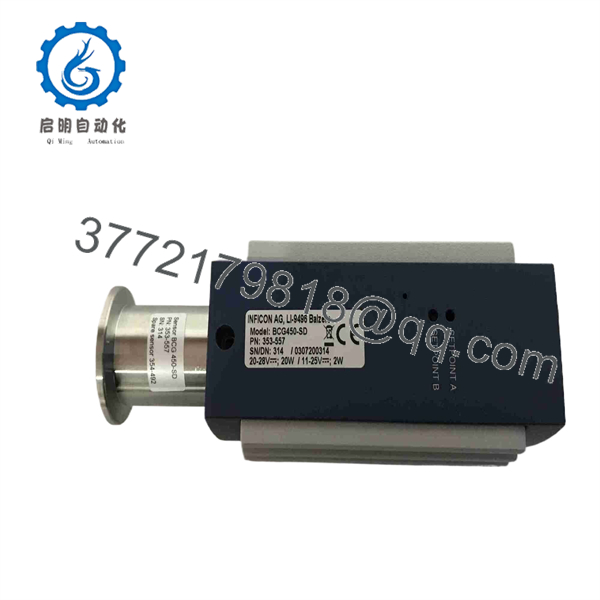
BCG450-SD 353-557
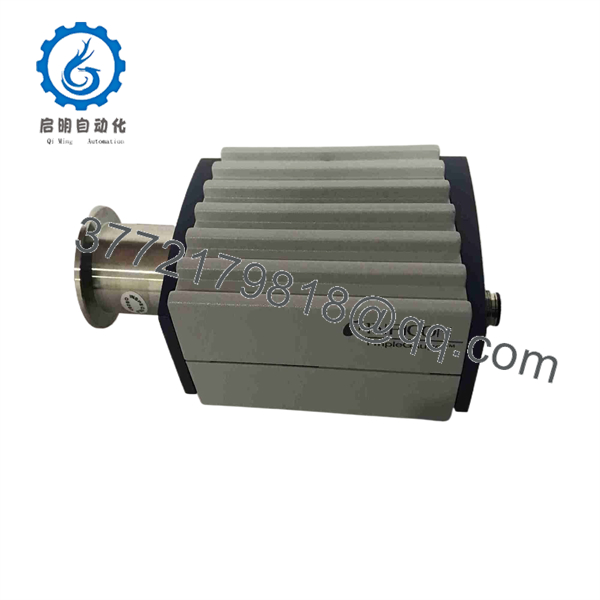
BCG450-SD 353-557
FAQ
1. What isON 353-557?
It is an INFICON TripleGauge with a DeviceNet interface and DN 25 ISO-KF vacuum connection.
2. What pressure range he measure?
The specified measurement range is 5 × 10⁻¹⁰ to 1500 mbar, equivalent to approximately 3.75 × 10⁻¹⁰ to 1125 Torr.
3. What is the difference between 353-557 and 353-558?
re DeviceNet gauges, but 353-557 uses a DN 25 ISO-KF connection, while 353-558 uses a DN 40 CF-R connection.
4. Does 353-557 support DeviceNet?
Yes. INFICON identifies as the DeviceNet version, and specifically lists part number 353-557 for the DN 25 ISO-KF configuration.
5. How many switching functions are integrated?
he provides two adjustable switching functions. Their relay contacts are available through the sensor cable connector.
6. Can -SP 353-554ce 353-557?
Not as a communication-interface replacement. 353-554 is the PROFIBUS version, whereas 353-557 is the DeviceNet version. The correct variant must match the fieldbus used by the vacuum-control system.
7. What should I verify before purchasing a used or surplus 353-557?
Verify the model, part number 353-557, DN 25 ISO-KF connection, DeviceNet functionality, sensor condition, vacuum calibration/measurement performance, switching outputs, and actual functional-test results. For semiconductor or other contamination-sensitive vacuum systems, also inspect the vacuum-exposed surfaces and flange hardware before installation.