WhatsApp: +86 16626708626
 Email:
  Phone: +86 16626708626
Description
Key Technical Specifications
| Parameter | Value |
|---|---|
| Model | 5517C |
| Brand | Keysight Technologies |
| Former Brand | Agilent / Hewlett-Packard |
| Product Type | Dual-frequency HeNe laser head |
| Nominal Wavelength | 632.991354 nm |
| Reference Frequency | 2.4–3.0 MHz |
| Standard Beam Diameter | 6 mm |
| Option 003 Beam | 3 mm |
| Option 009 Beam | 9 mm |
| Laser Type | Helium-Neon, continuous wave |
| Polarization | Linear |
| Operating Temperature | 0–40 °C |
| Warm-Up Time | Less than 10 minutes; approximately 5 minutes typical |
| Supply | +15 V ± 0.3 V / −15 V ± 0.3 V |
| Maximum +15 V Current | 2.2 A |
| Maximum −15 V Current | 0.02 A |
| Weight | Approximately 3.4 kg |
| Application | Laser interferometer positioning systems |
The published Keysight specification lists the 5517B/C/D family at approximately 3.4 kg, with +15 V ±0.3 V at 2.2 A maximum and −15 V ±0.3 V at 0.02 A maximum.
Product Introduction
The Keysight 5517C is a dual-frequency helium-neon laser head used as the optical reference in precision laser interferometer systems. It produces a nominal 633 nm optical wavelength and operates in the 2.4–3.0 MHz reference-frequency range. The standard configuration uses a 6 mm beam diameter.
The 5517C is used with compatible interferometer and measurement hardware rather than as a standalone distance-measurement instrument. Beam-size variants are important: 5517C Option 003 uses a 3 mm beam, while Option 009 uses a 9 mm beam. Verify the exact option suffix before replacing a laser head.
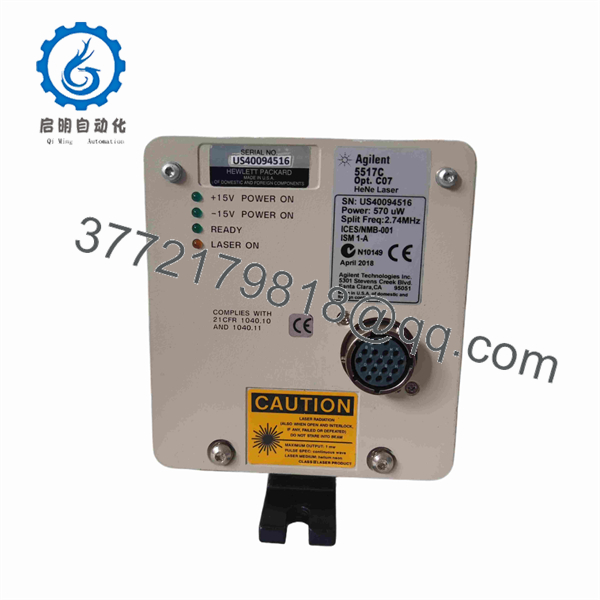
5517C
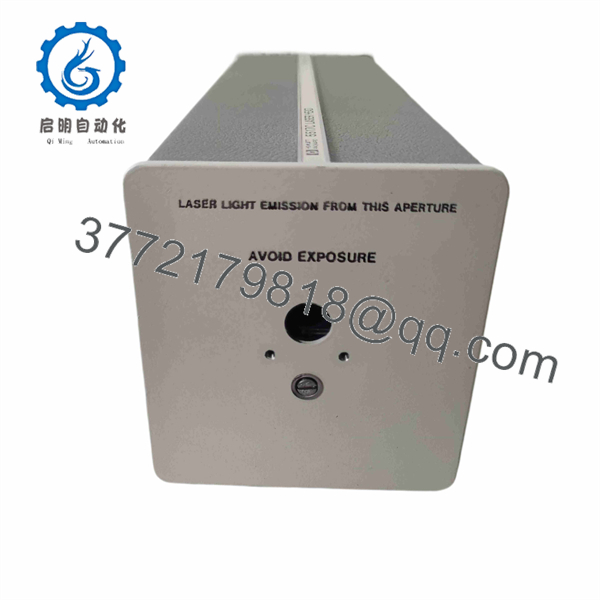
5517C
Installation & Configuration Guide
Stage 1: Pre-Installation Preparation — 5–10 Minutes
⚠️ Safety First: The 5517C is a Class 2 laser product under the applicable U.S. laser safety classification referenced by the manufacturer documentation. Follow the site’s laser-safety procedure and avoid direct or reflected beam exposure.
Tools Required:
- ESD protection
- Digital multimeter
- Appropriate mounting tools
- Optical alignment equipment as specified by the interferometer manufacturer
- Smartphone or camera for documenting cable and mounting orientation
Data Backup:
- Record the complete 5517C model and option number.
- Photograph the existing laser-head mounting position.
- Record the interferometer model.
- Record the existing beam-size option.
- Document power-supply connections.
- Record the existing optical alignment reference.
Stage 2: Removing the Old Laser Head — 5–10 Minutes
- Disable the laser system and remove power.
- Allow the laser head to reach a safe, non-operating state.
- Disconnect the power/interface cable.
- Protect the optical path from contamination.
- Release the mounting hardware.
- Remove the laser head without touching optical surfaces.
- Protect the removed unit for comparison and possible return.
⚠️ Do not use the laser head’s external appearance alone to identify its optical configuration. Check the model and option markings.
Stage 3: Installing the New Laser Head — 5–10 Minutes
- Verify the exact model: 5517C.
- Verify whether the original system uses standard 6 mm, Option 003, or Option 009 beam diameter.
- Inspect the optical aperture and connector.
- Install the laser head in the original mounting location.
- Secure the mechanical mounting without stressing the housing.
- Connect the correct power/interface cable.
- Confirm the supply voltage before energizing.
Self-Checklist:
- 5517C verified
- Beam-size option verified
- Interferometer compatibility checked
- Optical path clean
- Mount secure
- Cable secure
- Power supply verified
Stage 4: Power-On & Optical Testing — 10–20 Minutes
- Verify the power supply before switching on the laser.
- Apply power.
- Confirm the power indicators illuminate normally.
- Allow the laser head to stabilize.
- Verify the laser/ready status.
- Check the reference-frequency output with compatible diagnostic equipment.
- Confirm the interferometer detects the optical reference.
- Perform the manufacturer’s recommended optical alignment procedure.
- Verify measurement feedback at the controller.
- Record the final optical and electrical test results.
⚠️ Do not adjust the internal laser optics or frequency electronics as part of a routine replacement. If the output is abnormal, treat the head as a calibrated measurement component and follow the manufacturer’s service/calibration procedure.
Frequently Asked Questions (FAQ)
What is the Keysight 5517C?
The 5517C is a dual-frequency helium-neon laser head used in precision laser interferometer positioning systems. It provides the stable optical reference required for displacement measurement.
What wavelength does the 5517C use?
The published nominal vacuum wavelength for the 5517C/D generation is 632.991354 nm. This is the optical reference wavelength rather than simply a generic “633 nm” laser specification.
What is the 5517C reference frequency?
The 5517C has a 2.4–3.0 MHz reference-frequency range. The 5517A, 5517B, 5517C, and 5517D use different frequency ranges, so the models should not be treated as interchangeable based only on physical appearance.
What is the standard beam diameter?
The standard 5517C beam diameter is 6 mm. Keysight also documents Option 003 with a 3 mm beam and Option 009 with a 9 mm beam. Verify the option before ordering a replacement.
Is 5517C the same as an Agilent 5517C?
The model is associated with the Hewlett-Packard/Agilent/Keysight 5517 laser-head product lineage. Current Keysight documentation continues to identify the 5517C as part of the 5517 laser-head family.
What power does the 5517C require?
The published technical overview specifies +15 V ±0.3 V at up to 2.2 A and −15 V ±0.3 V at up to 0.02 A for the 5517B/C/D family. Use the compatible Keysight/Agilent power interface rather than applying an arbitrary ±15 V supply.
Can I replace a 5517C with a 5517B or 5517D?
Do not assume direct interchangeability. The models have different reference-frequency ranges: 5517B is 1.9–2.4 MHz, 5517C is 2.4–3.0 MHz, and 5517D is 3.4–4.0 MHz. The interferometer electronics and measurement architecture must be checked before substitution.
What should I verify before buying a used 5517C?
Verify:
- Exact model: 5517C
- Option suffix, if applicable
- 6 mm / 3 mm / 9 mm beam configuration
- Serial number and manufacturing information
- Laser output and READY status
- Reference-frequency output
- Warm-up behavior
- Optical condition
- Compatible interferometer
- Calibration/service history
- Physical condition and return terms
For precision metrology equipment, calibration and optical performance matter as much as the model number. Keysight provides current support and product-documentation resources for the 5517 family.