WhatsApp: +86 16626708626
 Email:
  Phone: +86 16626708626
Description
Key Technical Specifications
| Parameter | Value |
|---|---|
| Channels | 64 (differential FET multiplexer) |
| Resolution | 16-bit |
| Accuracy | 0.01% of reading |
| Full-Scale Input Range | 4 mV to 16 V (60 V with E1513A attenuator SCP) |
| Autoranging Gains | x1, x4, x16, x64, x256 |
| Scan Rate | Up to 100,000 channels/sec |
| Data Buffer | 64 kSa (65,024 readings) dual-ported FIFO |
| On-Line Monitoring | Current Value Table (CVT) RAM, per-channel |
| Data Format | IEEE 754, 32-bit floating point (Engineering Units or raw voltage) |
| Scan Lists | 4 lists, up to 1,024 channel assignments each, plus “List of Lists” |
| SCP Capacity | Up to 8 Signal Conditioning Plug-ons |
| Programming | SCPI and Compiled SCPI |
| Format | C-size, 1-slot, register-based VXI |
| Scan Trigger Jitter | ± 100 ps typical |
Product Introduction
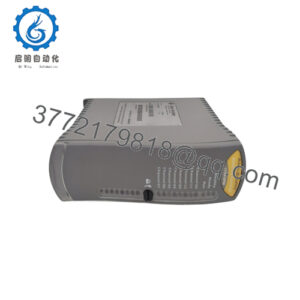
The E1413 (shipped as A, B, and C revisions) is a 64-channel scanning A/D converter built into a single-width, C-size VXI module. It runs 16-bit resolution at 0.01% reading accuracy across a 4 mV to 16 V input range, extendable to 60 V with the E1513A attenuator SCP, and scans up to 100,000 channels per second while autoranging on the fly.
The module’s dual-ported 64 kSa FIFO and Current Value Table separate high-speed block capture from real-time channel monitoring, so you’re not choosing between throughput and live visibility. With up to eight Signal Conditioning Plug-ons per module, it handles DC voltage, temperature, resistance, and strain in one chassis slot — which is why it kept showing up in mixed-signal data acquisition racks long after newer digitizers hit the market. Multiple units sync off a shared TTL trigger line for parallel scanning across mainframes.
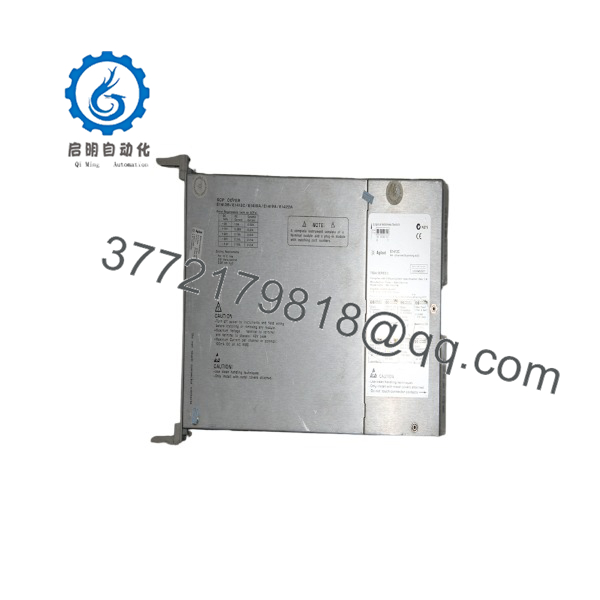
E1413C
Troubleshooting Quick Reference
| Symptom | Possible Cause | Relevance to this Part | Quick Check Method | Recommendation |
|---|---|---|---|---|
| Readings drift or fail self-calibration | On-board calibration source degraded | ✅ High | Run CAL:ZERO/CAL:GAIN command and compare to a known reference source | If cal fails repeatedly after warm-up, module likely needs replacement or repair |
| No signal from a specific channel block | SCP not seated or wrong SCP type for that block | ❌ Low | Reseat the SCP for that 8-channel block, verify SCP part number matches application | Usually an SCP issue, not the base A/D module |
| FIFO overflow / dropped samples | Scan rate exceeds host controller’s read-back speed | ❌ Low | Check host transfer rate against configured scan list rate | Reduce scan rate or optimize D32 block transfer on the controller side |
| All channels return zero or full-scale | VXI backplane communication fault | ✅ Medium | Verify module is recognized by Resource Manager (e.g., on an E1406A) | If module doesn’t enumerate, check backplane seating before replacing |
| Erratic readings only under load/vibration | VXI backplane connector oxidation | ❌ Low | Reseat module firmly, inspect P1/P2 connector pins | Common wear issue on older racks — often resolved without replacement |
| Trigger sync failure across multiple E1413 modules | TTL trigger wiring or timing mismatch | ✅ Medium | Confirm TTL trigger output from master module reaches all slaves | Check trigger bus wiring before assuming module fault |
If you’re still stuck after running these checks, send us photos of the SCP configuration and any error codes returned by your SCPI query so we can help narrow it down.
Frequently Asked Questions (FAQ)
Do I need Signal Conditioning Plug-ons (SCPs) to use this module?
For most real-world measurements, yes. The base E1413 gives you the A/D and multiplexer, but SCPs (E1501A through E1538A) add input protection, gain, and function-specific signal conditioning for things like temperature or strain. Running without SCPs limits you to basic direct voltage input.
Can I mix E1413A, B, and C revisions in the same mainframe?
Generally yes — they’re functionally similar and share the same SCPI command set. That said, verify firmware and driver compatibility with your specific controller (like an E1406A) before assuming a drop-in swap, especially on older E1413A units.
Is this module hot-swappable?
No. Pull power to the mainframe before installing or removing it. It’s a register-based module addressed by the Resource Manager at boot — yanking it live risks backplane errors for other modules sharing the bus.
Why is this cheaper than buying new from Keysight?
This is a discontinued product line — Keysight doesn’t manufacture new units anymore. What you’re getting is either pulled New Surplus stock (unused, tested or untested depending on listing) or a Refurbished unit that’s been through function and calibration testing. It’s genuine OEM hardware, just not currently in production.
Will my existing scan lists and calibration data carry over to a replacement module?
No. Scan list configuration and calibration constants live in the module you’re replacing. Document your scan list setup and SCP assignments before swapping, then reprogram or reload them on the new unit.
How do I know if the accuracy spec still holds on a used unit?
Ask for the test report from CAL:ZERO/CAL:GAIN verification against a known reference. To be honest, on a module this old, don’t take “tested” at face value — request the actual calibration data points, not just a pass/fail sticker.
Does this work with all the SCP modules listed for the E1413 family?
Yes, the E1413A/B/C interface with the full E1501A–E1538A SCP lineup. Verify your specific SCP part number against the application (voltage, temperature, resistance, strain) before ordering — mismatched SCP function for your measurement type is a common ordering mistake.