WhatsApp: +86 16626708626
 Email:
  Phone: +86 16626708626
Description
Key Technical Specifications
| Parameter | Value |
|---|---|
| Manufacturer | Kollmorgen |
| Full Model | AKD-N00307-DSEC-E000 |
| Product Family | AKD-N decentralized servo drives |
| Product Type | Decentralized EtherCAT servo drive |
| Current Class | AKD-N00307 |
| Continuous Output Current | 3 A |
| Peak Output Current | 9 A |
| Continuous Output Power Capacity | 2,000 W |
| DC Bus Supply Range | 320–680 V DC |
| Maximum DC Bus Voltage | 800 V DC |
| Standby Supply | 55 V DC supplied through the AKD-C system architecture |
| Primary Motion Network | EtherCAT |
| Motor Connection | Dual-cable motor connection |
| Motor Power Cable | Separate motor power cable required |
| Feedback Cable | Separate motor-feedback cable required |
| Safety Option | Local Safe Torque Off, STO |
| Functional Safety Rating | SIL 2 / Performance Level d, when installed in a compliant safety circuit |
| Digital Inputs | 3 |
| Digital Outputs | 1 |
| Feedback Interfaces | SFD, BiSS C, EnDat 2.1, EnDat 2.2, Hall, Comcoder, Hiperface, and Hiperface DSL |
| Ingress Protection | IP67 |
| UL Enclosure Classification | UL Type 4X |
| Vibration Class | 3M5 |
| Dimensions | 75 × 130 × 201 mm |
| Mounting Location | Machine-mounted near the motor, outside the primary control cabinet |
| AKD-C Compatibility | Requires AKD-C centralized smart power supply architecture |
| System Capacity | One AKD-C supports up to 16 AKD-N drives across two strings of up to eight drives each |
| AKD-C to First Drive Cable | CCNCN1 hybrid cable, 40 m maximum |
| Drive-to-Drive Cable | CCNNN1 hybrid cable, 25 m maximum |
| Drive-to-Motor Cable Length | 5 m maximum |
| Temperature Range | 0 to +40 °C at nominal conditions; derate 4% per °C above +40 °C; +55 °C maximum |
| Humidity | 5–95% RH, non-condensing |
| Altitude | Full rating to 1,000 m; derate 1.5% per 100 m above 1,000 m; 2,000 m maximum |
| Configuration Software | Kollmorgen WorkBench |
| Lifecycle Note | Verify motor cable type, feedback protocol, local STO wiring, AKD-C firmware, and EtherCAT configuration before ordering |
The AKD-N00307-DSEC-E000 is a 3 A continuous, 9 A peak AKD-N decentralized servo drive with 320–680 V DC input, EtherCAT communications, dual-cable motor/feedback connections, and local STO. Kollmorgen specifies the -DS configuration as dual-cable connection with local Safe Torque Off.
Product Introduction
The Kollmorgen AKD-N00307-DSEC-E000 is a machine-mounted decentralized servo drive for one EtherCAT motion axis. It installs near the motor rather than inside the electrical cabinet, using the AKD-C centralized power supply system for DC bus power, communications, standby power, and system-level architecture. The drive provides 3 A continuous current and 9 A peak current for servo applications up to 2,000 W continuous output capacity.
The DSEC option is important: it specifies a dual-cable motor connection with local Safe Torque Off capability. Use it where each axis needs individually controlled torque removal through a safety relay or safety controller. Confirm the installed motor feedback type, power cable, feedback cable, EtherCAT node configuration, AKD-C string position, heat-sinking method, and local STO circuit before installing a replacement.
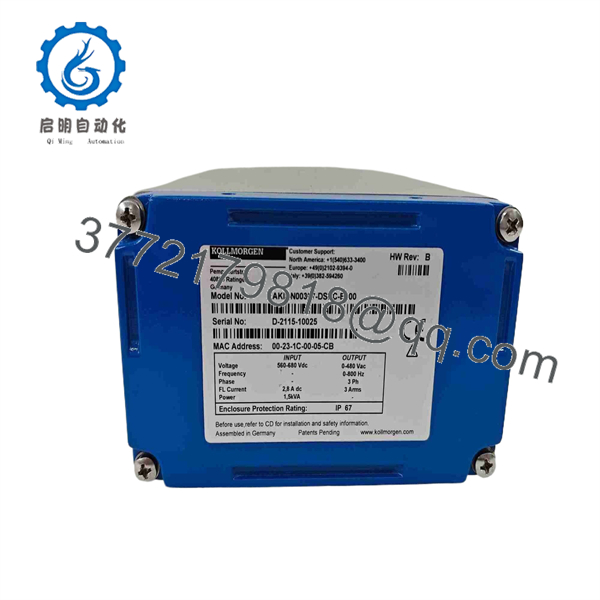
AKD-N00307-DSEC-E000
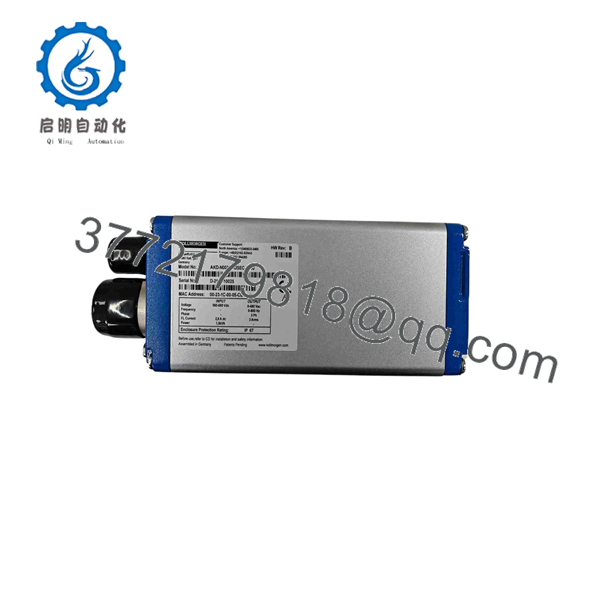
AKD-N00307-DSEC-E000
Troubleshooting Quick Reference
| Symptom | Possible Cause | Relevance to this Part | Quick Check Method | Recommendation |
|---|---|---|---|---|
| No drive status indication | Missing DC bus supply, absent 24 V control supply, damaged hybrid cable, failed AKD-C string output | ⚠️ Medium | Check AKD-C health first; measure the applicable control supply and inspect the CCNCN1/CCNNN1 hybrid cable and connectors | Verify system power and cable integrity before replacing the AKD-N drive |
| Drive powers up but motor will not enable | Local STO active, hardware enable absent, software enable missing, motor fault active | ⚠️ Medium | Measure local STO input at X6; verify STO enable is at +24 V DC for torque release; check drive status and controller enable command | Restore the safety circuit and enable sequence. Do not bypass STO to test a production machine |
| Local STO status remains active | STO input wiring open, safety relay output missing, failed safety circuit, local STO configuration issue | ⚠️ Medium | Check local STO enable wiring and safety-relay outputs; verify the STO status signal and compare with the safety-controller state | Diagnose the external safety circuit first. The drive is correctly inhibiting torque if STO is commanded active |
| Motor jerks or immediately faults at enable | Incorrect motor parameters, wrong feedback type, phase wiring error, encoder connection issue, mechanical binding | ⚠️ Medium | Check the motor/feedback cable part numbers; review motor data and feedback selection in WorkBench; inspect mechanical load | Confirm motor and feedback configuration before replacing the servo drive |
| Following error occurs during motion | Encoder signal loss, motor overload, poor tuning, mechanical obstruction, feedback cable failure | ⚠️ Medium | Review the drive fault code; inspect feedback connector; monitor actual versus commanded position in WorkBench | Check the motor, feedback cable, coupling, and load first. A following error does not prove the drive is defective |
| EtherCAT node is missing | Broken EtherCAT path, incorrect topology, drive not powered, duplicate node configuration, controller configuration mismatch | ⚠️ Medium | Check EtherCAT link LEDs, cable continuity, controller scan results, and physical drive order in the string | Verify network topology and power before replacing the unit |
| EtherCAT communication works but axis reports drive fault | DC bus undervoltage, overtemperature, feedback issue, STO active, overload, internal hardware alarm | ✅ High | Read the exact fault code through Kollmorgen WorkBench or the EtherCAT master; record fault history before reset | Use the fault code, not guesswork. Correct the reported root cause before commissioning |
| Drive overheats after an hour of operation | Inadequate heat sink, poor thermal interface, high continuous torque, ambient temperature too high | ⚠️ Medium | Query drv.temperature in WorkBench; inspect mounting surface and thermal film; measure local ambient temperature |
Keep internal control-card and power-stage temperatures below 85 °C in normal operation. Warning occurs at 90 °C and shutdown at 95 °C |
| Drive trips only at high load | Motor sizing issue, insufficient cooling, excessive acceleration, DC bus instability, mechanical drag | ⚠️ Medium | Trend current, bus voltage, and temperature during the fault; compare duty cycle with continuous-current rating | Reduce acceleration or duty cycle, improve cooling, and inspect the mechanics before replacing the drive |
| Replacement drive communicates but motor feedback is invalid | Wrong feedback protocol, incorrect feedback cable, incompatible motor, parameter file not restored | ✅ High | Compare old drive parameter file, encoder type, feedback connector, and motor nameplate; verify feedback in WorkBench | Restore the approved configuration. Do not guess encoder settings |
| Drive shows no local I/O response | Incorrect I/O wiring, missing 24 V input common, configuration mismatch | ⚠️ Medium | Measure input signal at the drive I/O connector and check I/O status in WorkBench | Verify I/O reference and configuration. The drive provides three digital inputs and one digital output |
| Motor brake does not release | Brake supply capacity exceeded, incorrect brake wiring, missing command, AKD-C standby supply limitation | ⚠️ Medium | Measure brake voltage at the motor during enable; calculate total brake current on the AKD-C 24 V supply | Verify system brake-current budget. The AKD-C supply limits depend on the number of AKD-N axes and brake loads |
| Drive is replaced but safety validation fails | Local STO wiring differs, incorrect safety relay connection, wrong DSEC option, unverified functional test | ✅ High | Compare X6 STO wiring, safety relay outputs, and STO status behavior against the approved safety drawing | Perform the required machine safety validation before returning to service |
| Drive has intermittent faults after washdown or cleaning | Damaged connector seal, improperly tightened connector, cable jacket damage, moisture ingress | ⚠️ Medium | Inspect connector O-rings, mating faces, cable glands, and housing for damage; check for moisture before energizing | Maintain the IP67 seal. Do not assume IP67 protection survives damaged or incorrectly mated connectors |
| Unit does not fit or uses the wrong cable set | Incorrect single-cable versus dual-cable variant, wrong connector series, incorrect mounting hardware | ✅ High | Confirm the full DSEC code, motor cable and feedback cable arrangement, and physical connector layout |
The DSEC version requires separate motor-power and feedback cables. Do not substitute a single-cable AKD-N variant without a design review |
❗ DC-bus warning: This drive uses a high-voltage DC bus. The specified input range is 320–680 V DC, with maximum system voltage up to 800 V DC. Isolate and verify discharge according to the AKD-C/AKD-N service procedure before handling connectors or replacing the drive.
❗ STO warning: Local STO removes torque; it does not necessarily stop a moving load immediately. For vertical axes, suspended loads, high-inertia mechanisms, or external energy sources, provide a controlled stop, brake control, and risk-assessed mechanical safety design.
❗ Thermal warning: Machine mounting is part of the electrical design. For AKD-N 3 A drives operating at full capacity on a 480 V system and 40 °C ambient temperature, Kollmorgen’s project guide specifies a 240 × 240 × 10 mm aluminum cooling surface as the baseline for continuous operation. Mounting on a random painted bracket is not the same thing.
❗ Cable warning: Do not modify hybrid, motor, feedback, or connector assemblies. Kollmorgen specifies cable types and maximum lengths for the AKD-C/AKD-N system; unauthorized cable changes can affect DC bus voltage drop, EtherCAT behavior, STO performance, EMC, and IP67 sealing.
If troubleshooting remains unresolved, provide technical support with photos of the full drive label, AKD-C model, hybrid and motor/feedback cable labels, EtherCAT topology, local STO wiring, motor nameplate, WorkBench fault history, drv.temperature values, DC bus status, and the complete parameter backup.
Frequently Asked Questions
What does the Kollmorgen AKD-N00307-DSEC-E000 do?
It controls one servo axis in a Kollmorgen decentralized AKD-N motion system. The drive receives DC bus power and EtherCAT communications through the AKD-C/AKD-N system, then controls a nearby motor using separate motor-power and feedback cables. It is rated for 3 A continuous output and 9 A peak output.
What does DSEC mean in the part number?
DS identifies the dual-cable motor connection with local Safe Torque Off. The EC portion identifies EtherCAT communications. This model therefore uses separate motor-power and feedback connections, supports EtherCAT, and includes local STO for individual-axis torque removal.
Can I use this drive without an AKD-C power supply?
No. The AKD-N is designed as part of the AKD-C/AKD-N decentralized system. The AKD-C supplies the system DC bus and manages the system architecture. Verify the AKD-C model, string topology, DC bus capacity, standby power, brake-current budget, and compatible firmware before replacing an AKD-N drive.
How many AKD-N drives can one AKD-C support?
An AKD-C supports up to 16 AKD-N drives across two strings, with up to eight drives on each string. The actual usable quantity depends on total power demand, duty cycle, regenerative load, DC bus design, brake requirements, cable lengths, and the selected AKD-C capacity.
Can I use a single-cable motor with the DSEC model?
No, not as a standard installation. The DSEC is a dual-cable version that requires separate motor-power and feedback cables. Single-cable motor applications use other AKD-N variants and a different connector/cable arrangement. Do not improvise an adapter unless Kollmorgen documentation specifically supports the exact motor, drive, and cable combination.
Can I hot-swap the AKD-N00307-DSEC-E000?
No. Do not disconnect a high-voltage decentralized servo drive while energized. Shut down the machine through the approved maintenance procedure, isolate mains and DC bus energy, verify discharge, secure the load, remove the STO enable as required, and use ESD precautions. A live drive replacement can damage connectors, the DC bus, the AKD-C, or the replacement drive.
Does local STO make the axis safe to service?
Local STO prevents the drive from producing motor torque when properly implemented in a validated safety circuit. It does not remove high-voltage DC bus energy, prevent externally driven motion, secure a vertical load, or substitute for lockout/tagout. Use a complete machine-specific safe-work procedure.
What should I back up before replacing the drive?
Back up the WorkBench parameter file, motor model and nameplate data, feedback type, EtherCAT configuration, node topology, axis scaling, limits, motion tuning, digital I/O assignments, local STO wiring, fault history, AKD-C firmware version, and installed cable part numbers. Take photos of every connector and the machine-side heat-sink mounting before removal.
Why does the replacement drive fault with “feedback” or “commutation” errors?
The usual causes are a wrong feedback protocol, incorrect motor parameters, damaged or mismatched feedback cable, loose connector, incompatible motor, or a missing parameter restore. Verify SFD, BiSS C, EnDat, Hall, Comcoder, Hiperface, or Hiperface DSL selection against the motor documentation before declaring the replacement defective.
What condition should I request for a production-critical spare?
Request New Original / New Surplus with full Kollmorgen label photos, full model number, connector condition, firmware information if available, and original protective packaging. For Refurbished (tested) stock, require a documented test covering DC bus power-up, EtherCAT communication, motor feedback, 3 A continuous operation, 9 A peak-current response where safely testable, local STO validation, digital I/O, thermal behavior, and sustained runtime. Request actual stock confirmation, lead time, warranty, return terms, and test evidence before purchase.