WhatsApp: +86 16626708626
 Email:
  Phone: +86 16626708626
Description
Key Technical Specifications
| Parameter | Value |
|---|---|
| Model | E33NCHA-LNN-NS-00 |
| Manufacturer / Brand | Pacific Scientific / Kollmorgen |
| Product Series | E-Series |
| Motor Type | Hybrid step motor |
| Frame Size | NEMA 34 |
| Frame Face Size | Approximately 86 × 86 mm / 3.38 in |
| Step Angle | 1.8° |
| Winding | 4-lead parallel winding |
| Rotor Stack | 3-stack configuration |
| Mounting | NEMA mounting configuration |
| Shaft Configuration | Single / smooth shaft configuration |
| Power Reference | 35 V, 168 W reported in a 2024 trade record |
| Application Reference | Industrial machinery; cigarette-manufacturing equipment |
The E-Series listing specifically identifies the E33NCHA-LNN-NS-00 as a hybrid step motor with a NEMA 34 frame and 4-lead parallel winding. A 2024 trade record identifies a shipment of this exact model as a stepper motor with a 35 V supply and 168 W capacity.
Important specification note: Public third-party listings disagree on several electrical values, including voltage, current, torque, and dimensions. For example, one listing gives 24 V DC, 3 A, and 6.64 N·m, while another reports 35 V and 168 W. These values should not be treated as interchangeable specifications for the exact winding configuration. Verify the motor nameplate and the applicable Pacific Scientific/Kollmorgen motor data before selecting or commissioning a drive.
Product Introduction
The Pacific Scientific E33NCHA-LNN-NS-00 is an E-Series hybrid step motor using a NEMA 34 mounting configuration. The published E-Series information identifies a 4-lead parallel winding, three rotor stacks, and a single/smooth shaft configuration.
For replacement work, the critical point is matching the motor’s winding and electrical characteristics to the existing stepper drive. The NEMA 34 mechanical interface alone does not establish electrical compatibility. Confirm phase current, winding inductance, voltage limits, connector/lead arrangement, and required torque before installation.
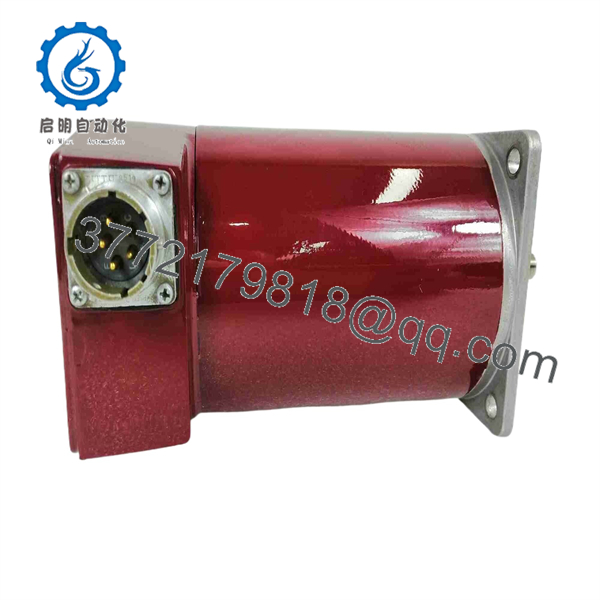
E33NCHA-LNN-NS-00
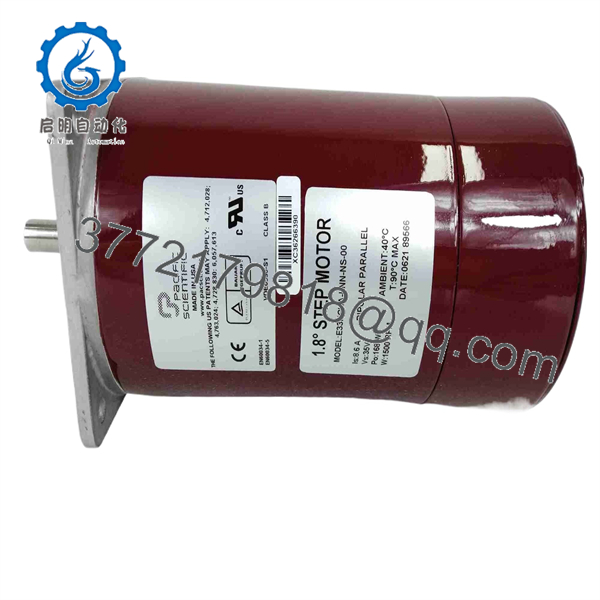
E33NCHA-LNN-NS-00
Installation & Configuration Guide
Stage 1: Pre-Installation Preparation — 5–10 minutes
⚠️ Safety First: Stop the machine through the approved operating procedure. Isolate the motor drive from its power source and apply lockout/tagout before disconnecting motor wiring. Do not rely on the drive’s enable input as the only isolation method.
Tools Required:
- ESD protection where the drive electronics are exposed
- Insulated screwdriver set
- Multimeter
- Wire labels
- Camera or smartphone
- Appropriate mechanical torque tools
- Motor wiring diagram and drive manual
Before removing the existing motor:
- Record the exact motor model and suffix.
- Photograph the motor nameplate.
- Photograph the motor connector or terminal wiring.
- Record the existing drive model and configured motor parameters.
- Record phase-current, microstepping, acceleration, and current-limit settings.
- Mark each motor lead before disconnecting it.
- Record the mechanical mounting orientation and shaft coupling position.
⚠️ Do not assume that another NEMA 34 motor is electrically interchangeable. NEMA 34 primarily describes the mechanical frame size; winding characteristics still have to match the drive.
Stage 2: Removing the Existing Motor — 5–10 minutes
- Confirm that the drive is isolated and the DC bus has discharged according to the drive manufacturer’s procedure.
- Remove the motor-side connector or terminal wiring.
- Keep the phase wires identified; do not rely on wire color alone.
- Release the mechanical coupling, belt, or gearbox connection.
- Support the motor before removing the mounting bolts.
- Remove the motor without loading or bending the shaft.
- Inspect the coupling, keyway, mounting plate, and shaft for wear.
⚠️ Keep the original motor until commissioning is complete. It provides a physical and electrical reference if the replacement does not behave as expected.
Stage 3: Installing the E33NCHA-LNN-NS-00 — 10–15 minutes
- Verify that the replacement marking reads E33NCHA-LNN-NS-00.
- Confirm the NEMA 34 mounting pattern against the machine mounting plate.
- Check shaft diameter, shaft length, keyway requirements, and coupling fit before applying mechanical load.
- Confirm the motor winding configuration from the applicable documentation.
- Do not connect the motor to the drive until phase-current and winding compatibility have been verified.
- Connect the four motor leads according to the correct phase/winding diagram.
- Tighten mounting hardware to the machine manufacturer’s specified torque.
- Reinstall the coupling without forcing the motor shaft laterally.
- Check that the shaft rotates freely where the machine design permits manual rotation.
- Route motor cables separately from sensitive encoder, analog, or low-level signal wiring where applicable.
Self-Checklist:
- Exact model verified
- Nameplate photographed
- Winding configuration verified
- Drive current setting checked
- Phase wiring verified
- Mounting bolts secured
- Coupling aligned
- Cable routing checked
Stage 4: Power-On & Commissioning — 10–20 minutes
- Keep the machine mechanically safe and prevent an unexpected production cycle.
- Power the drive and verify that no motor fault is reported.
- Check the configured motor-current value against the motor documentation.
- Jog the axis at low speed.
- Confirm the commanded direction.
- Check for abnormal vibration, resonance, excessive heating, or missed steps.
- Test acceleration and deceleration at reduced values before returning to production settings.
- Verify the full travel range at low speed.
- Restore the normal motion profile only after the axis behaves correctly.
⚠️ If the motor vibrates but does not rotate, immediately stop the test. Incorrect phase pairing is one of the first things to check.
⚠️ If the motor overheats rapidly, stop operation and verify current settings, winding configuration, duty cycle, and mechanical loading. Do not solve excessive heating simply by increasing cooling without determining the electrical cause.
Frequently Asked Questions (FAQ)
Can I replace another NEMA 34 stepper motor directly with E33NCHA-LNN-NS-00?
Not based on frame size alone. The uses a NEMA 34 mechanical configuration, but the drive must also match the motor’s winding and electrical characteristics. Verify phase current, inductance, voltage limits, and winding connection before replacement.
Is a servo motor or a stepper motor?
It is a hybrid step motor, not a conventional AC servo motor. Current product references place it in the Pacific Scientific E-Series stepper-motor family.
How many motor leads does this model use?
The published E-Series information identifies the with a 4-lead parallel winding configuration. Do not substitute a different winding arrangement without confirming the drive requirements.
What does NEMA 34 tell me about this motor?
NEMA 34 identifies the mechanical frame/mounting class. The published E-Series reference gives the frame as approximately 3.38 inches in diameter, while other listings describe the faceplate as approximately 86 × 86 mm. It does not, by itself, tell you the correct drive current or motor torque.
Is the motor specification 24 V or 35 V?
This requires careful verification. A third-party listing reports 24 V DC and 3 A, while a 2024 trade record identifies this exact model with a 35 V supply and 168 W capacity. Because these sources conflict, I would not use either value as the commissioning setpoint without checking the actual motor nameplate and applicable manufacturer documentation.
Does include an encoder?
The available product documentation I found does not establish an integrated encoder as part of this exact -LNN-NS-00 configuration. Treat it as an open-loop stepper configuration unless the physical unit or OEM documentation confirms otherwise. One current product listing likewise describes the standard configuration as typically open-loop.
Is this model still available as new original stock?
Current industrial-parts suppliers list the exact model, but public listings do not provide enough evidence to establish a universal OEM production or inventory status. One 2024 trade record documents the model as a new shipment, while current suppliers advertise new stock. For procurement, verify the actual serial number, manufacturing condition, packaging, and test evidence of the specific unit being quoted.