WhatsApp: +86 16626708626
 Email:
 Phone: +86 16626708626
Description
Core Product Summary
The Kollmorgen S20360-SRS is a digital brushless servo drive from the S200 series, configured with the SynqNet option card fitted with standard RJ-45 connectors. It regulates phase current to a brushless servomotor so that a SynqNet motion controller can execute torque, velocity, and position commands on a single axis. The model designation identifies a 3 ARMS continuous current rating and a 120/240 VAC, single- or three-phase supply input, with a peak output current of 9 ARMS.
In three-phase 240 VAC service the drive delivers up to 1100 W continuous output power, or up to 450 W from a 120 VAC single-phase supply. Feedback support covers SFD/Halls on every unit, plus sine encoder and EnDat 2.1 signals through the SynqNet option card. Integration requires a SynqNet motion controller and the S200 Tools software; setup is performed through an RS-232 serial port. The drive mounts on a panel or bracket using the specified mounting dimensions and connects via plug-in screw terminals for power and I/O, an RJ-45 SynqNet port, a 15-pin D-Sub for discrete I/O, and a serial connector.
Key Technical Specifications
| Parameter | Value |
|---|---|
| Product family / type | S200 series digital brushless servo drive, single-axis, SynqNet option card with RJ-45 connectors |
| Supply input | 120/240 VAC, single-phase or three-phase |
| Continuous output current (convection) | 4.5 ARMS at 0–30 °C; 3.0 ARMS at 40 °C; 2.0 ARMS at 50 °C |
| Peak output current | 9 ARMS (0–50 °C ambient), minimum 3.0 s from 0 ARMS |
| Continuous output power | 1100 W (240 VAC, 3-phase); 900 W (240 VAC, 1-phase); 450 W (120 VAC, 1-phase) |
| Peak output power (1 s) | 3000 VA (240 VAC, 3-phase); 2600 VA (240 VAC, 1-phase); 1300 VA (120 VAC, 1-phase) |
| Continuous motor shaft power at 3000 rpm | 750 W (240 VAC 3-phase, 0–30 °C); 500 W at 40 °C |
| Line current at continuous output | 5.0 ARMS (240 VAC 3-phase); 6.5 ARMS (240 VAC 1-phase); 6.5 ARMS (120 VAC 1-phase) |
| Feedback support | SFD/Halls (all units); sine encoder and EnDat 2.1 via SynqNet option card |
| Shunt regulator | External regen resistor 25–50 Ω; 15.5 J bus capacitance energy absorption |
| Power stage dissipation | 15 W at continuous current, 40 °C |
| Network interface | SynqNet motion network via RJ-45 connectors |
| Dimensions | 175 mm (H) × 54.8 mm (W) × 131.6 mm (D) |
| Weight | 0.84 kg |
| Certifications | UL certificate of compliance; EU Declaration of Conformity (Low Voltage 2014/35/EU and EMC 2014/30/EU), covering S20360 drives with -SRS suffix |
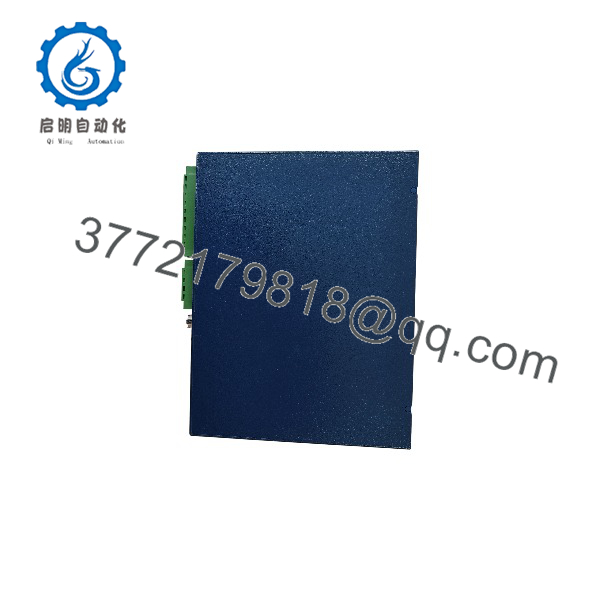
S20360-SRS
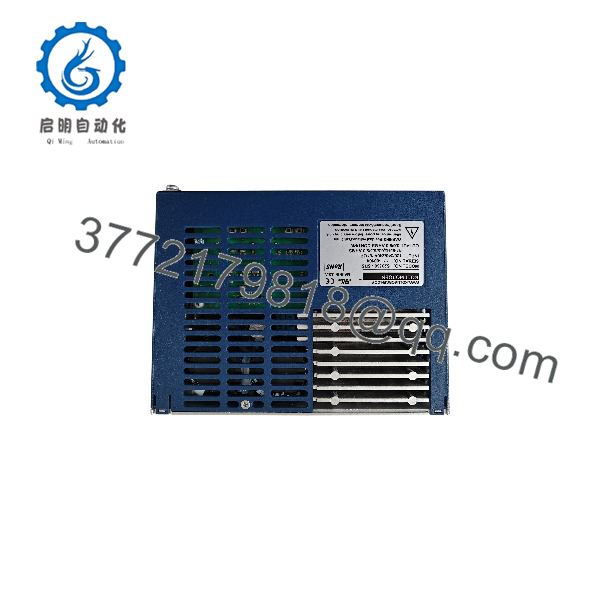
S20360-SRS
Engineering Selection Highlights
- SynqNet option card with RJ-45 connectors — the -SRS suffix defines the network interface; the drive is intended for axes commanded from a SynqNet motion controller rather than an analog velocity/torque source, so confirm the controller side before ordering.
- 9 ARMS peak current with 3.0 s minimum peak time from zero — supports short high-torque acceleration and deceleration bursts; verify that the motor’s peak rating and the duty profile fit within this envelope.
- Continuous current is ambient dependent — the usable continuous current falls from 4.5 ARMS (0–30 °C) to 3.0 ARMS at 40 °C and 2.0 ARMS at 50 °C, so cabinet temperature directly determines the continuous torque available.
- Supply flexibility with matching power output — the same unit runs on 120 VAC single-phase (450 W), 240 VAC single-phase (900 W), or 240 VAC three-phase (1100 W); the supply choice materially changes the continuous shaft power, not just the input rating.
- Regeneration requirements — the S20360 requires an external regeneration resistor between 25 and 50 Ω sized to the application’s regenerative energy; omitting or mis-sizing this resistor affects deceleration performance.
- Feedback device scope — SFD/Halls are supported on all units; sine encoder and EnDat 2.1 feedback require the SynqNet option card, which this model includes. Axes using SFD/Comcoder feedback through the CAN option card need a different S200 configuration.
- Commissioning dependency — setup and tuning use S200 Tools software over the RS-232 serial port, and SynqNet operation requires the matching SynqNet controller environment and MDK tooling.
System Compatibility & Integration Requirements
| Item / Dependency | Verified Compatibility or Requirement | Practical Note |
|---|---|---|
| Motion network | SynqNet option card with standard RJ-45 connectors | A SynqNet-capable motion controller and SynqNet cable with RJ-45 connections are required for network operation |
| Commissioning software | S200 Tools, installed on a PC | Drive configuration, motor feedback setup, and loop tuning are performed in S200 Tools |
| SynqNet development environment | MDK with SynqNet controller installation | Required to configure the drive as a SynqNet node |
| Serial service port | RS-232 serial port connector | Used for S200 Tools communication during setup |
| Feedback devices | SFD/Halls on all units; sine encoder and EnDat 2.1 via the SynqNet option card | Match the drive configuration to the motor’s feedback type |
| Supply input | 120/240 VAC, single- or three-phase | Continuous output power depends on the supply configuration used |
| Regeneration | External regen resistor, 25–50 Ω | Required for dissipating regenerative bus energy during deceleration |
| Discrete I/O | 15-pin D-Sub connector for discrete I/O | Interface for drive-level digital I/O functions |
| Power and control terminals | Plug-in detachable screw terminals | Power and I/O wiring is made through detachable screw-terminal connectors |
Dimensions, Mounting & Connection Notes
| Item | Data |
|---|---|
| Height × Width × Depth | 175 mm × 54.8 mm × 131.6 mm |
| Weight | 0.84 kg |
| Mounting | Panel mounting per the S200 mechanical outline drawings; SynqNet AC drives share the S20260/S20360/S20660 outline |
| Power and I/O wiring | Plug-in detachable screw terminals |
| SynqNet network connection | RJ-45 connectors on the SynqNet option card |
| Discrete I/O connection | 15-pin D-Sub connector |
| Serial connection | RS-232 serial port connector |
| Feedback connection | Feedback connector supporting SFD/Halls, sine encoder, and EnDat 2.1 signals |
| Regen resistor | External resistor, 25–50 Ω, connected per the wiring diagram |
| Operating ambient | Continuous current ratings are specified from 0 to 50 °C with derating above 30 °C |
Detailed wiring diagrams, connector pinouts, resistor characteristics, and fusing requirements are contained in the S200 Base and SynqNet Units Reference Manual; follow that document for the exact AC input wiring of S20360 SynqNet drives.
Detailed Product Overview
The Kollmorgen S20360-SRS belongs to the S200 family of compact digital servo drives for brushless motors. Within that family, the order code carries precise meaning: the “03” designates the 3 ARMS continuous current frame, the “6” designates the 120/240 VAC supply input, and the “-SRS” suffix specifies the SynqNet option card with standard RJ-45 connectors, together with “S” feedback support for SFD/Halls. Reading the code correctly matters in procurement: an S20360-VTS, for example, is the same power stage but an analog velocity/torque base drive, while an S20360-SDS uses a SynqNet card with micro-D connectors instead of RJ-45. The three variants are not interchangeable at the network cabling level.
Electrically, the drive is specified for 120/240 VAC operation on single- or three-phase supply, and the supply configuration determines the power ceiling rather than merely the input rating. At 240 VAC three-phase the continuous output power is 1100 W with 750 W of continuous motor shaft power at 3000 rpm (0–30 °C ambient); at 120 VAC single-phase this falls to 450 W. The 9 ARMS peak current is available for a minimum of 3 seconds from a standing start, which covers typical acceleration and deceleration bursts on light-to-medium inertia axes. Because the continuous current rating steps down from 4.5 ARMS at 0–30 °C to 2.0 ARMS at 50 °C, thermal planning of the enclosure is part of axis sizing, not an afterthought.
On the feedback side, every S200 unit supports Kollmorgen Smart Feedback Device (SFD) and Hall signals. The SynqNet option card fitted to this model extends feedback handling to sine encoders and EnDat 2.1 devices, so the drive can be matched to motors with high-resolution position feedback without an external interface. Feedback configuration is performed in the S200 Tools software over the RS-232 serial port; SynqNet node configuration additionally requires the MDK environment with the SynqNet controller installed. Engineers planning a retrofit should budget for both the software environment and the SynqNet cabling, which uses standard RJ-45 connections.
Integration details worth confirming at design time include the external regeneration resistor, which must be between 25 and 50 Ω for this frame, and the drive’s connection set: plug-in detachable screw terminals for power and control wiring, a 15-pin D-Sub for discrete I/O, and dedicated SynqNet and serial connectors. The unit measures 175 × 54.8 × 131.6 mm and weighs 0.84 kg, allowing several drives to be packed closely in a multi-axis cabinet, subject to the thermal derating noted above.
Compliance documentation for this exact model configuration exists in the form of a UL certificate of compliance and an EU Declaration of Conformity covering the Low Voltage and EMC Directives for S20360 drives with the -SRS suffix. For a machine builder shipping into markets that require these directives, the drive’s documentation set is therefore directly traceable to the exact order code — a detail that simplifies declaration work compared with loosely specified “S200-compatible” substitutes.
Applications & System Role
Within a machine architecture, the S20360-SRS sits between the mains supply and one brushless servomotor, converting motion commands received over the SynqNet network into precisely regulated phase currents. It is a networked axis amplifier: the motion controller handles trajectory and coordination, while the drive closes its current, velocity, and position loops around the motor and feedback device.
Typical fit scenarios follow directly from its verified capability profile:
- Single axes that must accelerate quickly and then hold continuous torque, supported by the 9 ARMS peak / 3 ARMS continuous rating and the 3-second minimum peak current time.
- Machines built around a SynqNet motion network, where multiple S200 drives coordinate axes over daisy-chained RJ-45 cabling from one controller.
- Axes equipped with high-resolution motor feedback, since the SynqNet option card adds sine encoder and EnDat 2.1 support to the base SFD/Halls capability.
- Equipment with mixed supply availability, since the drive operates on 120 VAC or 240 VAC, single- or three-phase — useful where a machine’s control cabinet supply dictates the axis power budget.
The drive’s protective and operational boundaries — supply configuration, ambient-based current derating, and regen resistor sizing — are the main engineering constraints to respect when matching it to an axis.
FAQ
What is the Kollmorgen S20360-SRS?
It is a single-axis digital servo drive from the Kollmorgen S200 series, built on the 3 ARMS continuous / 120–240 VAC power stage and fitted with the SynqNet option card using standard RJ-45 connectors.
What does the -SRS suffix mean?
-SRS designates the SynqNet option card with standard RJ connectors. It distinguishes this model from the -VTS analog velocity/torque base drive and the -SDS SynqNet variant with micro-D connectors.
What are the current and power ratings?
The drive supplies 4.5 ARMS continuous at 0–30 °C ambient (3.0 ARMS at 40 °C, 2.0 ARMS at 50 °C) and 9 ARMS peak for at least 3 seconds from zero. Continuous output power is 1100 W at 240 VAC three-phase, 900 W at 240 VAC single-phase, and 450 W at 120 VAC single-phase.
Which feedback devices does it support?
SFD/Halls feedback is supported on all units, and the SynqNet option card on this model adds sine encoder and EnDat 2.1 feedback support.
Which controller and software are required?
Network operation requires a SynqNet motion controller; drive setup, motor feedback configuration, and tuning are done in S200 Tools over the RS-232 serial port, with SynqNet node configuration performed through the MDK environment.
What regeneration hardware does it need?
The S20360 frame requires an external regeneration resistor between 25 and 50 Ω, selected per the reference manual’s wiring and resistor-characteristic guidance.
How is the drive wired and mounted?
Power and control wiring use plug-in detachable screw terminals, discrete I/O uses a 15-pin D-Sub, and the SynqNet network connects through RJ-45 connectors. The drive measures 175 × 54.8 × 131.6 mm, weighs 0.84 kg, and mounts per the S200 mechanical outline drawings.
Which approvals apply to this model?
A UL certificate of compliance and an EU Declaration of Conformity (Low Voltage Directive 2014/35/EU and EMC Directive 2014/30/EU) cover S20360 drives with the -SRS suffix.