WhatsApp: +86 16626708626
 Email:
 Phone: +86 16626708626
Description
Core Product Summary
The Kollmorgen S22460-SRS is the largest AC member of the S200 series of digital brushless servo drives, fitted with the SynqNet option card that uses standard RJ-45 connectors. It is the high-current frame of the family: the order code identifies a 24 ARMS continuous / 48 ARMS peak power stage operating from a 240 VAC three-phase supply, commanding one brushless servomotor axis over the SynqNet motion network.
Continuous output power is 8000 W, with up to 16000 VA available for one-second bursts, and continuous motor shaft power of 5000 W at 3000 rpm (0–30 °C ambient). Feedback support covers SFD/Halls on every unit, while the SynqNet option card adds sine encoder and EnDat 2.1 feedback handling. The drive requires an external regeneration resistor of 8–50 Ω, a SynqNet motion controller, and the S200 Tools software for commissioning over the RS-232 serial port. It is intended for axes whose torque and power demand exceeds the smaller S200 frames, and unlike the low-power S200 models it is specified for three-phase 240 VAC supply only.
Key Technical Specifications
| Parameter | Value |
|---|---|
| Product family / type | S200 series digital brushless servo drive, single-axis, SynqNet option card with RJ-45 connectors |
| Supply input | 240 VAC, three-phase |
| Continuous output current (convection) | 30 ARMS at 0–30 °C; 24 ARMS at 40 °C; 16 ARMS at 50 °C |
| Peak output current | 48 ARMS (0–50 °C ambient), minimum 3.0 s from 0 ARMS |
| Continuous output power | 8000 W (240 VAC, three-phase) |
| Peak output power (1 s) | 16000 VA (240 VAC, three-phase) |
| Continuous motor shaft power at 3000 rpm | 5000 W (0–30 °C); 4000 W at 40 °C |
| Line current at continuous output | 24 ARMS |
| Output current ripple frequency | 16 kHz |
| Minimum motor inductance (line-to-line) | 0.6 mH |
| Feedback support | SFD/Halls (all units); sine encoder and EnDat 2.1 via SynqNet option card |
| Regeneration | External regen resistor 8–50 Ω (8 Ω typical for S22460); shunt regulator up to 2500 W continuous at 10 Ω, maximum regen duty cycle 15% at 10 Ω; 60 J bus capacitance energy absorption |
| Power stage dissipation | 110 W at continuous current, 40 °C |
| Network interface | SynqNet motion network via RJ-45 connectors |
| Series standards compliance | S200 drives meet UL 508C, CE, EN 50178, EN 61800-C, and Semi F47 standards |
Engineering Selection Highlights
- High-current S200 frame — with 24 ARMS continuous and 48 ARMS peak, this is the highest-current AC drive in the S200 family; confirm the axis truly needs this rating, because the smaller frames are lighter, cheaper, and dissipate far less heat.
- Three-phase 240 VAC only — unlike the 1.5–6 ARMS S200 models, the S22460 is not specified for 120 VAC or single-phase supply; the cabinet must provide a 240 VAC three-phase feed.
- Ambient-dependent continuous current — usable continuous current falls from 30 ARMS at 0–30 °C to 24 ARMS at 40 °C and 16 ARMS at 50 °C, so enclosure cooling design directly sets the available continuous torque on a high-power axis.
- 48 ARMS peak with 3.0 s minimum duration — sized for high-inertia loads and aggressive acceleration/deceleration cycles; verify motor peak ratings and duty fit within this envelope.
- Regeneration planning is significant at this power level — an external resistor of 8–50 Ω is required, with the shunt regulator dissipating up to 2500 W continuous at 10 Ω and a 15% maximum regen duty cycle; undersized regen hardware becomes a hard limit on deceleration ramps.
- Motor inductance floor — the drive requires at least 0.6 mH line-to-line motor inductance, which matters when pairing it with very low-inductance, high-current windings.
- SynqNet option card with RJ-45 connectors — the -SRS suffix defines the network interface; the drive is commanded by a SynqNet motion controller, set up through S200 Tools over RS-232 with SynqNet configuration performed in the MDK environment.
System Compatibility & Integration Requirements
| Item / Dependency | Verified Compatibility or Requirement | Practical Note |
|---|---|---|
| Supply input | 240 VAC, three-phase | Single-phase or 120 VAC operation is not specified for this frame; supply planning must provide three-phase service |
| Motion network | SynqNet option card with standard RJ-45 connectors | A SynqNet-capable motion controller and RJ-45 network cabling are required for operation |
| Commissioning software | S200 Tools | Drive configuration, motor feedback setup, and loop tuning are performed in S200 Tools |
| SynqNet development environment | MDK with SynqNet controller installation | Required to configure the drive as a SynqNet node |
| Serial service port | RS-232 serial port | Used for S200 Tools communication during setup |
| Feedback devices | SFD/Halls on all units; sine encoder and EnDat 2.1 via the SynqNet option card | Match drive configuration to the motor’s feedback type |
| Regeneration | External regen resistor, 8–50 Ω (8 Ω typical for the S22460 frame) | Resistor sizing and duty cycle must follow the reference manual’s requirements |
| Motor inductance | Minimum 0.6 mH line-to-line | Applies to motor selection at this current level |
Dimensions, Mounting & Connection Notes
- The S22460 uses the larger S200 base-drive mechanical outline shared with the S21260 frame, distinct from the smaller S20260/S20360/S20660 outline; mounting dimensions are defined in the S200 Base and SynqNet Units Reference Manual mechanical outline drawings.
- AC input wiring for the S21260/S22460 frames is made through the J1 and TB1 power connections, which differ from the single-connector J1 wiring of the smaller frames; follow the reference manual’s AC input wiring section for this frame.
- Power and control wiring use plug-in detachable screw terminals; the SynqNet network connects through RJ-45 connectors on the option card, discrete I/O uses a 15-pin D-Sub, and commissioning uses the RS-232 serial port.
- An external regeneration resistor connects per the reference manual’s wiring diagram; the S22460 typically uses an 8 Ω resistor, with the permitted range extending to 50 Ω.
- Continuous current ratings are specified from 0 to 50 °C ambient with derating above 30 °C; the drive dissipates up to 110 W in the power stage at continuous current and 40 °C, which must be reflected in cabinet cooling design.
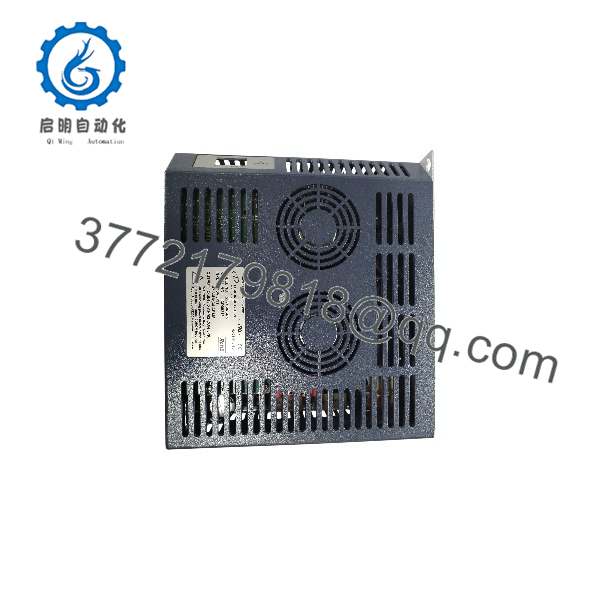
S22460-SRS
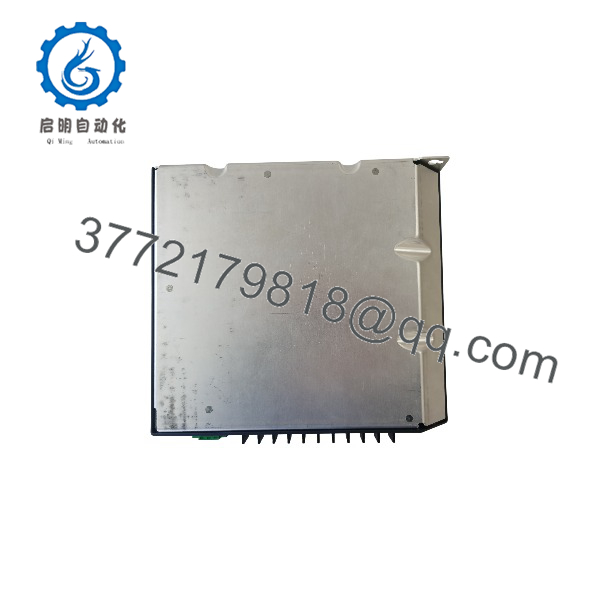
S22460-SRS
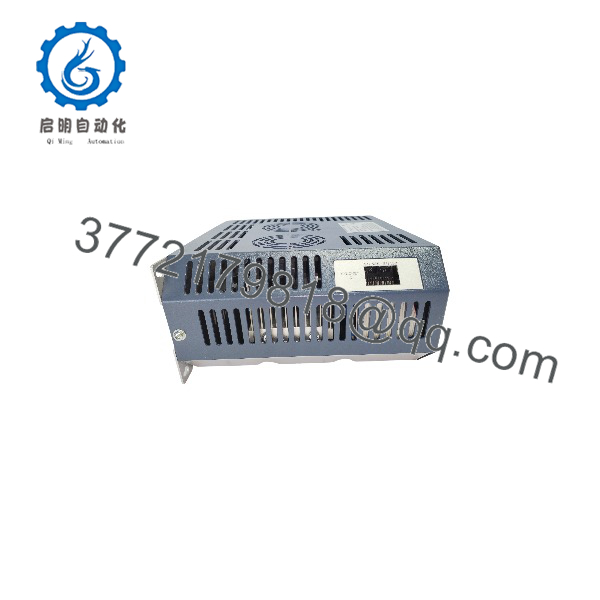
S22460-SRS
Detailed Product Overview
The Kollmorgen -SRS extends the S200 servo drive family to the highest AC power tier. The order code follows the S200 numbering logic: the “24” designates the 24 ARMS continuous current frame, the “6” designates the 240 VAC supply class, and “-SRS” specifies the SynqNet option card with standard RJ-45 connectors along with “S” feedback support for SFD/Halls. For procurement, the suffixes are not interchangeable labels: an S22460-VTS is the same power stage as an analog velocity/torque base drive, and an S22460-SDS carries the SynqNet function on a card with micro-D connectors. Machines wired for RJ-45 SynqNet cabling require the -SRS configuration.
Electrically, this frame is specified exclusively for 240 VAC three-phase input — a real distinction from the smaller S200 AC drives, which accept single-phase and 120 VAC supplies. The power stage delivers 30 ARMS continuous at 0–30 °C ambient, stepping down to 24 ARMS at 40 °C and 16 ARMS at 50 °C, with 48 ARMS peak available for at least 3 seconds from zero. Continuous output power is 8000 W, with 16000 VA available for one-second bursts, and the drive converts this into up to 5000 W of continuous shaft power at 3000 rpm under nominal conditions. The 16 kHz output current ripple frequency and the 0.6 mH minimum motor inductance define the motor-side matching constraints: very low-inductance windings that work on small drives may not be acceptable here.
At this power level, thermal and regenerative design dominate the integration work. The power stage dissipates up to 110 W at continuous load and 40 °C, so forced-air or generous convection planning in the cabinet is part of the axis specification. Deceleration energy is handled by the shunt regulator and an external regeneration resistor, typically 8 Ω for this frame and within an 8–50 Ω range, with the shunt regulator capable of 2500 W continuous duty at 10 Ω and a 15% maximum regen duty cycle. A machine that decelerates a large inertia frequently should be checked against these limits before the cycle timing is fixed.
On the control side, the drive behaves like the rest of the SynqNet S200 family. SFD/Halls feedback is supported on every unit, and the option card adds sine encoder and EnDat 2.1 feedback handling, allowing the drive to pair with high-resolution feedback motors without additional interfaces. Commissioning runs through S200 Tools over the RS-232 serial port, and the drive is configured as a SynqNet node through the MDK environment with the SynqNet controller installed. Wiring uses plug-in detachable screw terminals for power and I/O, a 15-pin D-Sub for discrete I/O, and the J1/TB1 power connections defined for this frame in the S200 reference manual.
Within a machine architecture, this drive is the rational choice when one axis’s continuous torque demand exceeds the 6 ARMS and 12 ARMS frames but the rest of the machine is already standardized on the S200/SynqNet platform. It concentrates the highest power tier of the family into the same commissioning workflow, software environment, and network infrastructure as its smaller siblings, which simplifies maintenance stocking and engineering familiarization compared with introducing a different drive platform for a single large axis.
Applications & System Role
The S22460-SRS sits at the top of the S200 power range as a single-axis, networked servo amplifier. A SynqNet motion controller generates the trajectory; the drive closes its current, velocity, and position loops around the motor and feedback device and converts the network commands into regulated phase currents at up to 48 ARMS peak.
Fit scenarios that follow from its verified capability profile:
- High-torque or high-inertia axes — large frame motion such as heavy gantry elements, large rotary tables, or high-force linear motor axes — where the 48 ARMS peak rating and 3-second peak duration cover demanding acceleration cycles.
- Axes requiring substantial continuous power, supported by the 8000 W continuous output and 5000 W continuous shaft power at 3000 rpm.
- Multi-axis SynqNet machines, where this drive can be mixed with smaller S200 SynqNet units on the same RJ-45 network when one axis of the machine dominates the power demand.
- Axes with high-resolution feedback, since the SynqNet option card adds sine encoder and EnDat 2.1 support to the base SFD/Halls capability.
The main engineering boundaries to respect are the three-phase-only supply requirement, the ambient-based current derating, the minimum motor inductance of 0.6 mH, and regen resistor sizing at multi-kilowatt regeneration levels.
FAQ
What is the Kollmorgen S22460-SRS?
It is the highest-current AC drive in the Kollmorgen S200 series: a single-axis digital brushless servo drive rated 24 ARMS continuous / 48 ARMS peak, fitted with the SynqNet option card that uses standard RJ-45 connectors.
What supply does it require?
240 VAC three-phase. Unlike the smaller S200 AC models, this frame is not specified for 120 VAC or single-phase input.
What are its power ratings?
Continuous output power is 8000 W, with 16000 VA peak available for one second. Continuous current is 30 ARMS at 0–30 °C ambient (24 ARMS at 40 °C, 16 ARMS at 50 °C), and peak current is 48 ARMS for at least 3 seconds from zero.
What does the -SRS suffix mean?
-SRS designates the SynqNet option card with standard RJ-45 connectors, distinguishing this model from the -VTS analog base drive and the -SDS SynqNet variant with micro-D connectors.
Which feedback devices does it support?
SFD/Halls feedback is supported on all units, and the SynqNet option card adds sine encoder and EnDat 2.1 feedback support.
Which controller and software are required?
Operation requires a SynqNet motion controller; the drive is configured and tuned in S200 Tools over the RS-232 serial port, with SynqNet node setup performed in the MDK environment.
What regeneration hardware does it need?
An external regeneration resistor of 8–50 Ω is required, with 8 Ω typical for the S22460 frame; the shunt regulator supports up to 2500 W continuous at 10 Ω with a 15% maximum regen duty cycle.
Are there motor-side matching constraints?
Yes. The drive requires a minimum motor line-to-line inductance of 0.6 mH and operates at a 16 kHz output current ripple frequency, which must be checked against the selected motor winding.