WhatsApp: +86 16626708626
 Email:
  Phone: +86 16626708626
Description
Key Technical Specifications
- Sensor Type: Moving-coil velocity transducer, self-generating — no external excitation power required
- Max Continuous Operating Temperature: 375 °C
- Frequency Response: 15 Hz to 2 kHz
- Output Sensitivity: 150 mV/in/s (5.91 mm/sec)
- Coil Resistance: 105 Ω
- Cable Configuration: Removable armored cable (up to 100 ft available in this configuration)
- Mounting: 4-hole flat base pattern, standard on many heavy-duty industrial gas turbines; stud-mount adapter available as p/n 8531
- Area Classification: Non-incendive when installed per Metrix drawing 8096
- Functional Safety: Metrix publishes a Safety Manual referencing IEC 61508-2 Annex D for integration into a Safety Instrumented Function — integrator is responsible for verifying loop-level compliance
- GE Cross-Reference: 392A8991P002
- Typical Application: OEM-standard sensor on many heavy-duty industrial gas turbines
Product Introduction
The Metrix 5485C-007-020 is a moving-coil velocity transducer built for continuous vibration monitoring on gas turbines and other machinery running at surface temperatures up to 375°C. Its zero-friction coil suspension self-generates a signal proportional to vibration velocity, so there’s no external power supply or signal conditioning needed at the sensor itself.
Plants replace this sensor like-for-like because it’s standard OEM equipment on many heavy-duty industrial gas turbines and cross-references directly to GE part number 392A8991P002 — matching the full part number, including the output and cable suffixes, keeps the swap from touching anything upstream in the monitoring system.
Troubleshooting Quick Reference
| Symptom | Possible Cause | Relevance to this Part | Quick Check Method | Recommendation |
|---|---|---|---|---|
| No signal / flat-line reading | Broken sensor coil or a cut cable conductor | ✅ High | Measure coil resistance at the connector — should read approximately 105 Ω | Verify cable continuity first; replace the sensor only if the coil itself reads open or shorted |
| Unusually low reading amplitude | Loose mounting or incorrect mounting bolt torque | ⚠️ Medium | Check mounting bolt torque and base-to-machine contact | Retorque to the Metrix-specified value before assuming sensor failure |
| Reading pegged high or showing erratic spikes | Cable damage, shield grounding fault, or EMI ingress | ✅ High | Inspect cable jacket for damage and check shield termination at both ends | Repair or replace the cable before condemning the sensor |
| Signal drifts as machine temperature rises | Sensor operating beyond its 375°C rating, or aging coil insulation | ⚠️ Medium | Measure actual case temperature at the sensor location with a contact probe | Confirm the sensor is within its rated envelope; drift near end of service life can look like this |
| Cross-axis noise contaminating the radial reading | Mounting orientation or mount stiffness issue, not the sensor itself | ❌ Low | Verify mounting orientation against the installation drawing; check for mount resonance | Correct the mechanical mounting before replacing the part |
If none of these checks resolve it, contact technical support with the sensor’s measured coil resistance and a photo of the mounting installation before ordering a replacement.
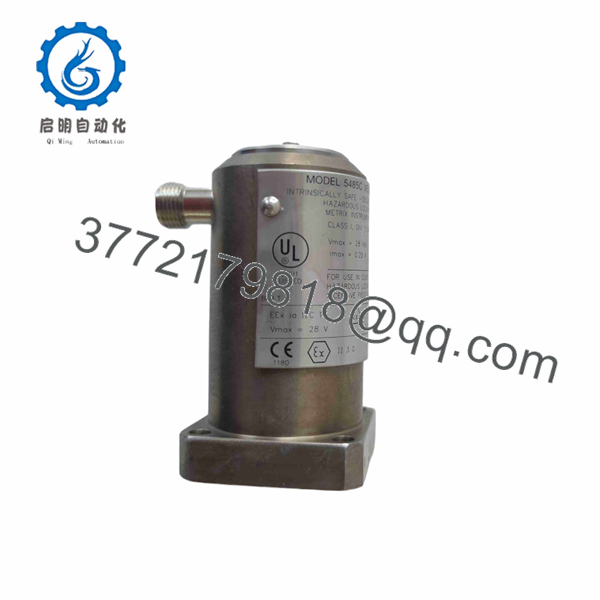
5485C-007-020
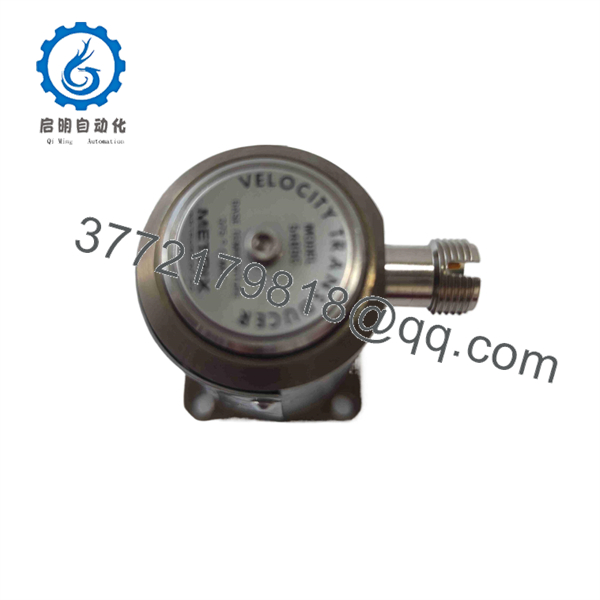
5485C-007-020
Frequently Asked Questions (FAQ)
Is this the same sensor GE originally installed on my turbine?
It cross-references to GE part number 392A8991P002, but confirm the full suffix on your existing sensor matches — the output sensitivity code and cable length/style both need to line up, or you’ll get a signal mismatch at your monitoring system.
Does this sensor need external power to operate?
No. It’s a self-generating moving-coil design — vibration moves the coil, and that motion produces the output signal directly. There’s no excitation voltage to supply at the sensor end.
What does the “-020” mean versus other suffixes I’ve seen, like “-040”?
That part of the number identifies the cable configuration — in this case, a removable cable arrangement, with the numeric suffix tied to cable length. Different cable lengths and fixed-versus-removable styles carry different suffixes, so match this exactly to what’s currently installed.
Can I install this in a hazardous area classification?
It’s rated non-incendive when installed per Metrix drawing 8096. Confirm that classification actually matches your site’s area classification requirement before installing — don’t assume “non-incendive” automatically satisfies every hazardous-area designation your plant uses.
Can this sensor be used in a Safety Instrumented Function (SIL) loop?
Metrix publishes a Safety Manual referencing IEC 61508-2 Annex D specifically for this purpose. If you’re integrating it into a SIF, that manual is required reading — the integrator is responsible for verifying the full loop meets the target SIL, not just the sensor in isolation.
Is this a direct drop-in replacement for the sensor already mounted on my machine?
Generally yes, provided the full part number matches — output sensitivity, coil resistance, and cable configuration all need to line up with what’s currently installed. Don’t swap in a sensor with a different output suffix and expect your monitoring system’s scaling to stay correct.
Why is a surplus unit priced under what I’d expect from a direct Metrix quote?
Surplus and distributor stock gets priced against available inventory rather than a factory list price. Ask the seller whether the unit is new-unused surplus or has any service history, since that affects how much confidence you can put in it before mounting it on a running turbine.