WhatsApp: +86 16626708626
 Email:
  Phone: +86 16626708626
Description
Key Technical Specifications
- Manufacturer: Moog
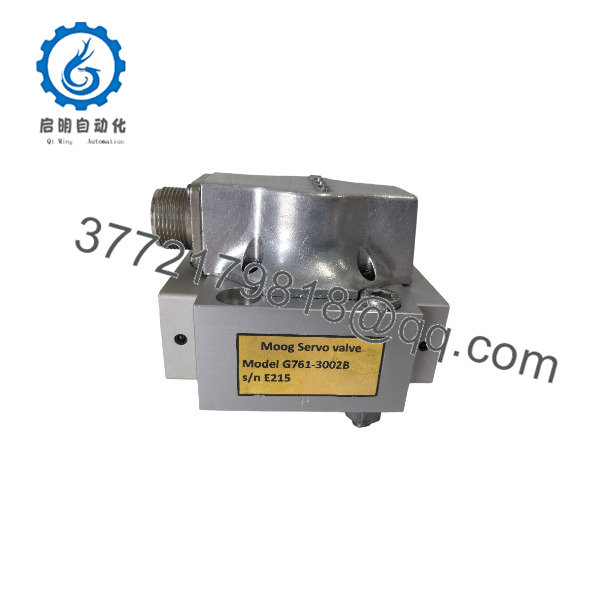
- Model: G761-3002B
- Series: 761 Series Flow Control Servo Valve
- Type Designation: H10JOGM4VPL
- Valve Design: Two-stage mechanical-feedback servo valve
- Rated Flow: 10 L/min (2.5 gpm)
- Rated Pressure Drop: 35 bar (500 psi) per spool land
- Rated Command Current: ±40 mA, single-coil configuration
- Mounting Pattern: ISO 10372-04-04-0-92, size 04
- Maximum Pressure, P/X/A/B: 315 bar (4,500 psi), aluminum body
- Maximum Pressure, P/X/A/B: 350 bar (5,000 psi), steel body
- Maximum Pressure, T Port: 210 bar (3,000 psi) static; 70 bar (1,000 psi) normal operation
- Minimum Operating Pressure: 14 bar (200 psi)
- Standard Response: Approximately 6 ms step response for the H10 high-response configuration
- High-Response Bandwidth: Approximately 120 Hz at −3 dB; 200 Hz phase response limit
- Typical Leakage: Approximately 1.0 L/min
- Operating Temperature: −29 to +135 °C (−20 to +275 °F)
- Storage Temperature: −40 to +60 °C (−40 to +140 °F)
- Hydraulic Fluid: Mineral-oil-based fluids meeting DIN 51524 Parts 1–3 or ISO 11158
- Recommended Viscosity: 15–100 cSt at 38 °C (100 °F)
- Recommended Cleanliness: ISO 4406 17/14/11 for functional safety; 15/13/10 for longer service life
- Electrical Connector: Four-pin connector mating with MS3106F14S-2S
- Coil Resistance: Approximately 80 Ω per coil at 25 °C for the ±40 mA coil option
- Valve Weight: Approximately 1.0 kg aluminum body or 1.7 kg steel body
Moog’s 761 Series catalog identifies G761-3002B as type H10JOGM4VPL, with 10 L/min rated flow and ±40 mA rated current. The catalog also specifies the ISO mounting pattern, pressure ratings, temperature range, connector, and hydraulic cleanliness requirements.
The valve uses a polarized torque motor, nozzle-flapper pilot stage, four-land spool, and mechanical feedback wire. The “H” designation identifies the high-response family; verify the complete nameplate type code before substituting a different 761-series valve.
Product Introduction
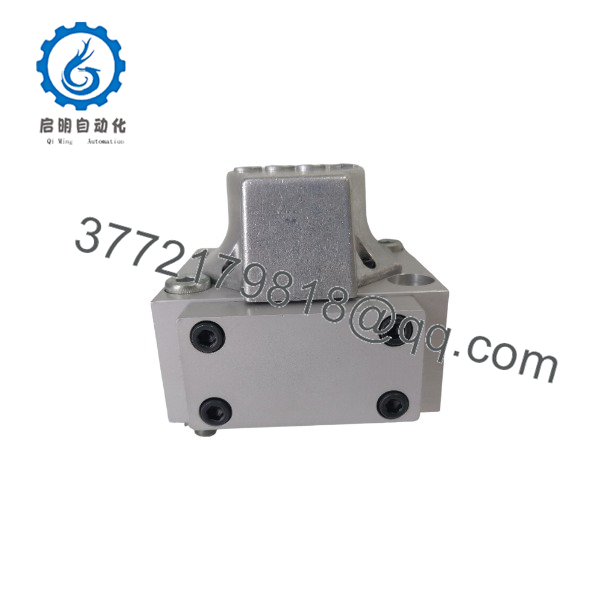
The Moog G761-3002B is a two-stage electrohydraulic flow-control servo valve for closed-loop position, speed, pressure, or force control. Its H10 configuration provides 10 L/min rated flow at a ±40 mA command, with mechanical spool feedback and ISO 10372-04-04-0-92 mounting.
This valve is selected where the hydraulic loop requires fast response, controlled spool positioning, and repeatable flow behavior. Verify body material, pilot-supply configuration, spool cut, connector location, seal material, and complete type code before installation.
G761-3002B
G761-3002B
Troubleshooting Quick Reference
| Symptom | Possible Cause | Relevance to This Part | Quick Check Method | Recommendation |
|---|---|---|---|---|
| Actuator does not respond to command | No command current, blocked pilot filter, insufficient hydraulic pressure, or open coil circuit | ✅ High | Measure command current at the connector and verify supply pressure at port P or X | Check the servo amplifier, filter, and hydraulic supply before replacing the valve |
| Actuator moves in the wrong direction | Coil polarity or connector wiring reversed | ✅ High | Verify the A/B/C/D coil wiring against the required flow direction and system schematic | Isolate electrical and hydraulic energy, then correct wiring before further testing |
| Valve drives hard over | Incorrect null, wrong valve polarity, failed amplifier, or feedback problem | ✅ High | Remove or reduce command signal under a controlled test; monitor valve current and actuator movement | Check polarity, null adjustment, and amplifier output before condemning the valve |
| High null bias | Mechanical null shift, spool wear, contamination, or incorrect controller offset | ✅ High | Measure current required to hold the actuator stationary at zero command | Record the original value and adjust null only under an approved procedure |
| Jerky or oscillating actuator motion | Contaminated oil, plugged pilot filter, excessive loop gain, or feedback instability | ✅ High | Inspect filter differential pressure and trend command, feedback, and valve current | Correct contamination and tuning issues before replacing the servo valve |
| Slow response | Partially blocked filter, low pilot pressure, incorrect valve response class, or hydraulic restriction | ✅ Medium | Check filter condition, pressure at P/X, and command-to-motion response time | Confirm that the installed valve is the H10 configuration specified by the application |
| External oil leakage | Damaged O-rings, poor manifold finish, loose mounting hardware, or body damage | ✅ High | Depressurize the system and inspect all P, T, A, B, and X interfaces | Replace seals with compatible material and verify mounting-surface flatness |
| Excessive internal leakage | Worn spool and bushing, contaminated oil, or damaged valve lands | ✅ High | Isolate the actuator and measure leakage using the approved hydraulic test procedure | Send the valve to Moog or an authorized service facility for evaluation |
| No change after command reversal | Electrical coil fault, blocked spool, or loss of pilot pressure | ✅ High | Measure coil resistance, command current, and pressure at the pilot supply port | Do not force the spool mechanically; inspect the coil circuit and pilot stage |
| Valve fails after replacement | Wrong flow rating, spool cut, coil current, pilot configuration, or connector location | ✅ High | Compare complete type codes and nameplates, not only the G761-3002B base number | Stop commissioning and verify the full Moog ordering code against the original valve |
Critical warning: Keep hydraulic cleanliness under control. Moog specifies ISO 4406 17/14/11 for functional safety and 15/13/10 for longer service life; contamination is a common cause of threshold increase, null shift, and spool failure. Contact technical support with the valve nameplate, complete type code, serial number, hydraulic schematic, coil measurements, filter data, and diagnostic logs if the fault remains unresolved.
Frequently Asked Questions
What is the rated flow of G761-3002B?
The G761-3002B has a rated flow of 10 L/min (2.5 gpm) at a 35 bar (500 psi) pressure drop per spool land. Actual flow changes with valve pressure drop and command current.
What electrical signal does it require?
The prefer configuration uses a ±40 mA rated current with a single-coil connection. The four-pin connector exposes both torque-motor coils, allowing single, series, or parallel wiring. Confirm the exact wiring arrangement in the amplifier documentation before energizing the valve.
Is this a proportional valve or a servo valve?
It is a two-stage electrohydraulic servo valve with mechanical spool feedback. It is intended for closed-loop control and should not be treated as a general-purpose proportional directional valve.
What pressure can the valve handle?
For ports P, X, A, and B, the catalog lists 315 bar (4,500 psi) for an aluminum body and 350 bar (5,000 psi) for a steel body. Port T has a 210 bar (3,000 psi) static limit and a 70 bar (1,000 psi) normal operating limit. Verify the actual body material on the nameplate before applying these limits.
Does it use internal or external pilot oil?
The 761 Series supports internal pilot supply through port P or external pilot supply through port X. The valve is normally configured for internal pilot operation; changing to external pilot operation requires relocating the designated screw and seal washer and updating the hydraulic labeling.
Can I replace another valve with this model?
Only when the complete application requirements match. Compare rated flow, response class, spool cut, command current, pressure rating, body material, pilot configuration, seal material, connector position, and valve revision. A model with a different flow code can produce unacceptable actuator gain or instability.
What condition should I expect from a surplus unit?
The listing should clearly state New Original, New Surplus, or Refurbished and tested. Request photographs of the nameplate, connector, mounting face, ports, and seals. For refurbished stock, request coil-resistance data, leakage results, null-bias results, and a functional test report; a visual inspection alone is not enough for a precision servo valve.