WhatsApp: +86 16626708626
 Email:
 Phone: +86 16626708626
Description
Core Product Summary
The MOOG SM3430D-DNASM5 is a SmartMotor from Moog Animatics — a fully integrated servo motion system that houses a brushless DC servo motor, a motion controller, a servo amplifier, and a position encoder in one NEMA 34 frame. The -DN suffix in the part number designates the DeviceNet fieldbus option, allowing the unit to be networked with other SmartMotors and DeviceNet-compatible controllers in multi-axis machines.
In the SM3430D base configuration, the motor is powered from a 48 VDC supply (within the SmartMotor’s 20–48 VDC input range) and delivers approximately 1.09 Nm of continuous torque at a rated speed around 2300 rpm, with a maximum current draw of about 10.26 A. Each unit is a complete, programmable axis: it communicates through a primary RS-232 port, executes motion programs stored in its internal non-volatile memory, and offers onboard digital I/O alongside the fieldbus interface, eliminating the need for a separate drive and controller cabinet per axis.
Key Technical Specifications
| Parameter | Value |
|---|---|
| Product type | Integrated servo system (SmartMotor): brushless DC servo motor with built-in controller, amplifier, and encoder |
| Manufacturer / brand | Moog Animatics |
| Frame size | NEMA 34 |
| Supply voltage | 20–48 VDC (rated at 48 VDC) |
| Continuous torque | approx. 1.09 Nm (155 oz-in) |
| Maximum current | approx. 10.26 A |
| Nominal power | approx. 0.22 kW |
| Rated speed | approx. 2300 rpm |
| Position feedback | Integrated encoder |
| Fieldbus option (per part number) | DN = DeviceNet |
| Primary communication | RS-232 (with RS-485/serial multi-axis networking) |
| Onboard I/O | Digital TTL I/O channels, expandable |
| Motion modes | Position, velocity, and torque control |
| Program storage | Internal non-volatile memory |
| Connector style | D-sub connector (D-style) |
Engineering Selection Highlights
- Complete axis in one unit: controller, amplifier, encoder, and motor are integrated, so no separate drive cabinet, motor cable, or encoder cable is required for this axis — a replacement changes only power, communication, and I/O wiring.
- DeviceNet option (-DN): the unit is specified for DeviceNet-based networking; in a machine that uses CANopen, PROFIBUS, or serial-only SmartMotors, this variant’s fieldbus configuration must match the installed network.
- 48 VDC supply class: the motor is designed for the SmartMotor 20–48 VDC supply range, with performance data based on 48 VDC operation; a lower supply voltage reduces the achievable speed and torque envelope.
- Torque-speed fit: approximately 1.09 Nm continuous torque at 2300 rpm places this mid-length NEMA 34 model between the shorter and longer stack variants; verify the application’s continuous torque and peak torque demand against the motor’s published torque curve at the actual supply voltage.
- Programmable stand-alone operation: motion programs are stored in the motor’s non-volatile memory, so a spare unit can be configured by downloading the existing axis program — keep program backups when maintaining machines built on these motors.
- Serial commissioning: every SmartMotor has a primary RS-232 port for setup and daisy-chained multi-axis communication regardless of the fieldbus option, so commissioning tools connect serially even in DeviceNet machines.
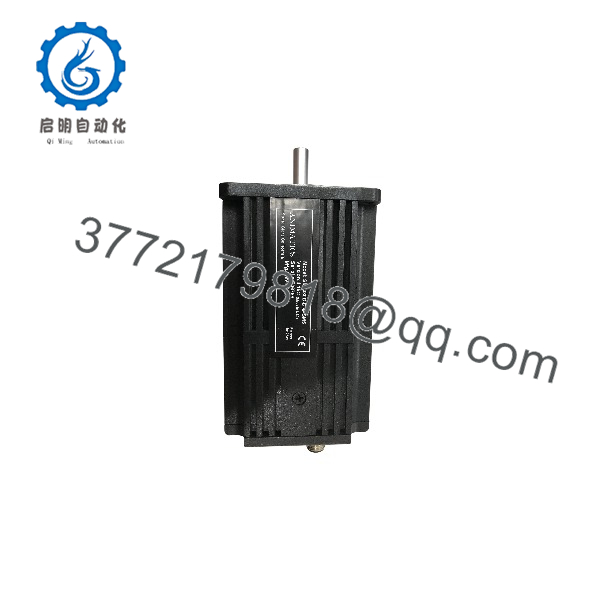
SM3430D-DNASM5
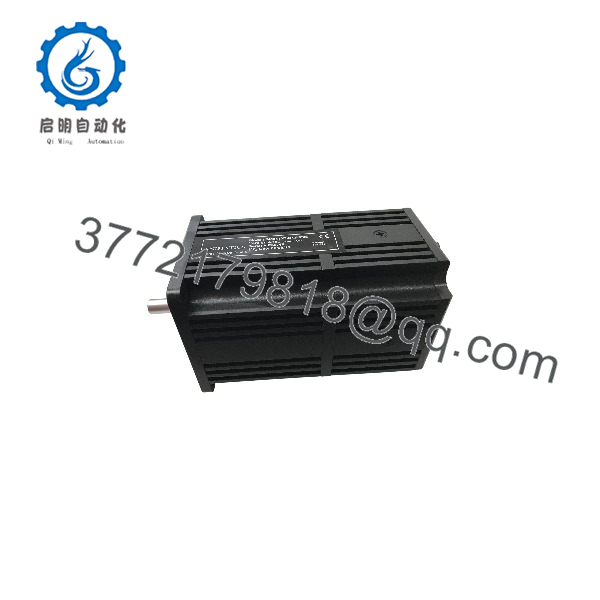
SM3430D-DNASM5
System Compatibility & Integration Requirements
| Item / Dependency | Verified Compatibility or Requirement | Practical Note |
|---|---|---|
| Machine architecture | Multi-axis SmartMotor networks from Moog Animatics | Units can be daisy-chained via serial links or networked by fieldbus for coordinated motion |
| Fieldbus | DeviceNet (per -DN option in the part number) | The installed machine network must be DeviceNet-compatible |
| Setup / programming interface | RS-232 primary port on every SmartMotor | Used for commissioning, program download, and serial multi-axis networking |
| Power supply | 20–48 VDC input range | Supply sizing must cover the maximum current demand of all connected axes |
| Software | Moog Animatics SmartMotor development software | Motion programs are written, downloaded, and stored in the motor’s non-volatile memory |
| I/O integration | Onboard digital I/O, expandable | Sensors and simple machine logic can connect directly to the motor |
| Mounting | NEMA 34 frame standard | Mounting pattern matches NEMA 34 mechanics; gearheads and mechanics designed for NEMA 34 frame sizes are the mechanical interface |
Dimensions, Mounting & Connection Notes
- The unit uses a NEMA 34 frame, so it conforms to the standard NEMA 34 flange mounting pattern and mates with NEMA 34 gearheads and mechanical interfaces.
- The D-style connector series uses D-sub connectors for communication, I/O, and power connections; wiring must follow the SmartMotor D-style connector pinout.
- Supply voltage is DC within the 20–48 VDC range; confirm polarity and supply capacity before connection.
- Exact housing dimensions and weight vary with the installed option set; consult the nameplate and the SmartMotor catalog data for the specific unit when planning mounting clearances.
Detailed Product Overview
The SmartMotor concept, developed by Animatics and carried forward under Moog, was created to collapse the traditional servo system — motor, drive, controller, encoder, and cabling — into a single housing. In the SM3430D-DNASM5, the NEMA 34 brushless DC motor carries its amplifier and motion controller in the rear housing, with feedback from an integrated encoder. The practical consequence for machine builders is architectural: instead of routing motor power and encoder cables from every axis to a central cabinet, each SmartMotor needs only DC power, a communication connection, and I/O wiring at the point of use.
The SM3430D designation positions this unit within the classic SmartMotor range: a NEMA 34 frame with a mid-length stack in the D-style (D-sub connector) series, running on the 20–48 VDC supply class with performance characterized at 48 VDC. At approximately 1.09 Nm continuous torque, 0.22 kW nominal power, and 2300 rpm rated speed with up to about 10.26 A of current draw, it covers the middle of the NEMA 34 torque range — enough for moderately loaded positioning axes, while heavier axes in the same machine family would use longer-stack variants.
The -DN suffix is defined in Moog Animatics’ part-numbering scheme as the DeviceNet option. For an engineer maintaining or expanding an existing machine, this is the critical integration detail: the unit participates in a DeviceNet network, alongside the RS-232 port that every SmartMotor provides for setup and serial multi-axis communication. Motion programs are held in internal non-volatile memory, meaning an axis can be re-commissioned by downloading the saved program rather than re-engineering the application — a point worth planning for in maintenance strategies, since a replacement unit must be flashed with the axis program and configured with the correct network address.
Because the controller is inside the motor, selection is not only about torque and speed. The axis count per network segment, the supply budget across all connected motors, and the available I/O on each unit all shape the machine design. With onboard digital I/O that can be expanded, simple end-of-travel sensors, grippers, or interlocks can be wired directly at the motor, letting a distributed machine run large portions of its logic without a separate PLC. For teams weighing replacement or expansion of an existing SmartMotor installation, the decisive checks are the DeviceNet configuration, the 48 VDC supply capacity, the stored axis program, and the NEMA 34 mechanical interface.
Applications & System Role
Within a machine architecture, the SM3430D-DNASM5 is not just a motor but a complete axis: it executes its own motion programs, closes its own position loop through the integrated encoder, and exchanges status and commands over DeviceNet or serial links with other axes and a host controller. This makes it suitable for distributed motion architectures in which several axes coordinate through a network without a centralized drive cabinet.
Typical fit scenarios follow directly from its verified capabilities: multi-axis machines that network SmartMotors via DeviceNet; positioning axes such as belt-driven linear stages, pick-and-place mechanisms, rotary indexers, and gating or diverting equipment; and applications that benefit from stand-alone programmability, where the axis must run sequences stored locally with only occasional host supervision. With position, velocity, and torque modes available, the same hardware covers both servo positioning and speed- or force-regulated tasks.
FAQ
What is the MOOG SM3430D-DNASM5?
It is a Moog Animatics SmartMotor — a NEMA 34 brushless DC servo motor with an integrated motion controller, amplifier, and encoder, configured with the DeviceNet fieldbus option.
What does the -DN suffix mean?
In the official Moog Animatics part-numbering scheme, DN designates the DeviceNet communication option, in addition to the RS-232 port present on every SmartMotor.
What are its main performance figures?
The SM3430D base motor is characterized by approximately 1.09 Nm continuous torque, 0.22 kW nominal power, and a rated speed around 2300 rpm, with a maximum current draw of about 10.26 A.
What supply voltage does it need?
It operates from a DC supply within the 20–48 VDC range, with performance data based on 48 VDC operation.
Does it require a separate drive or controller?
No. The amplifier, motion controller, and encoder are built into the motor housing; only DC power, communication, and I/O wiring are needed at the installation point.
How is it programmed and commissioned?
Motion programs are created in Moog Animatics’ SmartMotor software and downloaded over the RS-232 port, then stored in the motor’s internal non-volatile memory.
Can multiple units work together?
Yes. SmartMotors can be daisy-chained over serial links or networked via the fieldbus option — in this case DeviceNet — for coordinated multi-axis motion.
What mechanical interface does it use?
It follows the NEMA 34 frame standard, so it mounts to NEMA 34 flange patterns and mates with NEMA 34 gearheads and motion mechanics.