WhatsApp: +86 16626708626
 Email:
 Phone: +86 16626708626
Description
Key Technical Specifications
| Parameter | Value |
|---|---|
| Processor | Motorola/Freescale MPC750 PowerPC |
| Processor speed | 450 MHz |
| L1 cache | 32 KB instruction / 32 KB data |
| L2 cache | 1 MB, directly connected to MPC750 |
| Main memory | 512 MB PC100 ECC SDRAM |
| Flash memory | 1 MB firmware Flash plus 8 MB user Flash |
| NVRAM / RTC | 8 KB NVRAM with battery-backed real-time clock |
| VMEbus interface | VME64, A16/A24/A32 addressing, D08–D64 data |
| PCI architecture | 33 MHz PCI bus through the Hawk ASIC |
| PMC expansion | Two IEEE P1386.1 32/64-bit PMC slots |
| PCI expansion | 64-bit PCI expansion mezzanine connector |
| Ethernet | 10/100 Mbps auto-negotiating Ethernet |
| Serial port | One asynchronous serial port |
| Timers / watchdog | Four 32-bit timers, one 16-bit timer, watchdog timer |
| Board power | +3.3 V, +5 V, ±12 V; 7.5 W maximum per PMC slot |
| Front panel | Scanbe-style VME handles |
| Form factor | 6U VME, single slot unless PCI expansion mezzanine is installed |
The MVME2400-0361 is factory-configured with a 450 MHz MPC750 processor and 512 MB ECC SDRAM; the “0361” suffix also identifies the Scanbe front-panel handle configuration. The board uses the Hawk ASIC for PCI, interrupt control, and ECC memory control, and supports VME64 operation with two PMC expansion sites.
Product Introduction
The Motorola MVME2400-0361 is a 6U VMEbus processor module built around a 450 MHz MPC750 PowerPC, 512 MB ECC SDRAM, and Motorola’s Hawk system controller. It fits legacy industrial-control, test, communications, and data-acquisition systems that require VME64 compatibility and PMC-based I/O expansion.
The -0361 configuration is a high-memory, high-clock-speed variant of the MVME2400 family. Its 512 MB ECC SDRAM, 1 MB L2 cache, dual PMC slots, and VME64 interface make it a strong like-for-like service board for existing Motorola VME installations where a modern replacement would require software or hardware redesign.
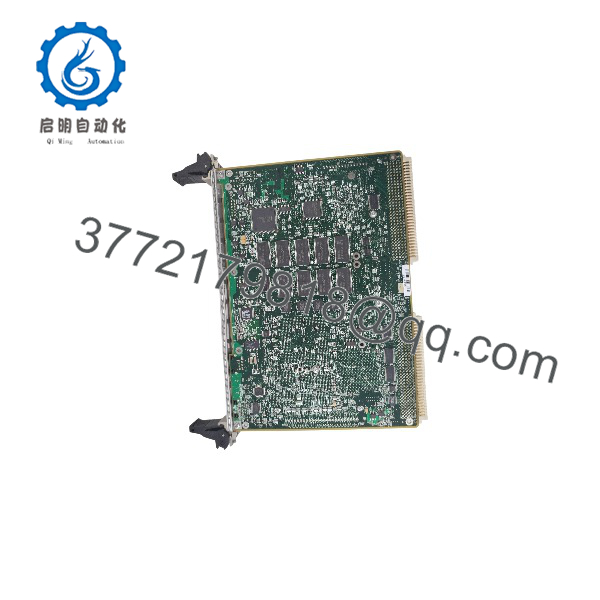
MVME2400-0361
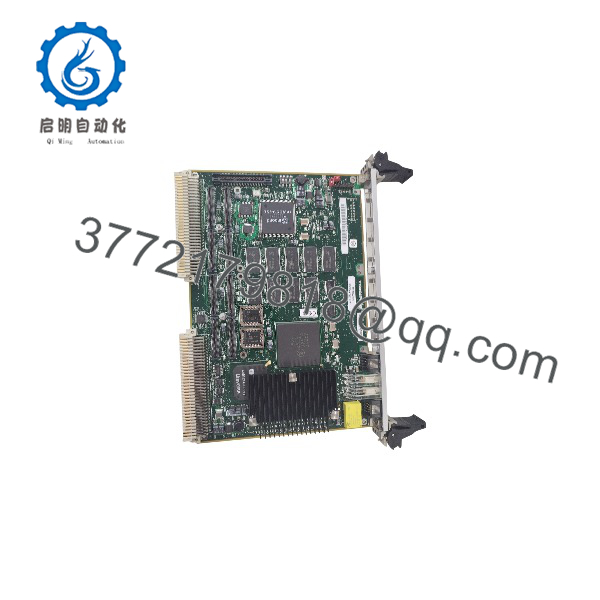
MVME2400-0361
Troubleshooting Quick Reference
| Symptom | Possible Cause | Relevance to this Part | Quick Check Method | Recommendation |
|---|---|---|---|---|
| No LEDs or no boot activity | Chassis power, fuse, backplane fault, or poor P1/P2 seating | ❌ Low | Measure +5 V and +3.3 V at the VME backplane; reseat the board with power off | Verify PSU, fuses, and connector engagement before replacing the SBC |
| Board powers up but does not boot | Corrupt Flash, failed boot device, or firmware/configuration fault | ✅ High | Connect to the serial debug port and capture the boot messages | Restore firmware or boot image; replace the board if Flash is damaged |
| No Ethernet link | Cable, switch port, PHY configuration, or driver issue | ❌ Low | Swap cable and switch port; check link LEDs and IP settings | Test networking externally before condemning the board |
| VME bus timeout or bus error | Incorrect address map, bus grant, terminator, or system-controller configuration | ✅ High | Compare VME jumpers and address map with system documentation | Correct configuration first; do not assume a failed CPU board |
| PMC card not recognized | PMC not seated, incompatible PMC, or PCI/PMC configuration mismatch | ❌ Low | Power down, reseat PMC, and test it in another known-good MVME2400 system | Verify PMC electrical and software compatibility |
| ECC memory errors or random resets | Weak RTC battery, overheating, poor contact, or failing SDRAM | ✅ Medium | Check battery voltage, clean contacts, verify airflow, and run memory diagnostics | Replace the board if ECC errors persist after environmental checks |
| Intermittent faults after installation | ESD damage, bent pins, or incomplete connector insertion | ✅ High | Inspect P1/P2 and PMC connectors; reseat using ESD protection | Replace only after connector, power, and configuration checks pass |
If the fault remains unresolved, send photos of the board and chassis, jumper settings, serial boot output, and diagnostic logs before ordering a replacement.
Frequently Asked Questions
Can I hot-swap the MVME2400-0361?
No. Power down the VME chassis before removing or installing the board. This is a conventional VME processor module, not a hot-swap design. Use a grounded ESD wrist strap and avoid contact with connector pins.
Is the MVME2400-0361 obsolete?
Yes. Motorola originally produced the MVME2400 series, and the product line later passed through Emerson ownership. Original manufacturing has ended, so dependable supply generally comes from controlled surplus or tested refurbished inventory.
What does the “-0361” suffix mean?
For the MVME2400 series, -0361 identifies a 450 MHz MPC750 configuration with 512 MB ECC SDRAM and Scanbe front-panel handles. Do not confuse it with lower-memory or lower-clock MVME2400 variants.
Will it directly replace another MVME2400 board?
Often yes, but verify CPU speed, SDRAM capacity, Flash contents, VME address map, PMC cards, firmware, and front-panel handle style. A same-family replacement can still fail to boot if its Flash image or configuration differs from the original board.
Will my application software remain after a board swap?
Not automatically. The application may reside in Flash, NVRAM, a PMC storage module, or another device in the VME chassis. Back up the boot image, application files, network settings, and VME configuration before removing the old board.
Why is this surplus board less expensive than a new OEM unit?
Because Motorola no longer manufactures it, pricing reflects available surplus inventory rather than current OEM production. New Surplus stock is unused original product; it may have older date codes but should not have field-operating hours.
What should I check before ordering?
Confirm the required 450 MHz MPC750 configuration, 512 MB ECC SDRAM, Scanbe handle style, PMC hardware, firmware/boot image, VME system-controller role, and chassis power budget. The base board’s stated power requirement excludes PMC cards, which may each require up to 7.5 W.