WhatsApp: +86 16626708626
 Email:
  Phone: +86 16626708626
Description
Key Technical Specifications
| Parameter | Value |
|---|---|
| Manufacturer | MTL / Eaton |
| Model | 8202-HO-IS |
| Product Family | MTL8000 |
| Product Type | HART-enabled I/O interface |
| Channels | 2 |
| Signal Type | HART analog signal |
| Safety Concept | Intrinsic Safety |
| Installation | MTL8000 backplane |
| Hazardous Area Application | Yes, subject to certified system configuration |
| Communication | HART |
| Isolation | Galvanic isolation, application dependent |
| Mounting | MTL8000 carrier/backplane |
| Configuration | Determined by host I/O system |
| Certification | Verify exact product certification marking before installation |
| Replacement Status | Verify against current MTL/Eaton documentation |
Product Introduction
The MTL 8202-HO-IS is an MTL8000-series HART interface module intended for process instrumentation applications where analog signals and HART communication must be integrated with an industrial I/O architecture. The -IS designation identifies an intrinsically safe application configuration.
The module belongs to the MTL8000 family and is intended for installation with the appropriate MTL8000 carrier and host system. Before replacement, verify the exact channel configuration, certification markings, terminal arrangement, and host-system compatibility from the installed module and current MTL/Eaton documentation.
Installation & Configuration Guide
Stage 1: Pre-Installation Preparation
Estimated time: 20–30 minutes
- Notify operations and place the affected process loop in its approved maintenance state.
- Apply the site’s LOTO procedure where required.
- Confirm the instrument loop has been made safe for maintenance.
- Wait at least 5 minutes after power isolation where applicable.
- Wear an ESD wrist strap.
- Prepare:
- Digital multimeter
- PH1 screwdriver
- Wire labels
- Camera/phone
- Approved documentation
- Loop drawings
- I/O configuration records
- Photograph the existing module and terminal wiring.
- Record the complete model number, revision, serial number, and certification markings.
- Record the host I/O system and carrier position.
⚠️ Intrinsic-safety wiring is not ordinary control wiring. Maintain the approved segregation, grounding, cable, and barrier/interface requirements throughout the replacement.
Stage 2: Removing the Old Module
Estimated time: 15–20 minutes
- Confirm the loop is in the approved maintenance condition.
- Verify power isolation where applicable.
- Identify both channels before disconnecting anything.
- Photograph the terminal arrangement.
- Label field wiring.
- Disconnect the wiring without stressing the terminals.
- Release the module retaining mechanism.
- Remove the module from the carrier/backplane.
- Inspect the carrier contacts for contamination or mechanical damage.
- Keep the original module until commissioning is complete.
⚠️ Do not swap channel wiring between the two channels. HART loops can appear electrically normal while the control-system point assignment is wrong.
Stage 3: Installing the New Module
Estimated time: 15–25 minutes
- Confirm the replacement marking is MTL 8202-HO-IS.
- Verify the certification markings against the installation requirements.
- Confirm the module is intended for the same carrier position.
- Inspect the connector and backplane interface.
- Install the module without forcing the connector.
- Lock the module into position.
- Reconnect Channel 1 wiring.
- Reconnect Channel 2 wiring.
- Verify polarity and terminal assignments against the loop drawing.
- Confirm hazardous-area segregation remains unchanged.
⚠️ Do not modify intrinsic-safety barriers, grounding arrangements, or field wiring simply because the replacement module fits mechanically. Certification applies to the complete approved circuit configuration.
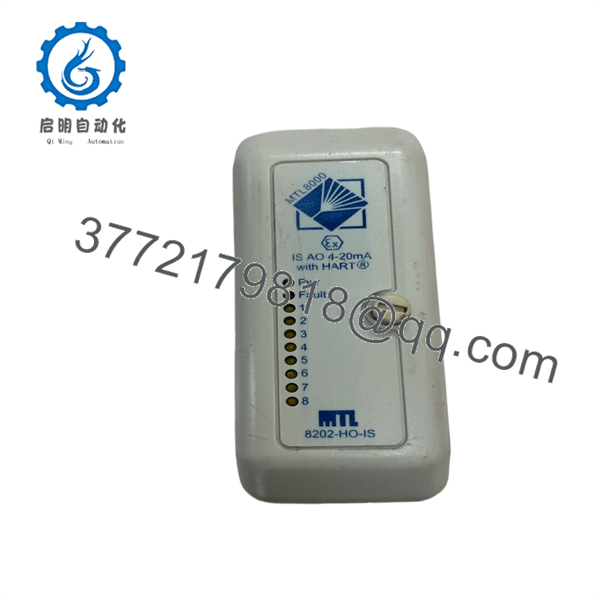
8202-HO-IS
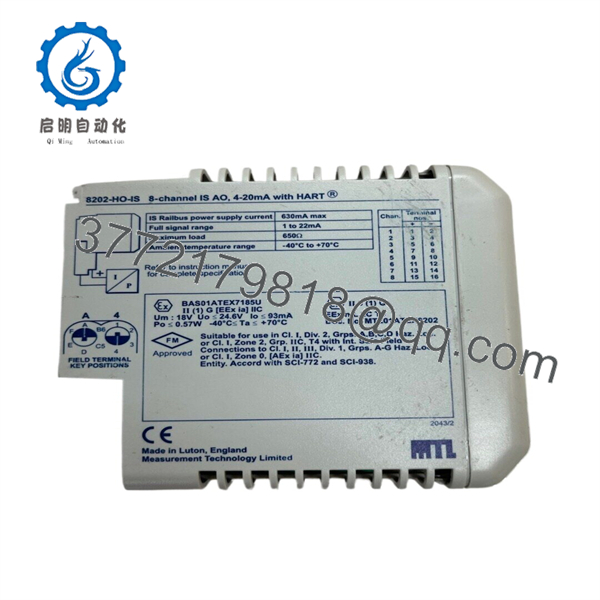
8202-HO-IS
Stage 4: Power-On & Testing
Estimated time: 30–60 minutes
- Verify supply voltage and polarity.
- Energize the system.
- Check module status indications.
- Confirm both channels appear correctly in the host I/O system.
- Verify the analog process value.
- Establish HART communication with the field instrument.
- Read the instrument tag and device identification.
- Check HART diagnostic information.
- Verify engineering-unit scaling.
- Confirm alarm limits and signal-failure behavior.
- Perform a controlled loop test where the plant procedure permits it.
- Record final module status and loop-test results.
⚠️ Do not close the maintenance work order merely because the analog value looks correct. For a HART loop, verify both the process variable and digital HART communication when the application depends on HART diagnostics or configuration.
Frequently Asked Questions (FAQ)
1. What is the MTL 8202-HO-IS?
The MTL 8202-HO-IS is an -series HART interface module intended for process instrumentation applications involving intrinsically safe signal circuits.
2. How many channels does the 8202-HO-IS provide?
The model is identified as a 2-channel HART I/O interface. Confirm the channel assignment and signal type against the installed system configuration before replacement.
3. Is the 8202-HO-IS suitable for hazardous-area instrumentation?
It is intended for intrinsically safe applications, but the module should not be treated as a standalone hazardous-area approval. Verify the exact certification marking and the complete installation, including carrier, wiring, field device, and associated apparatus.
4. Can I replace the module while the system is powered?
Do not assume it is hot-swappable. Whether removal under power is permitted depends on the specific system configuration and hazardous-area installation procedure. For a maintenance replacement, follow the applicable MTL/Eaton documentation and plant procedure.
5. Will replacing the 8202-HO-IS erase my HART instrument configuration?
The field instrument’s configuration is generally stored in the instrument itself, but host-system channel configuration and HART communication settings are separate matters. Back up the I/O database and record the existing loop configuration before replacement.
6. What should I verify before buying a replacement?
Match 8202-HO-IS exactly and verify the carrier, channel function, certification marking, terminal arrangement, host I/O configuration, and physical condition. For surplus stock, request photographs of the actual nameplate rather than relying only on a supplier’s catalog image.
7. What condition should I specify when purchasing?
Specify the condition explicitly: Factory Sealed, New Original/New Surplus, or Refurbished and Tested. For a safety-related or hazardous-area application, also request the actual serial/label information and applicable certification documentation.