WhatsApp: +86 16626708626
 Email:
 Phone: +86 16626708626
Description
Key Technical Specifications
NI identifies these specifications as typical unless otherwise noted. Sample rate, working voltage, and isolation rating describe different limits; do not substitute one for another.
| Parameter | Value |
|---|---|
| Analog Input Channels | 8 single-ended or 4 differential voltage inputs |
| AI Resolution and Sampling | 16 bits; 250 kS/s single-channel maximum; multiplexed multichannel acquisition, not simultaneous sampling |
| Analog Input Ranges | ±0.2 V, ±1 V, ±5 V, ±10 V; DC coupled |
| Analog Outputs | 4 voltage outputs; 16-bit resolution; ±10 V; ±5 mA drive |
| Maximum AO Update Rates | 1 channel: 500 kS/s; 2 channels: 450 kS/s/channel; 3 channels: 425 kS/s/channel; 4 channels: 400 kS/s/channel |
| Digital I/O | 6 fixed inputs and 4 fixed outputs; 5 V TTL/CMOS; referenced to D GND |
| Counter/Timers | 2 × 32-bit; internal timebases: 80 MHz, 20 MHz, 100 kHz; external timebase: up to 20 MHz |
| Continuous Isolation | Channel-to-earth and channel-to-bus: ≤30 V RMS or 60 V DC, Measurement Category I |
| Host Bus and Connector | Conventional PCI, 3.3 V or 5 V signaling environment; 37-pin D-SUB I/O connector |
| Bus Current Draw | No load: +5 V at 0.5 A and +12 V at 20 mA; AI/AO overvoltage condition: +5 V at 0.75 A and +12 V at 20 mA |
| Physical Characteristics | PCB: 97 × 155 mm; weight: 110 g |
| Environment and Calibration | Operating: 0 to 55 °C; 10–90% RH, noncondensing; 15-minute warm-up; 1-year calibration interval |
Specifications come from NI’s PCI/PXI-6230 specification sheet. Multichannel acquisition requires attention to convert intervals and settling time.
❗ Warning: The 60 V DC isolation rating does not mean the analog inputs measure ±60 V. The largest input range is ±10 V; analog channels must remain within 11 V of the applicable analog ground. Digital channels must remain within 5.25 V of D GND. This is not a direct mains-measurement device.
Product Introduction
The NI PCI-6230 is an M Series bank-isolated multifunction DAQ card for PCI-based measurement and control systems. It combines eight single-ended or four differential 16-bit analog inputs, four analog outputs, fixed-direction digital I/O, and two counters.
Its 60 V DC continuous isolation rating suits applications requiring a defined barrier between field circuitry and the host. Choose it for isolated voltage I/O and 5 V logic—not simultaneous sampling or direct connection to 24 V digital signals.
Troubleshooting Quick Reference
| Symptom | Possible Cause | Relevance to this Part | Quick Check Method | Recommendation |
|---|---|---|---|---|
| Card missing from the host or NI configuration utility | Driver/OS incompatibility, poor seating, or PCI host problem | Possible hardware issue; not established | Check OS hardware enumeration; verify PCI-6230 support in the installed NI-DAQmx version; power down before inspecting seating | Establish host and driver compatibility before replacing |
| All analog inputs read incorrectly | Incorrect terminal configuration, missing reference, or wrong channel assignment | Wiring/configuration first | Apply a known low-voltage source to one channel using the documented single-ended or differential connection; verify AI GND reference | Confirm configuration and wiring before testing additional channels |
| One channel remains inaccurate | Cable fault, selected range, calibration error, or input damage | Higher hardware suspicion after isolation | After 15-minute warm-up, compare channels using the same calibrated source, range, cable, and terminal configuration | Separate channel damage from common setup errors |
| Readings change when another channel changes | Multiplexer settling error or high source impedance | Acquisition architecture matters | Reduce scan rate or increase convert interval; repeat with a low-impedance source | Check NI’s settling-time guidance before replacing the card |
| Analog output falls under load | Load requires more than ±5 mA or external wiring is incorrect | Output limitation possible | Measure AO relative to AO GND with the load disconnected, then compare under load | Use suitable buffering for loads beyond the output rating |
| Digital input does not detect a field signal | Missing D GND reference, incorrect PFI selection, or incompatible voltage | Interface/configuration issue possible | Measure signal relative to D GND; valid input high is 2 to 5.25 V; valid low is 0 to 0.8 V | Use an appropriate interface for 24 V signals |
| Sensitive equipment moves during startup | AO startup transient | Documented behavior; revision matters | Disconnect the controlled load and capture AO relative to AO GND with an oscilloscope during startup | Verify board revision and design a safe output-enable sequence |
| Counter misses pulses | Wrong route, incompatible logic, or debounce filtering | Timing configuration requires checking | Verify selected input PFI, logic levels, pulse width, and debounce setting | Adjust routing/filtering within documented limits |
Electrical limits, settling behavior, startup transients, and timing functions follow NI specifications. These checks do not imply a documented failure rate.
If the issue remains, contact technical support with actual-unit label photos, connector wiring photos, OS and NI-DAQmx versions, task configuration, exact errors, and captured measurements.
Frequently Asked Questions (FAQ)
Does “60 V isolated” mean every channel is independently isolated?
No. NI describes the PCI-6230 as bank-isolated, not independently isolated channel by channel. Do not assume each input can float at an unrelated voltage. Verify the bank arrangement and ground references against NI’s safety-voltage diagram before wiring.
The continuous channel-to-bus rating is 30 V RMS or 60 V DC. NI also lists a 1,400 V RMS/1,950 V DC dielectric withstand test for five seconds. That is a short-duration test rating—not an operating voltage.
Likewise, isolation does not convert the card’s 5 V digital interface into a 24 V interface. Use suitable signal conditioning or interface circuitry for industrial-voltage signals.
Can I sample all eight inputs at 250 kS/s each?
No. Do not read “250 kS/s” as eight independent simultaneous converters running at that rate. The PCI-6230 uses multiplexed acquisition, and NI specifies multichannel performance through the convert interval and settling requirements.
For full-scale steps, NI lists:
- 4 µs convert interval: ±6 LSB settling accuracy.
- 5 µs convert interval: ±2 LSB.
- 7 µs convert interval: ±1 LSB.
Source impedance and channel-to-channel voltage changes affect settling. If timing alignment between channels is critical, verify whether multiplexed sampling satisfies the application before purchasing.
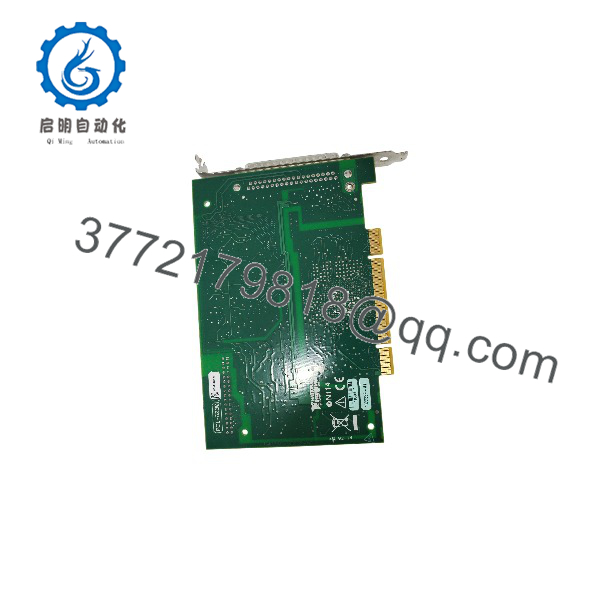
PCI-6230
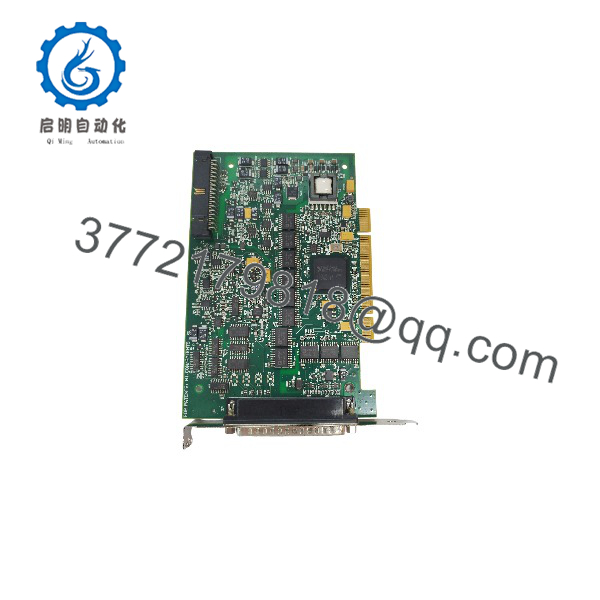
PCI-6230
Is any PCI-6230 a direct replacement, and does the hardware revision matter?
Match the model, OEM ordering number, board revision, accessories, software environment, and startup requirements. NI lists ordering part number 779615-01 for the PCI-6230.
A particularly important revision issue concerns analog output startup behavior. NI’s current specifications list a power-on glitch of ±2 V for 2 ms, but explicitly direct users of the earlier PCI-6230 board marked 192233B-01 to the January 2006 specification document, 371672A-01. Do not apply the later transient specification to that earlier board without checking its applicable document.
❗ A matching model name does not eliminate revision-specific startup risk. Capture the removed board’s identification before ordering.
Can I hot-swap it, and will my program survive replacement?
Plan a powered-down replacement. Place the process in a safe state, isolate external signal energy, shut down the host, disconnect power, and use grounded ESD protection before handling the board.
Preserve the host application, NI-DAQmx configuration, device alias, scaling, channel assignments, ranges, trigger routes, and output startup settings. NI identifies NI-DAQmx as the driver environment for this device; do not treat the card as a PLC CPU containing the machine’s application program.
Record the working OS and driver versions before removal. No specific firmware revision or supported firmware range has been established here. Request revision information from the seller instead of assuming that a newer board or driver will match the existing installation.
What wiring, power, and configuration traps should I check?
- Connector and pinout: Verify the 37-pin D-SUB assignments against the PCI-6230 pinout. Confirm AI GND, AO GND, D GND, and PFI connections individually. A connector that fits is not proof of correct wiring.
- Digital direction: The six digital inputs and four digital outputs have fixed directions. Software cannot turn an input terminal into an output.
- Switches and jumpers: Photograph any actual physical configuration before removal, but do not invent node-address, baud-rate, or termination switches. Preserve the software settings and verify the board’s applicable documentation.
- Power budget: Check both PCI supply rails. NI lists +5 V at 0.5 A and +12 V at 20 mA under no-load conditions, with +5 V rising to 0.75 A under the specified AI/AO overvoltage condition. Do not size the system from the no-load figure alone.
- Planning margin: Leave 20% capacity above the calculated system requirement where practical, while respecting the host’s per-slot and total limits. This is an engineering allowance, not an NI-specified rating.
- ESD handling: Use a grounded wrist strap and ESD-safe work surface. Keep the board in protective packaging until installation.
Is it obsolete or available as new surplus? What warranty applies?
Current OEM lifecycle classification, actual stock, condition, lead time, and seller warranty have not been verified. The available NI product information identifies the model and ordering number; it does not establish a particular seller’s inventory.
Require a quote that states:
- Actual quantity and stock location.
- Committed dispatch date.
- Condition: New Original / New Surplus, Factory Sealed, used, or Refurbished (tested), as supported by evidence.
- Serial number and hardware revision.
- Included accessories.
- Test and calibration documentation.
- Warranty duration, exclusions, and return procedure.
Do not assume “new surplus” means recently manufactured or recently calibrated. A lower price alone establishes neither authenticity nor condition. If a factory seal was opened for testing, disclose that fact.
What inspection and testing should the supplier document?
Request a serial-number-linked acceptance report covering the following sequence. This is a proposed purchasing checklist—not a statement that the offered board has passed testing.
- Inbound inspection and traceability
Review available OEM packing lists, purchase records, and applicable customs declarations. Cross-check board labels and serial numbers. Inspect for corrosion, scratches, rework, discoloration, connector damage, and missing components. Audit manuals and certificates. Check security markings only where that production version actually used them; labels alone do not authenticate a board. - Live functional testing
Identify the conventional PCI test host, OS, NI-DAQmx version, calibrated source, and measurement instruments. Record device detection and available self-test results. After the specified 15-minute warm-up, exercise every analog input and output, all digital lines, both counters, and the required trigger paths. For a specified run exceeding 24 hours, record duration, operating conditions, errors, and temperature observations. A network ping is not a functional test of a PCI card. - Electrical parameter testing
Verify appropriate low-voltage checks and installation grounding using a documented method. Do not apply a blanket 500 V megohmmeter test across signal terminals or PCI contacts. NI’s published dielectric withstand values describe defined insulation barriers; they do not authorize arbitrary field testing. Any insulation-resistance or hipot procedure requires the correct test points, grouping, voltage, and applicable OEM approval. - Firmware, revision, and configuration verification
Record the board revision, software environment, calibration dates, and any device-reported revision data. Preserve configuration screenshots and photographs of actual hardware settings where present. Check startup transients against the revision-specific specification. Keep functional testing separate from external calibration; NI specifies a one-year calibration interval. - Final QC and packaging
Require inspector sign-off, a dated QC label, a serial-linked report, ESD shielding packaging, cushioning, and a rigid corrugated box. Request actual-unit test photos and videos if available. Publish “verified functional under documented test conditions” only when those records exist—not as a substitute for them.