WhatsApp: +86 16626708626
 Email:
  Phone: +86 16626708626
Description
- Key Technical Specifications
| Parameter | Specification |
| Bus Interface | 32-bit, 33 MHz PXI / CompactPCI slot |
| Analog Inputs | 16 Single-Ended (SE) or 8 Differential (DIFF) |
| ADC Resolution | 16 bits |
| Max Sampling Rate | 333 kS/s (single-channel or multi-channel scan) |
| Input Ranges | ±0.05 V to ±10 V (software selectable across 7 gain settings) |
| Analog Outputs | 2 channels, 16-bit resolution, 333 kS/s update rate |
| Digital I/O | 8 TTL/CMOS digital lines |
| Counter/Timers | 2 channels, 24-bit resolution, 20 MHz source frequency |
| On-Board FIFO | 2,048 samples AI buffer, 2,048 samples AO buffer |
| I/O Connector | 68-pin female VHDCI or 68-pin female SCSI-II |
| Operating Temperature | 0 to 55°C |
| Power Requirement | +5 V DC @ 1.7 A (typical from PXI backplane) |
- Product Introduction
The National Instruments PXI-6052E is a 16-bit E Series multifunction data acquisition board engineered for CompactPCI and PXI chassis systems. Operating at sampling rates up to 333 kS/s across 16 single-ended or 8 differential analog input channels, it provides high-resolution Signal Conditioned Data Acquisition (SCXI) control, automated test bench measurements, and high-density laboratory instrumentation interface capability.
Utilizing NI-DAQ driver software, the PXI-6052E delivers precise timing through the onboard NI-PGIA amplifier, ensuring 16-bit accuracy across all input gain settings (from ±0.05 V up to ±10 V). Dual 16-bit analog outputs, 8 digital I/O lines, and two 24-bit counter/timers make this board a standard hardware baseline for legacy PXI systems running LabVIEW, C++, or MATLAB workflows.
- Troubleshooting Quick Reference
| Symptom | Possible Cause | Relevance to this Part | Quick Check Method | Recommendation |
| Board not recognized in MAX (Measurement & Automation Explorer) | PXI backplane slot seating error or PCI bridge driver conflict | ✅ High | Re-seat module in PXI chassis; check Device Manager for yellow bang under NI DAQ Devices | Ensure PXI chassis backplane supply is operational and slot card-guides are aligned. Re-install DAQmx / Traditional NI-DAQ drivers. |
| Noise / Ground Loop on Analog Inputs | Wrong input terminal configuration (RSE vs. DIFF) or unshielded cabling | ❌ Low | Measure voltage offset with inputs grounded locally at the 68-pin terminal block | Verify hardware configuration in software matches wiring. Use shielded twisted-pair cables (SH68-68-EP) for low-voltage signals. |
| Sample Rate / Buffer Overrun Errors | FIFO overflow caused by CPU latency or driver configuration | ✅ High | Run MAX Interactive Panel and test single-buffer vs. continuous DMA transfer | Increase host buffer size in NI-DAQmx or enable DMA data transfers instead of interrupt/programmed I/O. |
| Analog Output drift or static offset | Calibration constant corrupted or thermal warm-up incomplete | ✅ High | Perform Self-Calibrate function in NI MAX after 15-minute system warm-up | Run niselfcal routine. If self-calibration returns error code, internal reference voltage circuit has failed; module replacement required. |
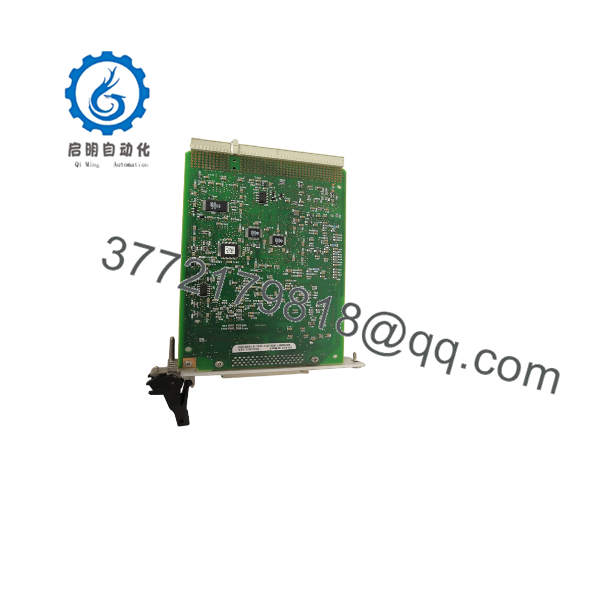
PXI-6052E
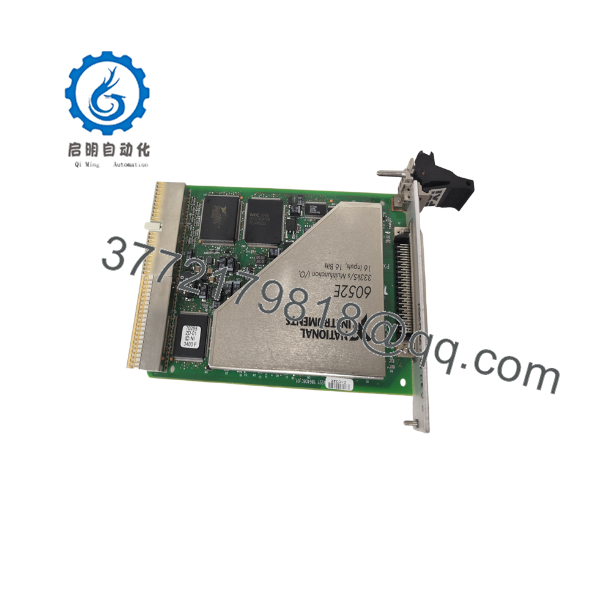
PXI-6052E
- Frequently Asked Questions (FAQ)
Q: Is the PXI-6052E supported by modern NI-DAQmx drivers on Windows 10 or 11?
A: Legacy E Series modules like the PXI-6052E were officially supported up through NI-DAQmx version 17.5 on 32-bit/64-bit Windows operating systems. If you are upgrading your controller to modern 64-bit Windows 10/11 running DAQmx 20.0+, you must verify driver release notes or maintain legacy driver compatibility to ensure hardware detection in NI MAX.
Q: What cable and connector block do I need to interface with the 68-pin connector?
A: The PXI-6052E features a 68-pin connector. It pairs directly with the SH68-68-EP shielded cable and the SCB-68 terminal block for standard screw-terminal signal termination.
Q: Can I use the PXI-6052E in a hybrid PXI Express (PXIe) slot?
A: No. The uses standard PXI/cPCI backplane connectors (J1/J2) and requires a standard PXI slot or a hybrid-compatible PXI slot with standard PCI signaling. It will not physically fit into a dedicated PXI Express (PXIe) peripheral slot.
Q: What is the difference between Single-Ended (SE) and Differential (DIFF) modes on this board?
A: In Single-Ended mode, you get 16 channels referenced to a common ground (AIGND). In Differential mode, channels are paired (0-8, 1-9, etc.) to give 8 independent channels with high common-mode noise rejection. Differential mode is strongly recommended when measuring low-voltage signals or signals coming from floating sources.
Q: What testing is conducted on your surplus or refurbished stock?
A: Every unit goes through a 5-step SOP inspection. We mount the module into a genuine NI PXI chassis, run complete terminal self-diagnostics, verify self-calibration offset limits, and perform a full 24-hour loopback signal acquisition test on all 16 analog inputs and dual analog outputs using a calibrated signal source.