WhatsApp: +86 16626708626
 Email:
  Phone: +86 16626708626
Description
Key Technical Specifications
| Parameter | Value |
|---|---|
| Manufacturer | Pacific Scientific |
| Part Number | 33VM52-000-29 |
| Alternative Format | 33VM5200029 |
| Series | 33VM Low-Inertia PMDC Servomotors |
| Motor Type | Permanent-magnet DC servo motor |
| Nominal Voltage | 24 V DC |
| Published Current Rating | 6.4 A |
| Published Continuous Current Range | 3.1–5.7 A in a broader catalog-derived listing; verify nameplate |
| Torque Constant | 5.9 oz-in/A |
| Terminal Resistance | 0.85 Ω |
| Rotor Inertia | 0.00043 oz-in-sec² |
| Magnet Material | Alnico V-7 |
| Cooling Provision | No forced-air cooling provision listed |
| Feedback Configuration | Base motor configuration may not include encoder or tachometer; verify installed assembly |
| Lifecycle Status | Obsolete; no direct OEM replacement stated in catalog-derived sources |
The strongest part-specific catalog information identifies the 33VM52-000-29 as a 24 V DC, 6.4 A Pacific Scientific permanent-magnet DC servo motor with a 5.9 oz-in/A torque constant, 0.85 Ω terminal resistance, and 0.00043 oz-in-sec² rotor inertia. One broader 33VM listing reports a 3.1–5.7 A continuous-current range, so use the physical motor nameplate and the original machine documentation as the final authority.
Product Introduction
The Pacific Scientific 33VM52-000-29 is a low-inertia permanent-magnet DC servo motor for legacy motion-control equipment. It is designed for axes that must accelerate, decelerate, and settle quickly, including positioners, feeders, indexing mechanisms, small handling equipment, inspection equipment, and specialized machine tools.
This is an older brushed DC servo-motor design, so an exact replacement depends on more than voltage. Confirm the motor nameplate, shaft dimensions, mounting face, connector or lead configuration, feedback device, brake option, load inertia, and existing DC servo amplifier settings. Some sold assemblies include an external encoder, such as an Optocoder LDA-196-100R, but that does not prove every 33VM52-000-29 includes the same feedback device.
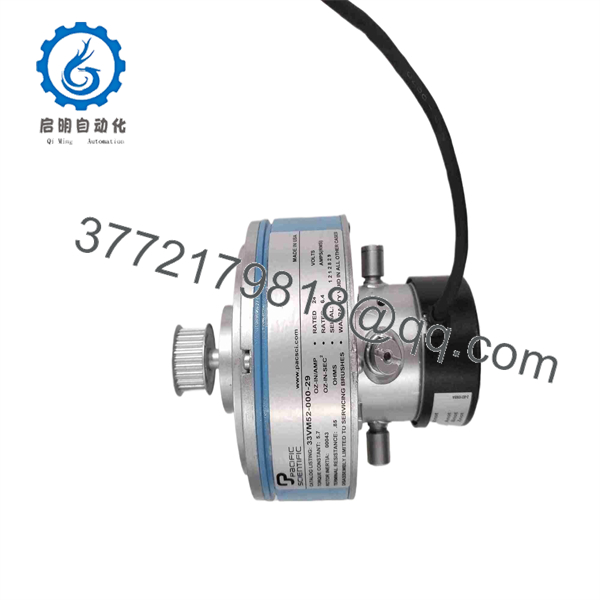
33VM52-000-29
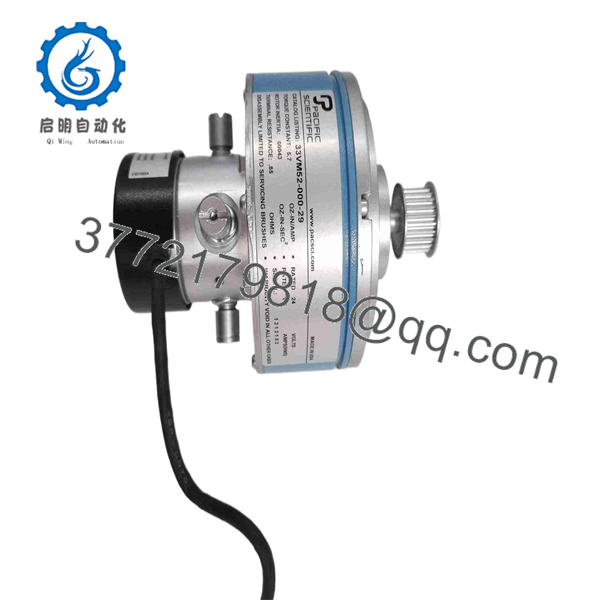
33VM52-000-29
Troubleshooting Quick Reference
| Symptom | Possible Cause | Relevance to This Part | Quick Check Method | Recommendation |
|---|---|---|---|---|
| Axis does not move when commanded | Drive disabled, fuse open, missing DC bus, motor brush failure, cable fault, mechanical jam | ⚠️ Medium | Measure DC bus voltage at the servo-drive output with the correct meter and procedure; inspect drive-enable status and interlocks | Check the amplifier and enable chain before replacing the motor |
| Motor has no torque but drive indicates run | Worn brushes, open armature, broken lead, drive current limit, coupling failure | ✅ High | With power isolated, measure armature resistance across motor leads and compare for stable low resistance; inspect coupling and shaft | Check brushes and wiring first. An open armature or severely worn brush assembly requires motor service or replacement |
| Axis chatters, hunts, or oscillates | Incorrect tuning, tach/encoder fault, loose coupling, excessive backlash, brush commutation issue | ⚠️ Medium | Trend following error and current demand in the drive; inspect couplings, belts, gearboxes, and feedback wiring | Restore the saved drive tuning and resolve mechanical play before condemning the motor |
| Motor overheats during normal duty | Overload, excessive acceleration, wrong current limit, brush wear, armature fault, insufficient cooling | ✅ High | Measure armature current under normal production; compare it with verified continuous-duty limits and check motor-case temperature | Reduce load or acceleration first. Persistent heating at normal current suggests an internal fault |
| Strong sparking visible at brushes | Worn brushes, contaminated commutator, weak brush springs, armature damage | ✅ High | Isolate equipment, remove brush inspection covers only if permitted, and inspect brush length and commutator condition | Do not continue running with heavy arcing. Send the motor for qualified DC servo repair or replace it |
| Motor runs rough or has cyclic speed variation | Commutator damage, brush wear, bearing wear, coupling misalignment, unstable drive output | ✅ High | Run unloaded at low speed where safe; listen for bearing noise and observe current ripple on the drive or scope | Check mechanics and drive output. Roughness that stays with the motor points to bearing or commutator repair |
| Position error increases after motor replacement | Encoder/tach mismatch, wrong polarity, incorrect scaling, feedback coupling slip, drive tuning not restored | ✅ High | Compare feedback device part number, counts per revolution, wiring polarity, and servo parameters with the removed assembly | Do not run automatic motion until direction, feedback count, home position, and travel limits are proven at low speed |
| Motor turns opposite the commanded direction | Armature polarity reversed, feedback polarity reversed, parameter mismatch | ✅ High | Run a supervised low-speed jog and compare commanded versus actual direction; verify lead marking and feedback polarity | Correct wiring or parameters with power isolated. Do not swap leads under power |
| Shaft feels rough when turned by hand | Bearing wear, contamination, crash damage, coupling side-load | ✅ High | Lock out the machine, decouple the load if practical, and rotate the shaft slowly by hand | Replace or repair the motor if roughness, binding, or bearing noise remains after decoupling |
| Replacement motor trips the drive immediately | Wrong voltage or resistance, shorted armature, incompatible feedback, wiring error | ✅ High | Measure armature resistance and insulation according to the OEM procedure; compare full nameplate data and wiring with the old motor | Stop the installation. Verify electrical and feedback compatibility before applying full drive power |
❗ This is a brushed DC servo motor. Brush and commutator condition matter. A motor can pass a simple continuity check and still fail under motion because brushes are worn, springs are weak, or the commutator is damaged. Before ordering a replacement, inspect the motor leads, brush condition, shaft bearings, mechanical coupling, and the amplifier’s output behavior.
If the diagnosis is unclear, send technical support photos of the nameplate, shaft, flange, connector or cable exit, feedback device label, brush area if accessible, drive fault log, and measured armature resistance.
Frequently Asked Questions
What is the Pacific Scientific 33VM52-000-29?
The Pacific Scientific 33VM52-000-29 is a 33VM-series low-inertia permanent-magnet DC servo motor. Part-specific references identify it as a 24 V DC motor with a published 6.4 A rating, a 5.9 oz-in/A torque constant, and Alnico V-7 permanent magnets. It is intended for legacy industrial motion-control axes that require fast speed or position response.
Is the 33VM52-000-29 a brushless servo motor?
No. It is a permanent-magnet DC servo motor from an older motion-control family and should be treated as a brushed DC motor unless the physical motor documentation proves otherwise. That means brush wear, commutator condition, armature continuity, and brush-contact quality are part of routine fault diagnosis.
Does this motor include an encoder or tachometer?
Do not assume it does. The base part-specific motor information does not list an integrated optical encoder or analog tachometer. However, some used assemblies are sold with an attached feedback device, including an Optocoder LDA-196-100R encoder. The installed machine may use a separately mounted encoder, tachometer, resolver, or another feedback arrangement. Verify the actual motor assembly before ordering.
Can I replace this motor with another 24 V DC motor?
Not safely without engineering verification. A replacement must match armature voltage, continuous and peak current capability, torque constant, terminal resistance, rotor inertia, shaft size, mounting face, bearing arrangement, feedback type and resolution, rotation direction, load inertia, and the existing DC servo amplifier. A generic 24 V DC motor can spin but still be unable to stabilize the servo loop or survive the duty cycle.
Is the 33VM52-000-29 obsolete?
Yes. Catalog-derived information identifies the model as obsolete with no direct replacement. Current availability generally comes from new surplus, tested used, refurbished, or repair-channel inventory. Confirm actual stock, physical condition, shaft and connector details, feedback configuration, lead time, and warranty before issuing a purchase order.
Can I hot-swap this servo motor?
No. Shut down the DC servo amplifier, isolate the machine under lockout/tagout, and verify that stored energy in the drive has discharged before disconnecting armature or feedback leads. Removing a DC motor under power can damage the amplifier, arc the connector, and create uncontrolled motion risk.
Will I need to retune the servo drive after replacement?
Possibly. If the replacement is an exact motor and feedback match, the old tuning may be close, but it still needs validation. Differences in rotor inertia, brush condition, bearing friction, feedback resolution, load coupling, or motor constant can change loop response. Start at reduced speed and low acceleration, confirm commanded direction and feedback polarity, then verify following error, current draw, position settling, and temperature before returning to automatic operation.
Why is a New Surplus motor cheaper than factory inventory?
New Surplus normally means unused original inventory released from excess stock, cancelled projects, shutdown spares, or discontinued-system holdings. The lower price may reflect that it is outside a current OEM distribution program, not that it is counterfeit or defective. Still, require actual nameplate photos, shaft and mounting photos, connector photos, storage-condition confirmation, serial traceability where available, and written warranty terms.
What testing should a supplier perform before shipping?
For New Original / New Surplus stock, request exact model verification, visual inspection for corrosion, moisture damage, scratches, UV-yellowing, rework evidence, damaged connectors, and shaft damage. The supplier should verify free shaft rotation and pack the motor in protective, static-safe materials with rigid support around the shaft and connector.
For Refurbished stock, request armature-resistance measurement, insulation testing using a method safe for the installed feedback device, brush and commutator inspection, bearing inspection, shaft-runout check where applicable, and a controlled run on a compatible DC servo amplifier. A useful test report records applied voltage, no-load current, direction, current stability, speed response, temperature during an extended run, feedback operation if fitted, and final quality-control sign-off.