WhatsApp: +86 16626708626
 Email:
  Phone: +86 16626708626
Description
Key Technical Specifications
| Parameter | Value |
|---|---|
| Model code | 591C15005301041000 |
| Product family | Parker SSD / Eurotherm 591C |
| Drive topology | Three-phase, two-quadrant, non-regenerative |
| Rated armature current | 150 A |
| Main input voltage | 220–500 V AC, three-phase, ±10% |
| Supply frequency | 50/60 Hz |
| Auxiliary control voltage | 220 V AC |
| Motor application | DC motor speed and torque control |
| Feedback options | Armature-voltage feedback, tachogenerator, encoder |
| Typical motor rating | Up to approximately 75 kW, application-dependent |
| Communications | RS232/RS485; optional Modbus or Profibus depending on fitted interface |
| Operating ambient | Typically 0–45 °C for lower-current frame sizes; derating may apply |
| Mounting | Panel-mounted enclosure |
| Cooling | Forced-air ventilation |
| Series status | Legacy/obsolete product family; verify replacement availability |
The exact meaning of every digit in 591C15005301041000 should be checked against the unit nameplate and Parker configuration documentation. Published 591C references commonly identify 150 A variants, but auxiliary voltage, feedback hardware, communications, and control-door configuration can differ by code.
Product Introduction
The Parker SSD 591C15005301041000 is a legacy three-phase, two-quadrant DC motor drive for industrial speed and torque control. The 591C platform is used with non-regenerative DC motors in machinery, production lines, and process equipment requiring controlled acceleration and stable armature regulation.
The 591C design provides configurable analog and digital control, armature-voltage or tachometer feedback, and optional serial communications. Confirm the complete product code, auxiliary supply, current rating, feedback board, and installed options before treating this unit as a direct replacement.
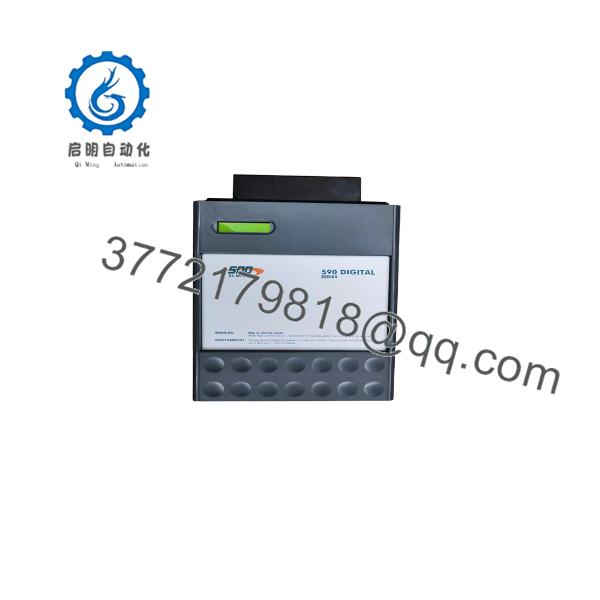
591C15005301041000
Troubleshooting Quick Reference
| Symptom | Possible Cause | Relevance to This Part | Quick Check Method | Recommendation |
|---|---|---|---|---|
| No LEDs or keypad activity | Missing control power, blown fuse, or failed power-supply section | ✅ High | Isolate the drive, then measure the specified 220 V AC control supply at the control terminals | Check fuses, control transformer, and wiring before replacing the drive |
| Main contactor will not energize | External permissive, emergency-stop circuit, or drive inhibit | ❌ Low | Verify run enable, coast-stop, contactor feedback, and terminal voltages against the schematic | Trace the enable chain before condemning the 591C |
| Overcurrent trip at start | Motor fault, incorrect current limit, mechanical jam, or SCR failure | ✅ Medium | Isolate the motor, inspect armature resistance, check shaft freedom, and review the diagnostic indication | Test the motor and load first; replace the drive only after external faults are excluded |
| Motor runs with unstable speed | Faulty tachogenerator, reversed feedback polarity, noise, or tuning error | ✅ Medium | Measure tachometer output while rotating the motor and verify feedback polarity and shielding | Confirm feedback wiring and configuration before replacing the controller |
| Motor runs at uncontrolled speed | Loss of feedback, incorrect feedback selection, or reference wiring fault | ✅ High | Remove the run command safely and verify feedback signal, armature-voltage setting, and reference input | Do not continue operation; investigate feedback and inhibit circuits immediately |
| Field-loss alarm | Open field circuit, blown field fuse, or incorrect field configuration | ❌ Low to ✅ Medium | Measure field voltage and resistance with the drive isolated; inspect field fuses and terminals | Correct the field circuit before replacing the armature controller |
| Communication timeout | Wrong option board, baud rate, node address, cable, or firmware mismatch | ✅ Medium | Check the installed RS232/RS485, Modbus, or Profibus hardware and compare settings with the master | Match the exact option configuration and firmware requirements |
| Drive trips after warming up | Blocked ventilation, fan failure, overloaded motor, or aged components | ✅ Medium | Check fan operation, cabinet temperature, heatsink temperature, and motor current under load | Correct airflow and overload conditions; use a tested replacement if thermal faults remain |
| I/O points appear inactive | Incorrect terminal wiring, missing common, or inactive configuration | ❌ Low | Measure 0–10 V or contact signals directly at the assigned terminals and check configuration parameters | Verify field wiring and parameter mapping before replacing the drive |
| SCR or armature fault indication | Failed thyristor, gate-pulse circuit, current transformer, or motor short | ✅ High | Apply only the manufacturer-approved isolation and semiconductor test procedure; inspect diagnostic logs | A qualified technician should test the power stack before return-to-service |
| Drive powers up but will not retain settings | Failed memory, low control voltage, or incorrect save procedure | ✅ Medium | Record parameters, cycle control power, and verify whether values persist | Back up settings before replacement; confirm whether the fitted control board retains configuration |
Never assume a dead 591C is defective until the 220 V AC control supply, fuses, inhibit chain, motor field, feedback circuit, and run reference have been checked. For unresolved faults, provide technical support with clear photos of the nameplate, terminal wiring, option boards, display codes, and diagnostic logs.
Frequently Asked Questions (FAQ)
What is Parker 591C15005301041000?
It is a Parker SSD/Eurotherm 591C digital DC drive configured for three-phase, two-quadrant operation. The 591C family is intended for non-regenerative DC motor speed and torque control, not four-quadrant regenerative braking.
Is this model obsolete?
The 591C is a legacy product family, and availability depends on remaining new-surplus, used, or refurbished stock. Do not assume a current Parker replacement has identical terminals, firmware, feedback hardware, or configuration parameters. Verify the complete nameplate code before ordering.
Can I use it as a direct replacement?
Only after comparing the full code and installation requirements. Check the armature current, main input voltage, auxiliary control voltage, field supply, feedback type, control terminals, communications option, mounting dimensions, and parameter set. Similar-looking 591C variants can have different control configurations.
Will the programming be retained during a swap?
Do not rely on the replacement retaining the original machine settings. Record every parameter, DIP-switch position, jumper position, feedback selection, and terminal connection before removing the old drive. A parameter backup or written commissioning sheet is strongly recommended.
Can this drive be hot-swapped?
Treat it as not hot-swappable. Isolate the main supply, auxiliary control supply, field supply, and stored DC energy according to the site lockout/tagout procedure before removal. Confirm zero voltage with a properly rated meter; the DC bus and power section can remain hazardous after shutdown.
Why might this unit cost less than a factory replacement?
Legacy-drive pricing usually reflects surplus inventory, discontinued OEM support, or refurbished-market status—not equivalent factory-new production. The listing should state whether the unit is factory sealed, new surplus, used, or refurbished and tested. Request serial-number photos, test results, and the applicable warranty before purchase.
What should I verify before ordering?
Send the seller the complete nameplate photograph and confirm 591C15005301041000, current rating, voltage code, auxiliary supply, feedback board, communications option, physical frame size, and condition. Also confirm stock status, dispatch lead time, warranty duration, and whether a functional test report is included.