WhatsApp: +86 16626708626
 Email:
  Phone: +86 16626708626
Description
Key Technical Specifications
| Parameter | Value |
|---|---|
| Model | DR1008B-230 |
| Manufacturer | Parker Hannifin / Compumotor |
| Product Family | DYNASERV DR Series |
| Motor Series | DR-B |
| Voltage Version | 230 VAC |
| Motor Type | Brushless direct-drive servo motor |
| Feedback | Brushless resolver |
| Peak Torque | 8 N·m / 6 lb-ft |
| Rated Speed | 2.0 rps at 230 VAC |
| Maximum Speed | 2.0 rps for the 230 VAC version |
| Maximum Resolution | 507,904 steps/rev |
| Motor Construction | DR-B direct-drive configuration |
| Rotor Inertia | Approx. 15 × 10⁻³ oz-in·s² / 7.9 × 10⁻⁴ kg·m² |
| Maximum Power Consumption | 0.8 kVA at 230 VAC |
| Mounting | Direct-drive flange mounting |
| Motor Cable | Dedicated DYNASERV motor connection |
| Feedback Cable | Dedicated resolver connection |
| Application | Rotary indexing, precision positioning, machine-tool and automation axes |
Parker’s motor data lists the DR1008B at 8 N·m peak torque, 2.0 rps rated speed for both 115 and 230 VAC configurations, 0.4/0.8 kVA maximum power consumption, and 507,904 maximum resolution. Parker’s current DYNASERV page describes the DR family as brushless-resolver direct-drive motors.
The DR1008B has a special mechanical configuration compared with other DR-B motors. Parker’s documentation provides a separate dimensional drawing specifically for the DR1008B, including six M5 mounting holes with a maximum depth of 5 mm and six M6 holes with a maximum depth of 12 mm.
Product Introduction
The Parker DR1008B-230 is a DYNASERV DR-B Series brushless direct-drive servo motor designed for rotary positioning without a conventional mechanical gearbox. The 230 VAC version provides up to 8 N·m peak torque and a rated speed of 2.0 rps, with resolver feedback used by the compatible DYNASERV drive for commutation and position control.
The motor is suited to precision rotary axes where direct coupling reduces the need for gear reduction. Its compact DR1008B mechanical design uses a dedicated mounting pattern, so dimensional compatibility and the correct Parker DYNASERV drive/feedback interface must be verified before substitution.
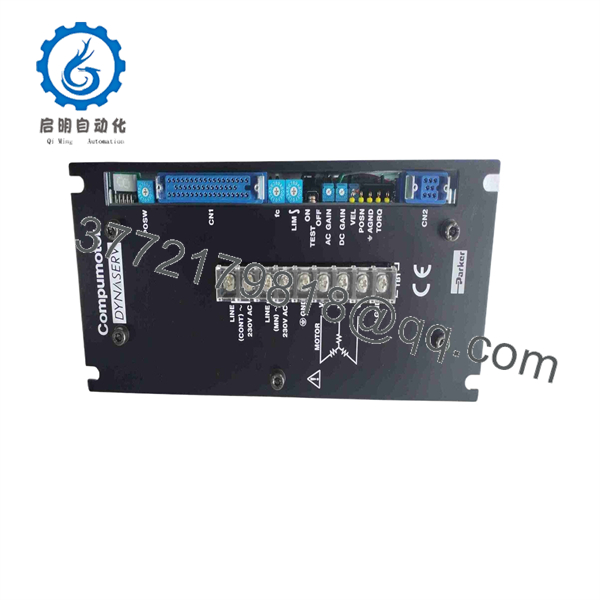
DR1008B-230
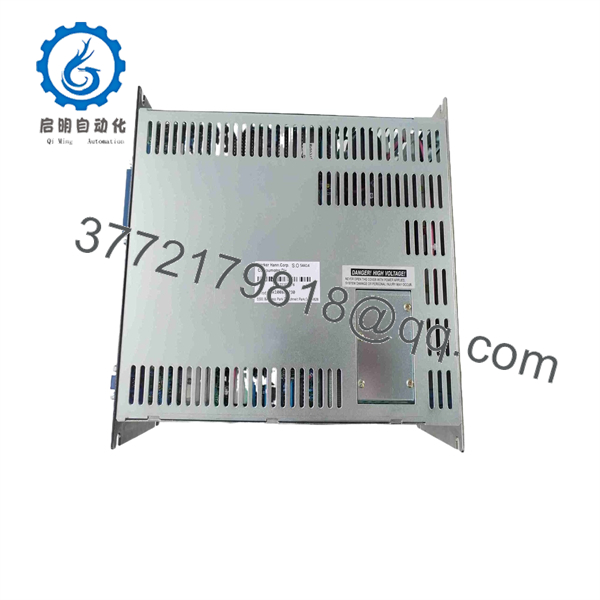
DR1008B-230
Installation & Configuration Guide
Stage 1 — Pre-Installation Preparation
- Verify the motor nameplate shows or the exact Parker equivalent required by the machine.
- Confirm that the existing drive is compatible with the DR-B resolver motor and the 230 VAC motor version.
- Record the existing motor orientation, shaft/load coupling position, resolver wiring, motor wiring, and drive parameters.
- Back up the DYNASERV drive parameters and machine-axis calibration data before removal.
- Apply the plant’s approved electrical isolation and lockout/tagout procedure.
- Prepare ESD protection, torque-controlled mechanical tools, alignment equipment, and the correct Parker cables/connectors.
- Do not energize the motor until the drive, motor, resolver, grounding, and mechanical coupling have all been checked.
Stage 2 — Removing the Old Motor
- Isolate all electrical power and verify the DC bus has discharged according to the applicable drive manual.
- Disable the machine axis and mechanically secure the driven load.
- Record shaft/coupling orientation before disconnecting the motor.
- Disconnect the motor power and resolver feedback cables.
- Remove the mechanical coupling or direct-drive attachment without applying impact loads to the motor bearings.
- Remove the mounting hardware and lift the motor using appropriate handling equipment.
- Inspect the machine mounting surface, coupling, cable connectors, and grounding points for damage or contamination.
Stage 3 — Installing the New Motor
- Confirm the replacement motor is , not the 115 VAC variant.
- Compare the flange and mounting-hole pattern with the removed motor. The has a dedicated mounting configuration, so do not assume another DR-B motor is mechanically interchangeable.
- Install the motor without forcing the shaft or mounting flange into alignment.
- Torque mounting fasteners according to the machine builder’s or Parker’s applicable specifications.
- Align the driven load and confirm there is no excessive radial or axial loading.
- Connect the correct motor power cable and resolver feedback cable.
- Restore the recorded drive parameters and verify the resolver configuration, motor model, direction, current limits, acceleration/deceleration limits, and position parameters.
- Check cable shielding and protective grounding before applying power.
Stage 4 — Power-On & Testing
- Perform a final mechanical and electrical inspection before energizing the system.
- Verify the drive recognizes valid resolver feedback and does not report an encoder/resolver fault.
- Check motor direction at low speed with the load safely controlled.
- Confirm the axis can reach the required position without excessive following error or oscillation.
- Test acceleration, deceleration, stopping, and holding behavior at reduced machine speed first.
- Run the machine through a controlled dry cycle before returning to production.
- If the motor does not commutate correctly, immediately remove the enable command and check resolver wiring, motor phase connections, drive compatibility, parameter settings, and mechanical load conditions.
Frequently Asked Questions (FAQ)
Q1: What is the Parker -230?
It is a Parker Compumotor DYNASERV DR-B Series direct-drive brushless servo motor for precision rotary motion. The 230 designation identifies the 230 VAC version documented in Parker’s DYNASERV material.
Q2: What is the peak torque of the -230?
The published motor data specifies 8 N·m (6 lb-ft) peak torque for the .
Q3: What is the rated speed?
The is specified at 2.0 rps for the 230 VAC configuration. That corresponds to approximately 120 rpm.
Q4: Does the -230 use an encoder?
The DYNASERV DR family uses brushless resolver feedback, rather than a conventional incremental encoder. Parker’s current product information identifies brushless resolver feedback as a characteristic of the DR direct-drive motor family.
Q5: Can a -115 replace a -230?
Do not treat the two versions as electrically interchangeable. Parker publishes separate 115 V and 230 V performance curves for the DR-B series. The drive, supply configuration, and machine wiring must be checked before substitution.
Q6: Is -230 still a current-generation Parker motor?
It is a legacy DYNASERV product. Parker still provides technical/support documentation, but its support archive identifies the material among legacy DYNASERV resources. Current Parker documentation also provides a recommended replacement path for the older DYNASERV family.
Q7: What should be verified before purchasing a replacement?
Verify the complete motor marking, , voltage version, resolver feedback, mounting dimensions, cable/connector configuration, and the exact compatible DYNASERV drive. The has a dedicated mechanical drawing, so flange and mounting-hole dimensions should be checked rather than relying on the general DR-B family description.