WhatsApp: +86 16626708626
 Email:
  Phone: +86 16626708626
Description
Key Technical Specifications
- Manufacturer: Portescap, historically associated with Danaher Motion
- Part Number: 57M300B5A
- Product Type: Synchronous AC motor assembly
- Published Application Description: Motor assembly for test-bulb equipment; verify against the installed machine BOM
- Nominal Supply Voltage: 120 V AC
- Nominal Supply Frequency: 60 Hz
- Nominal Speed: 300 RPM
- Operating Principle: Line-frequency synchronous motor; speed depends on supply frequency and internal gear/pole configuration
- Rotation Direction: Verify from the physical motor label, wiring diagram, or rotation arrow before installation
- Motor Shaft: Confirm shaft diameter, length, flat/keyway, thread, and coupling geometry from the actual unit
- Mounting: Confirm mounting-hole pattern, pilot diameter, body length, and cable exit orientation before purchase
- Lead/Connector Configuration: Verify wire count, lead length, connector type, and terminal identification before replacement
- Reported Weight: Approximately 0.253 kg / 0.56 lb for one pre-owned listing; treat this as reference only
- Lifecycle Status: Discontinued / legacy motor assembly
Available industrial references consistently identify the Portescap 57M300B5A as a 120 V AC, 60 Hz, 300 RPM motor assembly and list it as discontinued. Listings conflict on whether to call it a synchronous motor, a stepper motor, or a “test bulb” motor assembly. The published electrical and speed values are usable for identification, but mechanical dimensions, torque, wiring, direction, gearbox details, and exact end use must be confirmed from the physical motor and machine documentation.
Product Introduction
The Portescap 57M300B5A is a fixed-speed 120 V AC motor assembly rated at 300 RPM on a 60 Hz supply. It is used in legacy equipment requiring repeatable low-power rotary motion, and industrial inventory sources describe the assembly as a motor for test-bulb equipment.
This is not a servo motor or a variable-frequency drive motor. It should be replaced only when the incoming 120 V AC supply, frequency, mechanical mounting, shaft coupling, direction of rotation, and wiring match the installed unit. The part number is critical because a 300 RPM motor with the wrong shaft or gear arrangement will not solve the field problem.
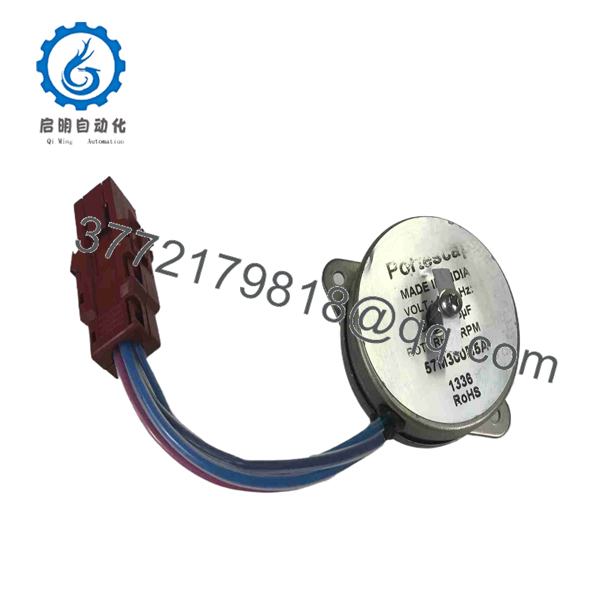
57M300B5A
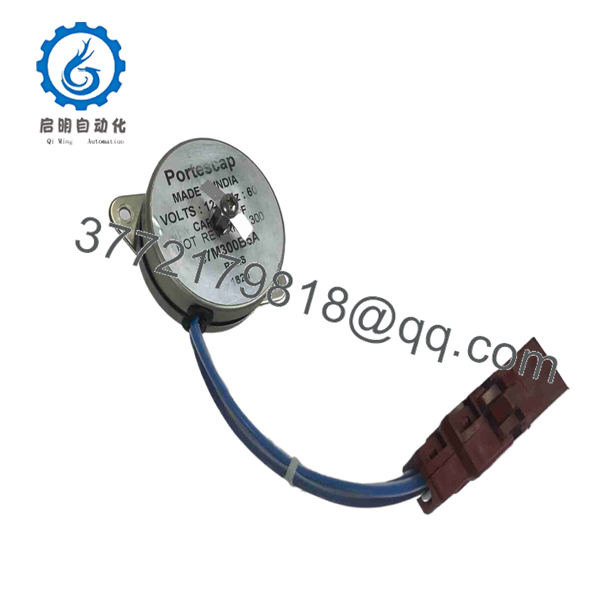
57M300B5A
Troubleshooting Quick Reference
| Symptom | Possible Cause | Relevance to This Part | Quick Check Method | Recommendation |
|---|---|---|---|---|
| Motor does not turn | No 120 V AC supply, open fuse, failed switch/relay, broken lead, seized load, failed winding | ⚠️ Medium | Measure 120 V AC across the motor supply leads during the run command using a properly rated meter | Verify control power and relay output before replacing the motor |
| Correct 120 V AC is present but shaft does not rotate | Seized gearbox/load, failed winding, rotor obstruction, damaged internal gear train | ✅ High | Isolate power, disconnect the driven load if possible, and check whether the shaft rotates freely by hand | If mechanics are free and rated voltage is present, replace or bench-test the motor |
| Motor hums but will not start | Mechanical binding, excessive load, failed internal mechanism, incorrect voltage | ✅ High | Remove or decouple the load where safe; verify supply voltage does not sag during start attempt | Do not leave a humming motor energized. It can overheat and damage the winding |
| Motor runs slowly | Supply frequency incorrect, low supply voltage, overloaded shaft, slipping coupling, internal gear wear | ⚠️ Medium | Measure supply voltage and frequency at the motor terminals; verify speed against expected 300 RPM on 60 Hz | Check power source and mechanics first. A 50 Hz supply may change the actual operating speed |
| Motor overheats | Jammed load, continuous stall, incorrect supply voltage, bearing wear, blocked ventilation | ✅ High | Measure motor-case temperature after a controlled run and inspect the driven mechanism for binding | Remove power if it becomes excessively hot. Correct the external load before fitting another motor |
| Motor is noisy or shaft feels rough | Bearing wear, damaged gears, bent shaft, coupling misalignment, debris in driven equipment | ✅ High | Lock out the equipment, decouple the load if practical, and rotate the shaft by hand | Replace or repair the motor if roughness remains with the load disconnected |
| New motor turns but machine motion is wrong | Wrong rotation direction, wrong shaft engagement, incorrect gear ratio, coupling installed incorrectly | ✅ High | Run a brief supervised jog with guards and safety controls in place; compare rotation and output travel with the removed motor | Stop immediately if motion is opposite or overtravels. Verify wiring and mechanical compatibility |
| Motor trips a fuse or breaker | Shorted winding, damaged cable, wrong voltage connection, failed relay/contactor, insulation breakdown | ✅ High | With power isolated, inspect leads and measure winding continuity; use only an OEM-appropriate insulation test method | Determine whether the fault follows the motor, cable, or upstream control circuit before replacement |
| Replacement motor does not fit | Shaft, mounting pattern, lead length, connector, body dimensions, or gear configuration differs | ✅ High | Compare all dimensions and photographs of the original and replacement before shipment | Do not machine or force-fit a motor without engineering approval. Request the exact 57M300B5A assembly |
❗ A 300 RPM rating assumes the specified 60 Hz supply. Do not install this motor on a 50 Hz power source or feed it from a VFD unless the machine manufacturer has explicitly approved the arrangement. Speed, torque, heating, and timing can change.
Before removal, photograph the motor label, mounting face, shaft and coupling, wire colors, terminal positions, cable routing, and the driven mechanism. Measure shaft diameter and usable shaft length with calipers. Those two measurements prevent the most common wrong-part purchase.
If diagnostics remain unclear, provide technical support with a photo of the full label, AC voltage and frequency readings at the motor, a video of the start behavior, shaft dimensions, mounting-hole spacing, and details of the driven load.
Frequently Asked Questions
What is the Portescap 57M300B5A?
The Portescap 57M300B5A is a 120 V AC, 60 Hz motor assembly with a published speed of 300 RPM. It is commonly identified as a synchronous AC motor and is listed by industrial sources as discontinued.
Is the 57M300B5A a servo motor?
No. Treat it as a fixed-speed AC motor assembly, not a servo motor. It does not provide the closed-loop encoder feedback, controllable torque profile, or variable positioning normally associated with a servo axis. Its published application is simple rotary actuation at a nominal 300 RPM on 120 V AC, 60 Hz.
Is it a synchronous motor or a stepper motor?
The most specific industrial sources call it a synchronous AC motor or motor assembly. One secondary-market listing calls it a “stepper motor,” but its stated 120 V AC, 60 Hz, 300 RPM ratings align with a line-powered synchronous motor application rather than a conventional low-voltage pulse-driven stepper motor. Use the actual label and wiring diagram as the final authority.
Can I use this motor on 230 V AC?
No. The available part-specific sources identify this motor as 120 V AC, 60 Hz. Applying 230 V AC to a 120 V AC motor can immediately overheat or destroy its winding. Verify the input voltage at the machine and the rating on the physical motor label before energizing it.
Can I run this motor from a VFD?
Usually, no. This is a fixed-speed synchronous AC motor intended for a 60 Hz AC supply. A VFD can alter voltage, frequency, waveform, speed, torque, and internal heating. Do not connect it to a VFD unless the machine OEM provides a compatible motor-control specification and has verified the driven mechanism can operate safely across the intended frequency range.
Is the 57M300B5A obsolete?
Yes. Industrial supply references list the Portescap 57M300B5A as discontinued. Current supply may consist of New Surplus, used, refurbished, or repair-channel inventory. Confirm actual physical stock, condition, full label, shaft condition, lead configuration, mechanical dimensions, and warranty before issuing a purchase order.
Why does the motor hum but not rotate?
A humming motor with applied voltage commonly indicates a mechanically seized load, damaged bearing or gear train, blocked rotor, low supply voltage, or internal winding/mechanism fault. Shut it down rather than leaving it energized. First decouple the load where safe and confirm that the shaft turns freely. If it still hums with correct 120 V AC supply and no mechanical load, the motor likely needs replacement or qualified repair.
What testing should a supplier perform before shipping?
For New Original / New Surplus stock, request exact part-number verification, label and date-code photographs, inspection for corrosion or storage damage, shaft-condition photos, mounting-face photographs, lead or connector photographs, and confirmation of the motor’s stated 120 V AC, 60 Hz rating.
For used or refurbished stock, request a documented functional test at 120 V AC, 60 Hz. The test should verify startup, stable rotation near the specified 300 RPM, current draw, direction of rotation, abnormal noise, vibration, no-load temperature rise, lead/connector condition, shaft runout where practical, and final quality-control sign-off. Ask for a test video, actual unit photos, written condition statement, and warranty terms before shipment.