WhatsApp: +86 16626708626
 Email:
  Phone: +86 16626708626
Description
3. Key Technical Specifications
| Parameter | Value |
|---|---|
| Imager | 2/3″ progressive scan interline-transfer CCD |
| Active Pixels | 768 (H) × 484 (V) |
| Pixel Size | 11.6 µm × 13.6 µm |
| Resolution (TV) | 570 (H) × 484 (V) lines |
| Frame Rate | 30 fps progressive / 60 Hz 2:1 interlace |
| Video Output | 1.0 V p-p composite 75 Ω + 8-bit RS-422 |
| S/N Ratio | 50 dB min (AGC off) |
| Min. Illumination | 1.0 lux (F=1.4, no IR cut) |
| Shutter | Full-frame electronic, 1/60 – 1/16,000 sec |
| Lens Mount | C-mount, 2/3″ format, back-focus adjustable |
| Power | 12 V DC, 420–500 mA |
| Operating Temperature | −10 °C to +50 °C |
| Dimensions / Weight | 44 × 48 × 136 mm / 323 g |
4. Product Introduction & Supply Chain Strategy
The PULNiX TM-9701 is a compact monochrome progressive-scan CCD camera that captures full-frame images of fast-moving objects without strobe lighting. It is used in machine-vision inspection, automated assembly verification, barcode reading, ITS, and scientific imaging lines that still rely on its internal frame memory and asynchronous reset capability.
Securing this unit as New Surplus protects Total Cost of Ownership. Genuine new-surplus stock avoids the hidden failure risk of refurbished cameras (degraded CCDs, aging capacitors) that can cause unplanned line stops. For an EOL progressive-scan platform, holding 1–2 units as buffer stock eliminates lead-time variability and last-time-buy pressure while remaining far below current OEM list pricing.
5. Installation & Configuration Guide
Stage 1: Pre-Installation (Prep & Safety)
Perform lock-out/tag-out on the host system and any 12 V power supply. Wear a grounded ESD wrist strap. Photograph the existing camera’s rear dial switch (shutter speed), lens orientation, cable routing, and any external trigger wiring. Verify the replacement unit is New Surplus and still in original anti-static packaging.
Stage 2: Removal
Disconnect the 12-pin power/video cable and any digital I/O cable. Support the camera body while unscrewing the C-mount lens. Extract the unit carefully; avoid stressing the rear connectors or bending pins.
Stage 3: Installation (Clone & Seat)
Mount the new TM-9701 using the same 1/4″-20 or 3/8″-16 holes. Re-install the original C-mount lens and set back focus if required. Set the rear 10-position dial switch to the exact shutter speed recorded from the old unit. Reconnect power, composite, and digital cables in the identical orientation.
Stage 4: Power-On & Testing
Apply 12 V DC and confirm current draw is within 420–500 mA. Observe the video output on a monitor or frame grabber; verify progressive or interlace mode, absence of ERR indicators, and correct asynchronous reset response. Capture a test image under production lighting and confirm full 484-line vertical resolution before returning the line to service.
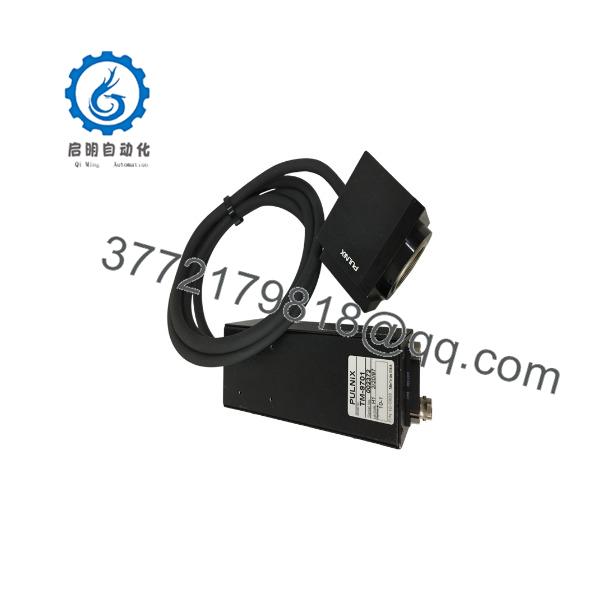
TM-9701
6. Firmware/Software Versions & Upgrade Notes
The TM-9701 uses fixed internal timing and a hardware dial switch for shutter control; no user-accessible firmware file is field-upgradable in the classic sense. Factory timing is locked to 14.31818 MHz pixel clock and standard RS-170 / progressive formats.
Do not attempt to force a newer progressive-scan camera or different timing board into the same frame-grabber configuration without verifying horizontal/vertical drive compatibility. Mismatched external HD/VD or VINIT polarity will produce incomplete frames or loss of asynchronous reset. Keep the original shutter dial setting and cable pin-out documented; changing either without re-qualification of the vision system risks false rejects or missed inspections.
7. Frequently Asked Questions (FAQ)
Q: Is this truly New Surplus or is it refurbished?
A: Brand New Surplus only. Original OEM manufacturing, original packaging opened solely for QC, zero operating hours, no pulled or repaired units.
Q: Why is the price lower than current OEM list but higher than used/refurbished offers?
A: Pricing reflects genuine new-surplus inventory secured from authorized channels. It is substantially below current list while eliminating the secondary failure cost of refurbished cameras that often surface after a few months of production use.
Q: Is the TM-9701 still in active production or is it EOL?
A: This is a legacy progressive-scan model. Strategic buffer stock of 1–2 units is the recommended approach for plants that still depend on its full-frame shutter and internal memory.
Q: Can I hot-swap the camera while the line is running?
A: No. Always follow LOTO, remove power, and verify the frame grabber is offline before cable disconnection. Live insertion risks damage to the camera electronics and the host interface.
Q: Will the new unit retain the same shutter and trigger behavior?
A: Yes, provided the rear dial switch is set identically and the external VINIT / HD / VD signals match the previous installation. Document the dial position before removal.
Q: What warranty is provided?
A: Standard 1-year warranty covering manufacturing defects. Full QC test report and serial-number traceability are supplied with every unit.
Q: Do you support last-time-buy or cross-site inventory sharing?
A: Yes. For multi-plant users of the TM-9701 we can coordinate consolidated New Surplus holdings to minimize total carrying cost while protecting against stock-outs.