WhatsApp: +86 16626708626
 Email:
  Phone: +86 16626708626
Description
Key Technical Specifications
| Parameter | Value / Feature Specification |
| Part Number | DSA-MTR12A2 |
| Motor Type | AC Brushless Permanent Magnet Servo Motor |
| Primary System Family | Reliance AutoMax / Distributed Power System |
| Supply Voltage | 230 / 460 VAC (Drive Dependent) |
| Phase / Frequency | 3-Phase AC / Variable Frequency |
| Feedback Mechanism | High-precision Resolver / Optical Encoder |
| Enclosure Rating | IP65 (Dust-tight and splash-proof housing) |
| Cooling Method | Totally Enclosed Non-Ventilated (TENV) / Convection |
| Mounting Standard | NEMA Standard Flange / IEC Metric Flange |
| Insulation Class | Class H Insulation |
| Operating Temperature | 0°C to +40°C (32°F to +104°F) |
| Compatible Drives | Reliance AutoMax Drives, Electro-Craft, Allen-Bradley Ultra Series |
Product Introduction & Supply Chain Strategy
The Reliance DSA-MTR12A2 is a high-performance AC brushless servo motor engineered for demanding motion control, web handling, and automated assembly operations using Reliance Electric AutoMax architecture. Utilizing high-coercivity permanent magnets and robust stator winding insulation, this motor delivers immediate torque response, smooth low-speed rotation, and steady continuous output across harsh industrial environments.
This product is a Brand New Surplus unit. It is not used, not pulled from a decommissioned plant, and not refurbished. All modules undergo rigorous quality verification to ensure OEM-level reliability. Holding this motor as New Surplus inventory is a high-ROI strategy. Because Reliance Electric legacy automation lines have been discontinued by Rockwell Automation, sourcing an exact drop-in replacement during a sudden mechanical or feedback coil failure is nearly impossible through standard distribution. Sourcing genuine New Surplus protects your plant from multi-week lead times while bypassing the high failure rates, thermal degradation, and rotor magnet wear associated with second-hand repairs.
Installation & Configuration Guide
1.Pre-Installation Preparation & Safety:Prerequisite.
Enforce complete Lock-Out/Tag-Out (LOTO) on the incoming line reactor and drive controller. Ensure all stored energy in the drive’s DC bus capacitors has fully bled off before touching motor wiring. Inspect the motor shaft keyway and mounting face for transit protection coatings; clean thoroughly using a non-corrosive solvent. Equip yourself with an ESD-safe strap when handling feedback resolver cables. Take reference photos of the mechanical coupling alignment, terminal box wiring, and grounding connections.
2.Mechanical Uncoupling & Motor Removal:
Remove protective guarding around the mechanical load coupling or gearhead. Unbolt the motor coupling hubs using appropriate pullers—never hammer directly on the motor shaft to avoid damaging the internal precision bearings or feedback resolver disc. Label and disconnect the power lead junction (U, V, W, PE) and the feedback resolver cable. Unbolt the mounting fasteners from the motor flange and carefully lift the motor from its base.
3.Mechanical Mounting & Alignment:
Align the new DSA-MTR12A2 motor flange with the mounting face and hand-tighten the mounting bolts. Use a dial indicator to check radial and axial runout; dial in shaft alignment to within ±0.05 mm (±0.002 in) to prevent premature bearing wear and vibration. Torque the mounting bolts evenly in a cross pattern to manufacturer specification. Secure the coupling hub to the shaft keyway without applying axial shock loads.
4.Electrical Wiring & Commutation Testing:
Connect motor power phases (U, V, W) and protective earth (PE) at the terminal box, ensuring correct phase rotation to match drive output. Connect the feedback connector, making sure the connector shield is grounded 360° at the cable gland. Apply low-voltage power to the drive controller and perform a manual motor commutation/resolver offset check via drive diagnostics. Jog the motor at low RPM to verify smooth rotation, normal temperature rise, and correct feedback polarity.
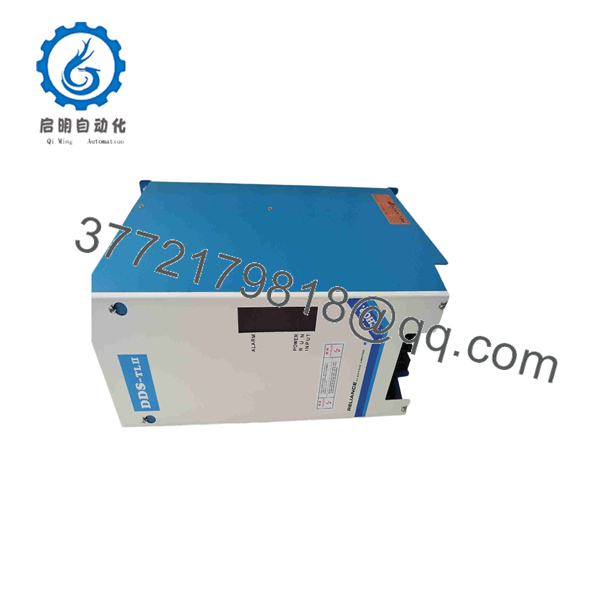
DSA-MTR12A2
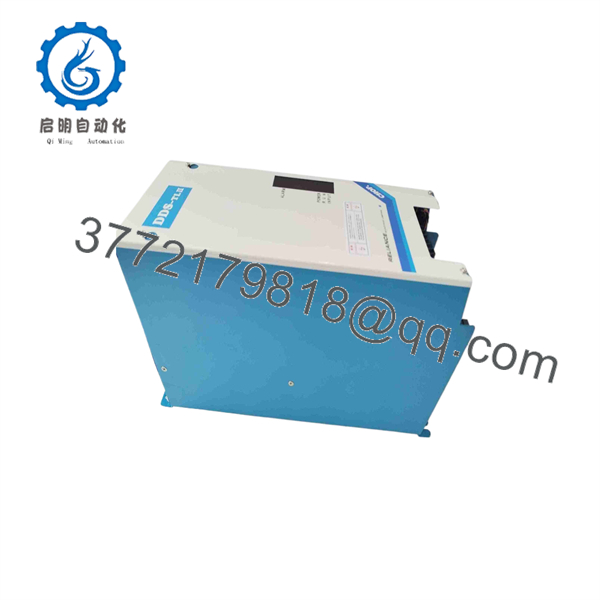
DSA-MTR12A2
Firmware/Software Versions & Upgrade Notes
- Feedback Signal Alignment: The DSA-MTR12A2 relies on factory-aligned resolver/encoder feedback for electronic commutation. Replacing or adjusting the feedback housing without specialized alignment tools will result in runaway motor conditions or immediate drive overcurrent trips (
F04/F12hardware faults). - Drive Parameter Configuration: When replacing an older generation Reliance motor, verify that the motor thermal model (I^2t), continuous current rating (I_{cont}), and pole count settings match the drive’s parameter table (e.g., AutoMax or Ultra Series motor database files).
- Encoder/Resolver Compatibility: Ensure that the drive interface card (such as a Reliance Resolver Input Module) is configured for the correct transformation ratio and phase angle corresponding to the
DSAseries specifications. - Firmware Version Caution: If updating the motion controller or drive firmware during a motor swap, cross-reference compatibility matrices. Upgrading drive firmware without updating motor parameter files can overwrite tuned velocity loop gains (K_p, K_i), leading to mechanical resonance.
Frequently Asked Questions (FAQ)
Why buy a New Surplus Reliance motor instead of sending my broken unit out for a rewind/rebuild?
Motor rewinds often alter the stator slot fill factor, magnetic core permeability, and original insulation class, reducing motor efficiency and thermal thresholds. Additionally, rebuilding a feedback resolver requires factory alignment equipment that many local repair shops lack. A New Surplus DSA-MTR12A2 provides original OEM winding specs, factory-aligned feedback, and immediate availability without waiting weeks for a repair shop return.
Is the Reliance DSA-MTR12A2 motor guaranteed to be unused?
Yes. Our New Surplus inventory consists of brand-new, unused motors obtained from spare parts reserves, plant expansion cancelations, or excess OEM warehouse stock. They feature clean shaft keyways, pristine mounting flanges, original insulation resistance levels, and zero runtime hours.
How do you verify the quality of legacy mechanical items like servo motors?
Every motor undergoes strict inbound quality inspection. We perform megohmmeter (Hi-Pot) insulation testing across all stator windings, measure phase-to-phase resistance balance, inspect shaft runout, perform surge testing, and verify feedback resolver signal integrity on an unpowered test stand prior to ESD-safe packaging.
Can I mount this servo motor in any physical orientation?
Yes, the can be mounted horizontally or vertically (shaft up or shaft down), provided the flange seal and cable gland entries are correctly oriented to prevent liquid ingress. When mounting shaft-up, ensure drip loops or liquid-tight conduits are installed to keep oil and coolants away from the shaft seal.
What causes immediate drive tripping (overcurrent/ground fault) right after installing a replacement motor?
The most common causes are reversed power phase wiring (swapping U and V phases causes positive feedback runaway), improper grounding shield connections introducing electrical noise into the resolver feedback cable, or mismatched drive motor code parameters. Double-check phase continuity and ground shielding before re-enabling the drive loop.
What warranty coverage is included with this motor?
This New Surplus unit comes complete with our comprehensive 1-to-2 year replacement warranty. Should any manufacturing defect or performance failure occur under standard operating conditions within the warranty period, we will immediately provide a replacement unit from our emergency surplus stock.