WhatsApp: +86 16626708626
 Email:
 Phone: +86 16626708626
Description
Key Technical Specifications
- Manufacturer: Square D (Schneider Electric)
- Part Number: KAL26250
- Product Family: KAL series molded case circuit breakers
- Frame Type: K-Frame (250 A frame)
- Number of Poles: 2
- Phase: 1-phase (used on single-phase or 2-wire circuits)
- Rated Current: 250 A (fixed thermal trip, LI – Long-Time & Instantaneous)
- Voltage Rating: 600 VAC
- Interrupting Rating: 25 kAIC @ 480 VAC (standard interrupting capacity for KAL)
- Trip Type: Thermal-magnetic (LI: Long-Time + Instantaneous)
- Terminal Connection: Feed-thru lugs (line and load side)
- Mounting: Free-standing / panel-mount (bolt-on style per K-frame design)
- Standards: UL listed, CSA certified; meets NEMA / IEC molded case breaker standards
- Approx. Weight: 8 lbs (≈ 3.6 kg)
Note: Exact short-circuit ratings at 240 V / 600 V, DC ratings, and accessory compatibility vary by revision and region. Always verify against the nameplate and project short-circuit study before installation.
Product Introduction
The Square D KAL26250 is a 250 A, 600 VAC, 2-pole molded case circuit breaker from the legacy KAL (K-Frame, high interrupting) family. It provides thermal-magnetic overcurrent protection (LI – Long-Time and Instantaneous) for feeders, motor circuits, and industrial loads up to 250 A in 600 VAC systems.
This breaker is specified where existing switchgear, MCCs, and panelboards were built around Square D’s classic K-Frame design. Buyers choose KAL26250 units to maintain as-built coordination and mechanical fit in legacy equipment, avoiding costly panel retrofits while keeping the same interrupting class and trip characteristics.
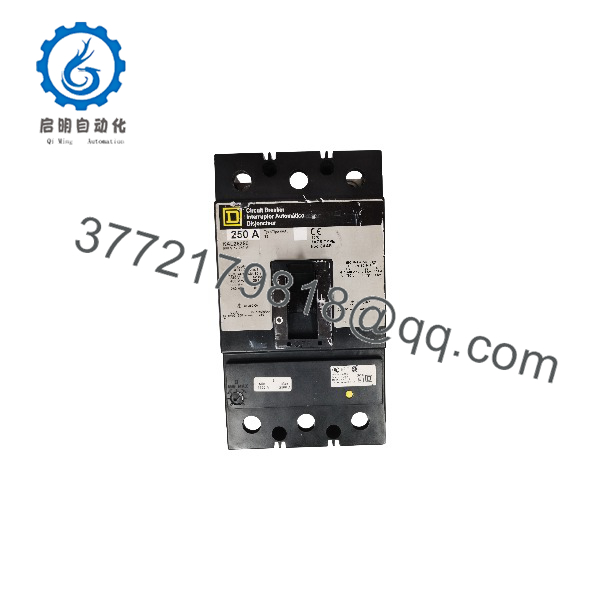
KAL26250
Troubleshooting Quick Reference
| Symptom | Possible Cause | Relevance to this Part | Quick Check Method | Recommendation |
|---|---|---|---|---|
| Breaker will not reset (handle stuck in tripped position) | Internal trip mechanism latched; severe overload or short still present | ✅ High | Ensure load is de-energized; verify no fault downstream with insulation resistance / continuity tests | Clear fault, then attempt reset; if still stuck, suspect internal damage |
| Immediate trip on reset (instantaneous trip) | Downstream short circuit; ground fault; inrush exceeding instantaneous setting | ✅ High | Isolate load sections; megger cables and equipment; check for phase-to-phase or phase-to-ground faults | Repair fault before re-energizing; do not force breaker closed |
| Breaker trips after a delay under normal load | Thermal overload; loose terminations causing heating; ambient temperature high | ✅ High | Measure actual load current; check terminal torque and temperature (IR thermometer); inspect for discoloration | Reduce load or correct connections; if trips below rated current, test or replace breaker |
| One pole hot, other cool | Unbalanced load; high-resistance connection on one pole; internal contact wear | ✅ Medium | Measure current per pole; check terminal torque; inspect for hot spots | Tighten/repair connections; if imbalance persists with balanced load, replace breaker |
| Breaker appears physically damaged (cracks, burns, melted lugs) | Past fault event; over-torqued lugs; poor terminations | ✅ High | Visual inspection of case, lugs, and arc chutes; check for discoloration or deformation | Do not reuse visibly damaged breakers; replace and investigate root cause |
If you’re unsure whether the breaker or the load is at fault, share photos of the nameplate, terminations, and any trip logs or protection relay data. That often tells us whether this is a breaker issue or a downstream problem.
Frequently Asked Questions (FAQ)
Q1: What exactly is the Square D KAL26250?
A: It’s a 250 A, 600 VAC, 2-pole molded case circuit breaker from Square D’s KAL (K-Frame, high interrupting) family. It provides thermal-magnetic LI (Long-Time + Instantaneous) protection with feed-thru lugs for line and load connections.
Q2: Is the KAL26250 still made by Square D?
A: No. Square D has discontinued the classic K-Frame / KAL breakers in favor of the PowerPact line (J-frame for KA/KAL class). KAL26250 units now come from surplus stock or reconditioned inventories.
Q3: What replaced the in new designs?
A: For new panels and retrofits, Square D uses PowerPact J-frame breakers (JD / JG / JJ / JL) in the 250 A class. A direct electrical equivalent would be a 250 A, 2-pole, 600 V J-frame breaker with matching interrupting rating, but mechanical fit and accessories must be verified.
Q4: Can I use a in place of a KA26250 or vice versa?
A: Not automatically. Both are 250 A K-Frame breakers, but “KAL” denotes the higher interrupting rating version. You can usually substitute a higher AIC breaker in the same frame if voltage, poles, and physical dimensions match, but you must confirm interrupting ratings, trip curves, and panel listing.
Q5: What does “feed-thru” mean on the ?
A: Feed-thru means the breaker has lugs on both line and load sides in a straight-through arrangement, simplifying wiring in tight spaces and certain panel layouts. It’s a mechanical terminal style, not a special electrical function.
Q6: What condition are these breakers in?
A: Available units are typically “New Surplus” (never installed, old stock) or “Refurbished / Reconditioned” (cleaned, tested, with worn parts replaced as needed). They are not new from the factory. For critical applications, request test reports and photos of the actual breaker before purchase.
Q7: Will a PowerPact J-frame breaker fit where my is now?
A: Sometimes, but not always. PowerPact breakers can have different mounting footprints, especially in I-Line and older bolt-on panels. In many cases, adapter brackets and filler plates are needed to make a J-frame fit a legacy K-Frame opening. Verify mechanical dimensions and panel listing before retrofitting.