 WhatsApp: +86 16626708626
 Email:
  Phone: +86 16626708626
Description
Technical Features & Benefits
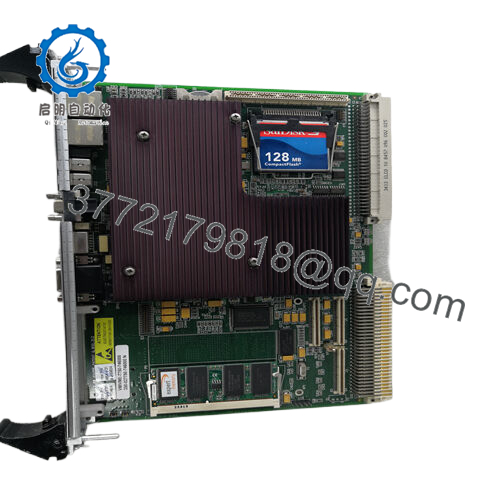
The VMIPC4-7301 represents a pinnacle of reliability for the VMEbus architecture, specifically designed for those who need more than just simple logic execution. At its core, this module utilizes an Intel Pentium III processor clocked at 733MHz, which provides a significant boost in floating-point math performance compared to earlier RISC-based VME controllers. One of the standout benefits of the VMIPC4-7301 is its memory architecture; with up to 512MB of SDRAM, it can handle complex operating systems like Windows NT, 2000, or VxWorks without the stuttering associated with lower-tier embedded boards.
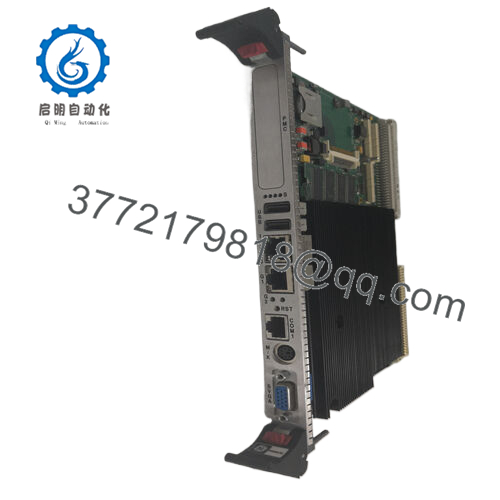
From a hardware design perspective, GE engineered this unit to be a “single-slot” solution. This is a massive benefit for engineers working in crowded VME racks where every millimeter of real estate is precious. The inclusion of an onboard 10/100BaseTX Ethernet controller means the VMIPC4-7301 can talk to your factory network natively, eliminating the need for expensive and bulky network bridge cards. Furthermore, the built-in AGP video controller allows for local monitoring directly from the rack—a feature that has saved me countless hours during onsite troubleshooting when I didn’t want to haul a full programming terminal across a plant floor.
Applications & Industry Context
In the heavy industrial sectors of the late 90s and early 2000s—think steel mills, high-speed printing presses, and power generation facilities—the VMEbus was the gold standard for ruggedized computing. The VMIPC4-7301 was often the “brains” behind complex motion control and data acquisition systems. In a typical turbine control environment, for instance, you have thousands of analog signals coming in that need to be processed with zero-latency jitter. The VMIPC4-7301 thrives here because it provides a bridge between high-level PC-based computing and the deterministic nature of the VME backplane.
We also see the VMIPC4-7301 widely used in simulation and defense applications. When you are simulating flight dynamics or naval propulsion, you need a processor that can handle high-speed data throughput between the CPU and the I/O modules. The operational challenge in these environments is heat and vibration. Unlike a standard desktop PC, the VMIPC4-7301 is built on a stiffened PCB with industrial-grade components that can withstand the constant humming and thermal cycling of an engine room. It’s not just a computer; it’s an industrial tool designed to live in places where standard consumer electronics would fail within a week.
Related Models
- VMIPC4-7300: The standard version without the specific BIOS or memory enhancements found in the 7301 variant.
- VMIVME-7750: The broader family of GE Fanuc processors that the VMIPC4-7301 belongs to, offering various CPU speeds.
- VMIVME-7697: A slightly older Pentium-based VME processor used in similar legacy GE control systems.
- VMIVME-7452: A dedicated VME bridge and expansion module often used in conjunction with the VMIPC4-7301.
- VMIVME-7740: A lower-power version of this architecture designed for fanless or sealed enclosure environments.
- 1756-L83E: A modern Allen-Bradley alternative often considered during full system migrations from VME to ControlLogix.

- VMIPC4-7301
Technical Specifications Table
| Specification | Details |
| CPU | Intel Pentium III (733 MHz) |
| Bus Architecture | VMEbus (64-bit support) |
| Memory | 512 MB SDRAM (standard configuration) |
| Flash Memory | Onboard 128 KB for BIOS / 32 MB for User Data |
| Video Controller | Integrated AGP with up to 1600×1200 resolution |
| Networking | 10/100BaseTX Ethernet (RJ45) |
| I/O Ports | 2x RS-232 Serial, 1x Parallel, 2x USB 1.1 |
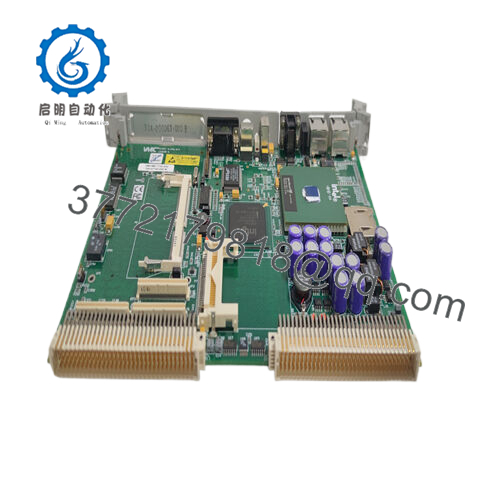
| Expansion Slot | 1x PMC (PCI Mezzanine Card) Slot |
| Storage Interface | Integrated IDE controller for external drives |
| Operating Temperature | 0°C to 55°C (32°F to 131°F) |
| Humidity | 5% to 95% non-condensing |
| Form Factor | Single-slot 6U VME |
Product Role & System Fit
The VMIPC4-7301 acts as the primary master in a VME64 system. Its role is essentially that of a conductor in an orchestra; it manages the timing of the VME backplane, handles interrupts from peripheral cards, and runs the high-level application code. Within a GE Fanuc environment, this module is highly compatible with a range of VMIVME digital and analog I/O cards. Because it supports the PMC expansion standard, you can effectively “bolt on” specialized functionality—like a high-speed fiber optic link or extra serial ports—without moving to a multi-slot configuration.
In terms of software fit, the VMIPC4-7301 is a versatile beast. It was originally designed to bridge the gap between “Open Systems” and industrial hardware. This means it can run standard Windows-based SCADA software while simultaneously managing real-time tasks through an RTOS (Real-Time Operating System) layer. If you are looking to replace an aging VME processor while keeping your existing I/O cards, the VMIPC4-7301 is often the path of least resistance. It provides the necessary computing headroom for modern software updates while maintaining the electrical characteristics required by the VME specification.
Installation & Maintenance Insights
If you’ve ever swapped a VME card, you know the drill: check your jumpers first. The VMIPC4-7301 is no different. Before sliding it into the rack, ensure your VMEbus address jumpers are set correctly to avoid bus conflicts with other masters. One field observation I’ve noted over the years is that the VMIPC4-7301 relies heavily on the backplane’s +5V supply. If your power supply is sagging even slightly, you might see intermittent “blue screens” or watchdog timeouts. It’s always worth checking the voltage at the test points on the rack before commissioning a new module.
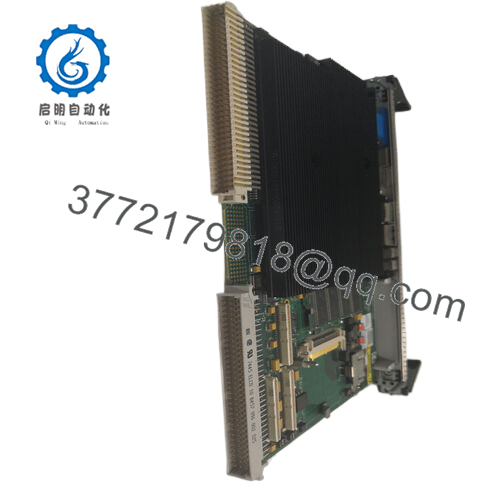
Maintenance-wise, the VMIPC4-7301 is relatively low-touch. Since it uses an active heatsink in most configurations, the primary failure point is often dust accumulation in the cooling fins. A quick blast of compressed air during scheduled downtime can prevent thermal throttling. If you are using the IDE interface for a local hard drive, I strongly suggest upgrading to an industrial-grade CompactFlash or SSD adapter. The spinning disks of the era are the most likely component to fail, and moving to solid-state storage makes the VMIPC4-7301 virtually bulletproof in high-vibration environments.
Warranty & Support
While the VMIPC4-7301 is a legacy component, it remains a critical asset for many facilities that cannot afford a multi-million dollar system overhaul. We offer a comprehensive 12-month warranty on all VMIPC4-7301 units, ensuring they have been fully stress-tested and the onboard CMOS battery has been replaced. Support for these units is specialized; while you won’t find the latest drivers on a standard consumer website, we maintain a deep archive of the original GE Fanuc board support packages (BSPs) and driver sets.
If your plant is running on these modules, it is wise to keep at least one “hot-spare” configured with your specific BIOS settings. Our technical team can assist with firmware mirroring to ensure your replacement VMIPC4-7301 is a “plug-and-play” experience. We understand that in the world of industrial automation, “legacy” doesn’t mean “obsolete”—it means “proven.” Our commitment is to keep your proven systems running at peak efficiency with high-quality, verified hardware.
Maximizing Reliability in Legacy GE VME Systems
When managing a fleet of VME hardware, the VMIPC4-7301 often becomes the most reliable part of the cabinet if treated correctly. One trick we’ve used in the field to extend the life of these units involves the PMC slot. By offloading heavy communication tasks to a dedicated PMC card, you free up the Pentium III processor to focus entirely on logic execution. This reduces the thermal load on the VMIPC4-7301 and can significantly extend its operational life.
Another critical factor is the VMEbus termination. If you are installing the VMIPC4-7301 as the first or last card in the rack, ensure the termination resistors on the backplane are properly seated. Reflections on the bus can lead to “parity errors” that are notoriously difficult to track down. The VMIPC4-7301 has built-in diagnostics that can help identify these issues, but a solid physical layer is the best defense. For engineers looking to squeeze every last bit of performance out of their 733MHz CPU, I recommend streamlining the BIOS to disable any unused ports like the parallel or floppy interfaces, which reduces the interrupt overhead.
In conclusion, the VMIPC4-7301 is a workhorse of the GE Fanuc era. It represents a time when industrial computers were built to last decades, not just a few years. Whether you are maintaining a legacy power plant control system or supporting a specialized military test bench, this processor provides the deterministic power and ruggedness required for the job. It remains a top choice for those who need a reliable, high-performance Intel-based controller in the classic VME64 form factor.