WhatsApp: +86 16626708626
 Email:
  Phone: +86 16626708626
Description
Key Technical Specifications
| Parameter | Value |
|---|---|
| Model | Woodward 8273-126 |
| Product family | 2301D digital control platform |
| Primary function | Prime-mover speed control and generator load sharing |
| Typical designation | 2301D-J |
| Intended prime movers | Diesel engines, gas engines, steam turbines, and gas turbines |
| Speed-control range | 600–3,600 RPM |
| Governing modes | Isochronous and droop speed control |
| Supply-voltage range | 18–40 VDC |
| Nominal supply voltage | 24 VDC |
| Maximum current consumption | 0.589 A |
| Maximum power consumption | Less than 20 W |
| Magnetic pickup input range | 100–20,000 Hz |
| Discrete inputs | Eight total; three configurable |
| Discrete-input supply | 24 VDC output power available for discrete inputs |
| Discrete outputs | Four configurable driver outputs |
| Discrete-output activation supply | External 24 VDC required |
| Maximum discrete-output current | 800 mA |
| Analog inputs | Two configurable channels |
| Analog outputs | One configurable channel |
| Serial communication | RS-232 and RS-422 |
| Service connector | Front-panel 9-pin serial connector |
| Configuration software | Woodward Watch Window |
| Configuration retention | Nonvolatile memory |
| Operating temperature | −40 to +70 °C (−40 to +158 °F) |
| Approximate weight | 1.75 kg / 3.86 lb |
| Product status | Legacy / limited aftermarket availability |
The Woodward 8273-126 is identified as a 2301D-J digital load-sharing and speed controller for medium- and high-speed prime movers. It runs from 18–40 VDC, accepts magnetic-pickup speed feedback from 100–20,000 Hz, and provides configurable discrete and analog I/O for governing, load-sharing, synchronizing-related interfaces, alarms, and external control logic.
Product Introduction
The Woodward 8273-126 is a 2301D digital load-sharing and speed-control module for engines and turbines driving generators or mechanical loads. It governs prime-mover speed in isochronous or droop mode and coordinates real-load sharing when generator sets operate in parallel.
The 8273-126 supports magnetic pickup speed feedback, programmable discrete and analog I/O, and front-panel serial setup through Woodward Watch Window software. It is commonly retained in generator-control, oil and gas, marine, industrial power, and turbine-control systems because a replacement must preserve tuning, actuator interface details, load-share wiring, and site operating logic.
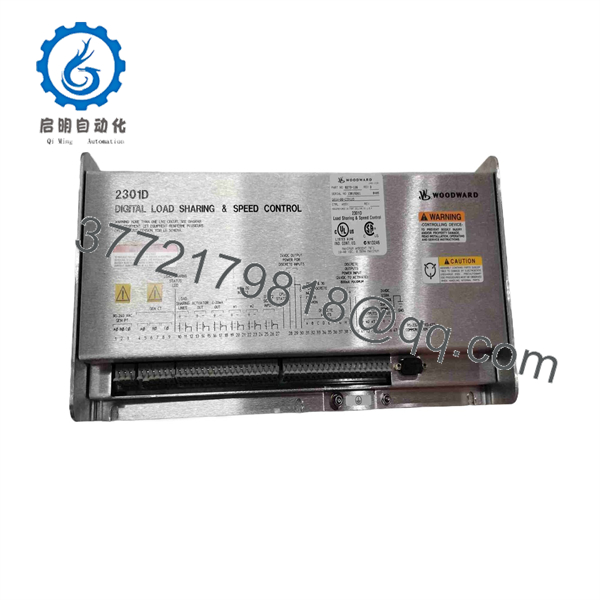
8273-126
Troubleshooting Quick Reference
| Symptom | Possible Cause | Relevance to this Part | Quick Check Method | Recommendation |
|---|---|---|---|---|
| Controller has no power or no front-panel activity | Missing 24 VDC control power, open fuse, poor ground, reversed polarity, failed supply | ❌ Low | Measure DC voltage at the controller supply terminals with the system enabled. Confirm voltage remains within 18–40 VDC during cranking, actuator movement, and breaker operation. | Check upstream fuses, battery charger, DC distribution, and negative return before replacing the controller. |
| Engine will not start or fuel actuator remains at minimum | Start permissive missing, emergency stop active, actuator wiring open, shutdown relay active, discrete input logic incorrect | ⚠️ Medium | Review generator-control alarms and ESD status. Verify start/run input states, actuator supply, and command signal using the approved wiring drawing. | Do not replace the 8273-126 until shutdown logic, actuator continuity, and start permissives have been verified. |
| Engine starts but speed immediately drops or unit trips | Incorrect speed-reference setting, loss of MPU feedback, unstable actuator signal, fuel-system fault, shutdown logic action | ⚠️ Medium | Check actual engine RPM independently. Measure MPU signal frequency and inspect the controller diagnostic status through Watch Window, if available. | Investigate speed feedback and fuel/actuator hardware first. Avoid repeated crank attempts without identifying the trip source. |
| Controller indicates overspeed or erratic speed | Noisy MPU cable, excessive air gap, damaged pickup, incorrect tooth count, shield grounded at both ends | ✅ High | Measure MPU frequency against actual RPM and flywheel tooth count. Inspect sensor gap and cable continuity. Verify the shield terminates at one end according to the approved grounding design. | Correct the MPU installation before replacing the controller. VFD and ignition noise can corrupt an otherwise healthy speed signal. |
| Generator frequency hunts under steady load | Incorrect PID tuning, actuator stiction, fuel pressure instability, loose linkage, bad MPU signal | ⚠️ Medium | Trend speed reference, actual speed, actuator command, load, and MPU frequency. Check mechanical linkage movement with the unit safely stopped. | Restore the archived tuning file first. Do not adjust gain, stability, or dynamics blindly during production operation. |
| Generator sets will not share load | Load-share wiring issue, CT/PT signal problem, incorrect droop/isochronous setup, mismatched controller configuration | ✅ High | Compare kW readings, breaker status, load-share line wiring, and mode selection across all paralleled units. Review the active load-sharing parameters in Watch Window. | Check common load-share circuits and configuration consistency before replacing one controller. Parallel-operation faults are frequently system-level issues. |
| One generator carries all load | Incorrect load-share bias, bad analog input, CT polarity error, actuator limit, incorrect governor mode | ⚠️ Medium | Compare each unit’s kW, speed bias, actuator position, and load-share signal. Verify CT polarity and scaling against the approved switchgear drawings. | Correct CT and load-share wiring errors before changing controller parameters. A reversed CT can mimic a failed load-sharing controller. |
| Discrete start, stop, or mode commands do not work | Missing discrete input common, incorrect jumper, wrong terminal wiring, PLC output failure | ⚠️ Medium | Verify the configured discrete-input logic and measure voltage at the relevant input. Confirm the required discrete-input power common arrangement, including terminals 29 and 30 where applicable. | Check input common and field logic before replacing the controller. This is a common commissioning error. |
| Output relay or driver does not energize | External 24 VDC output supply absent, output overloaded, wrong configuration, failed interposing relay | ⚠️ Medium | Measure the external 24 VDC feed used to activate discrete outputs. Check the load current; outputs are limited to 800 mA maximum. | Test with a known-good interposing relay or approved test load. Do not exceed the output rating. |
| Watch Window cannot connect | Wrong COM port, incorrect cable, incompatible software release, RS-232/422 mismatch, controller fault | ⚠️ Medium | Confirm serial interface selection, 9-pin cable pinout, PC adapter settings, and Watch Window version. Try local connection before condemning the controller. | Match the software revision to the installed controller revision. Back up settings immediately once communication is restored. |
| Replacement powers up but machine behavior is wrong | Configuration not restored, incorrect actuator calibration, wrong speed-setting range, different I/O logic, firmware mismatch | ✅ High | Compare every parameter group against the archived file: speed range, MPU teeth, actuator type, fuel limits, dynamics, load sharing, shutdowns, and I/O assignments. | Never run a replacement using defaults. Download and validate the approved configuration during a planned commissioning window. |
❗ Configuration warning: Back up the running controller before removing it. The 8273-126 contains application-specific governing parameters, actuator calibration, fuel limits, speed reference scaling, load-share behavior, alarm logic, and discrete I/O assignments. A physically identical controller with factory defaults is not a ready-to-run spare.
❗ MPU shielding warning: Use a dedicated twisted, shielded cable for magnetic pickup feedback. Grounding the shield at both ends can create a noise loop; noise can look like a real speed change and cause hunting, false overspeed, or load-sharing instability. Verify the site drawing before changing shield termination.
❗ Output wiring warning: The discrete output drivers require an external 24 VDC activation supply and are limited to 800 mA. Use appropriately rated interposing relays for higher-current coils, solenoids, or annunciator loads. Do not drive a large fuel-valve coil directly from a controller output.
❗ Live replacement warning: Do not hot-swap this control while the engine or turbine is online. Removing the controller can drop the actuator command and initiate an immediate trip, fuel closure, load rejection, or unsafe speed transient. Perform work only under an approved outage, lockout, and generator-control procedure.
Keep these checks in mind and you will save yourself 90% of typical rework time. If the fault remains unresolved, contact qualified Woodward or generator-control support with the controller nameplate and revision, Watch Window archive, event logs, speed trend, MPU signal measurement, actuator type, load-share wiring record, and generator operating mode.
Frequently Asked Questions (FAQ)
Q: What is the Woodward 8273-126 used for?
A: The 8273-126 is a Woodward 2301D digital speed governor and load-sharing control. It regulates prime-mover speed and coordinates real-power sharing among paralleled generator sets. Typical applications include diesel generators, gas engines, industrial turbines, marine power systems, and mechanical-drive packages.
Q: Is the 8273-126 the same as a standard engine ECU?
A: No. It is a dedicated governor and load-sharing controller. It receives engine-speed feedback, processes speed and load-control logic, and commands a fuel actuator or turbine-control interface. It may work alongside an engine ECU, generator controller, synchronizer, switchgear PLC, or ESD system, but it does not replace all of those devices.
Q: What DC supply does the 8273-126 need?
A: The controller operates from 18–40 VDC, with 24 VDC as the nominal control voltage. Maximum current draw is listed as 0.589 A, with power consumption below 20 W. Verify supply voltage while the engine is cranking and while output loads operate, because weak battery systems and bad DC returns often create intermittent governor faults.
Q: What speed signal can the 8273-126 accept?
A: It accepts a magnetic pickup signal in the 100–20,000 Hz range. The final RPM relationship depends on the number of flywheel teeth or gear teeth passing the pickup. Confirm the tooth count, sensor gap, cable shielding, and actual frequency before changing controller settings.
Q: Can I replace an older 2301A with an 8273-126?
A: Not as a direct plug-in swap. The 2301D architecture uses digital configuration, different terminal mapping, different diagnostics, and different tuning workflow from many older analog 2301A installations. A retrofit may be practical, but it requires a documented wiring review, actuator compatibility check, configuration development, functional testing, and controlled recommissioning.
Q: Do I need Woodward Watch Window software for a replacement?
A: Yes. Use Watch Window and the correct serial connection to archive the old controller and load the validated configuration into the replacement. The controller’s nonvolatile memory retains its parameters after power loss, but that does not help if the replacement has never received the site-specific setup.
Q: Can I hot-swap the Woodward 8273-126 while the engine is running?
A: No. Pulling a live governing controller can remove the actuator command and cause a trip, fuel shutdown, load rejection, or overspeed-related protection action. Isolate the unit under a planned maintenance procedure and coordinate with operations, electrical protection, and the responsible control engineer.
Q: Why is New Surplus 8273-126 inventory cheaper than factory stock?
A: New Surplus generally means unused original inventory released from an OEM spare shelf, canceled project, distributor excess, or liquidation source. The price can be lower because it may not include current factory support, current firmware confirmation, software licensing, cables, terminal plugs, or calibration records. Before purchasing, request photos of the exact controller label and revision, manufacturing date, connector condition, power-on test record, serial communication test, I/O simulation record, warranty terms, and confirmed lead time.