WhatsApp: +86 16626708626
 Email:
  Phone: +86 16626708626
Description
Key Technical Specifications
- Function: Positions single-acting steam turbine valve servos/actuators via precise hydraulic control pressure
- Setpoint Signal: 4-20 mA into 200 Ω, 70 dB CMRR, ±100 V common mode voltage range
- Supply/Control Pressure Rating: 10 bar / 145 psi (this part number’s rating; 25 bar variants exist under different part numbers)
- Power Input: 18-32 Vdc, 24 Vdc nominal; 25 W steady state, 90 W transient (2 s max)
- Analog Output: 4-20 mA, max external load 500 Ω, ±0.5% full-scale accuracy
- Discrete Outputs: 3 total (configurable NO/NC), 0.5 A at 24 Vdc max
- Pressure Stability: < ±2% of setpoint; Accuracy: < ±0.2% of full range
- Environmental: −40 to +85°C ambient, 95% RH, oil temperature 15-70°C, IP66 enclosure
- Physical: Approx. 270 x 270 x 290 mm (10.6 x 10.6 x 11.4 in), approx. 25 kg without oil
- Hazardous Area Rating: Zone 2, Category 3, Group II G, Ex nA IIC T4; Class I, Division 2, Groups A, B, C, D, T3
- Certifications: CE (EMC Directive 2014/30/EU, ATEX 2014/34/EU), IECEx, CSA (Class I Div 1/2)
- Redundancy: Simplex on this part number — dual-redundant models available under separate part numbers (9907-1253/1254)
Product Introduction
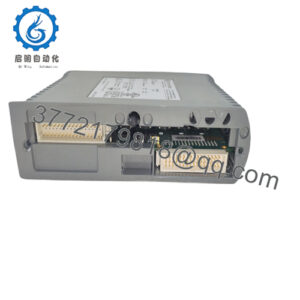
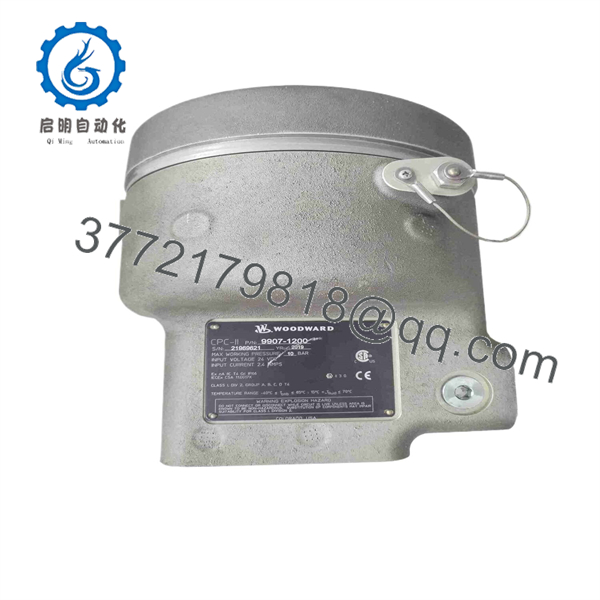
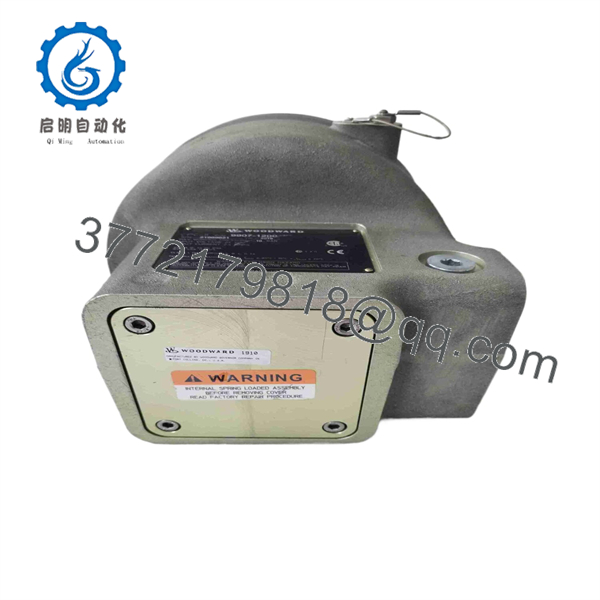
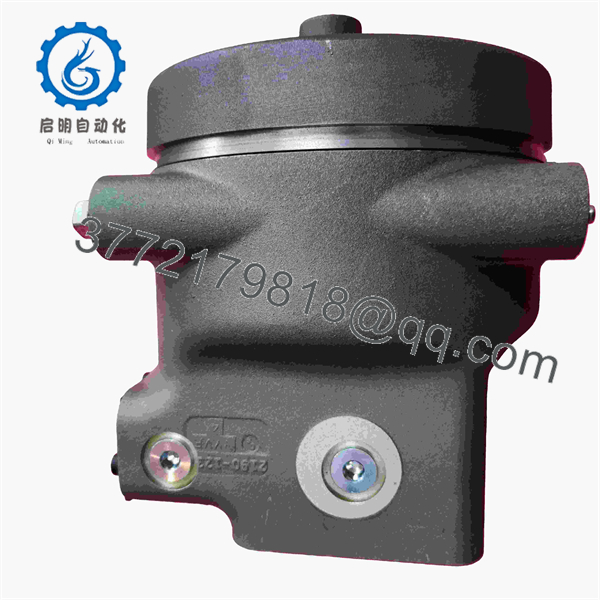
The Woodward 9907-1200 is a CPC-II Current-to-Pressure Converter built to position single-acting steam turbine governor valves, converting a 4-20 mA pressure demand signal into a precise, stable hydraulic control pressure. This specific part number is the 10 bar, Zone 2 / Class I Division 2 simplex variant with enhanced dynamics.
It runs on 18-32 Vdc and mounts directly to a hydraulic adapter manifold, with a rotary 3-way hydraulic valve driven by a brushless limited-angle actuator. A built-in “silt buster” function periodically flushes contaminants from the valve without disturbing servo position, addressing oil contamination — one of the more common reliability issues on older current-to-pressure converters.
9907-1200
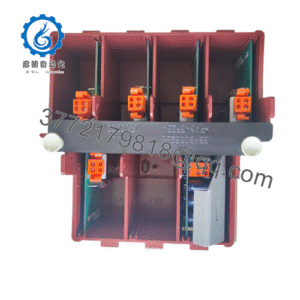
9907-1200
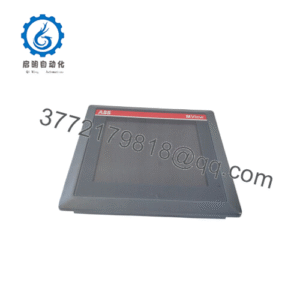
9907-1200
Troubleshooting Quick Reference
| Symptom | Possible Cause | Relevance to this Part | Quick Check Method | Recommendation |
|---|---|---|---|---|
| No pressure output at all | Power supply fault or return spring engaged (unpowered state) | ✅ High | Measure input voltage at power terminals (18-32 Vdc) | Confirm power source before condemning the unit |
| Pressure output unstable or oscillating | Dynamic gain settings (Primary Gain, Proportional/Integral Trim) mismatched to system | ⚠️ Medium | Review dynamic settings via PC Service Tool against downstream volume | Retune before assuming hardware fault |
| Setpoint signal fault alarm | Analog input wiring issue or signal out of range | ✅ High | Check setpoint signal at terminals against Service Tool reading | Verify wiring and range settings before replacing |
| Redundant link fault (redundant models only) | Communication wiring fault between paired units | ⚠️ Medium | Check Discrete Output 3 / Discrete Input 2 wiring between units | Confirm redundant link wiring before replacing either unit |
| Slow or sluggish valve response | Silt/debris buildup in the rotary hydraulic valve or supply pressure too low | ❌ Low | Check supply pressure and silt buster settings | Adjust silt buster interval before assuming valve wear |
Record the Part Number and Serial Number displayed on the PC Service Tool before contacting technical support — Woodward’s diagnostics reference these directly, and the detailed fault flash codes (LED) narrow down the issue faster than guesswork.
Frequently Asked Questions (FAQ)
Can I substitute this for a 25 bar CPC-II model?
No. This part number (9907-1200) is rated for 10 bar supply and control pressure. The 25 bar variants (9907-1197, 9907-1198) are separate part numbers with different pressure ratings — confirm your system’s pressure requirements before ordering.
Is this a simplex or redundant unit?
Simplex. If your application needs dual-redundant CPC-IIs, Woodward offers separate part numbers (9907-1253, 9907-1254) for that configuration, or the CPC-DX Dual Transfer Skid for a fully redundant mounted arrangement.
Do I need special tools to configure this after installation?
Yes — dynamic performance settings, redundancy configuration, and analog I/O scaling are all done through Woodward’s PC Service Tool over an RS-232 connection. This isn’t a plug-and-play swap; budget time for proper commissioning.
What happens if this unit loses power or detects a fault?
An internal return spring forces the hydraulic valve to connect control pressure to drain — a failsafe design that closes the turbine valve rather than leaving it in an unknown position.
Can I replace an older CPC or non-Woodward converter with this unit?
Woodward’s manual includes a dedicated chapter on replacing older CPCs and non-Woodward converters with the CPC-II, including adapter manifold guidance for units like Voith converters. Check that chapter before assuming a direct hydraulic fit.
Why is this priced below a factory-new quote?
If you’re seeing surplus pricing, confirm condition and testing history with your supplier — this is precision hydraulic-electronic equipment on a turbine control loop, and a poorly tested surplus unit is a bad place to cut corners. Ask for the part number and serial number so you can verify against Woodward’s records if needed.