WhatsApp: +86 16626708626
 Email:
  Phone: +86 16626708626
Description
3. Key Technical Specifications
| Parameter | Value |
|---|---|
| Model | SMM40 |
| Manufacturer | Woodward / Sawamura Denki Kogyo |
| Product Type | Permanent Magnet Synchronizing Motor |
| Compatible Governors | UG, PSG, SG series |
| Primary Power | 24 Vdc nominal |
| AC Versions | 110 Vac / 220 Vac (with internal rectifiers) |
| Safe Torque | Approx. 0.2 N·m |
| Rated Speeds (typical) | 1, 2, 4, 8 RPM (24 Vdc versions) |
| Adjustable Range | Available with PM/APM motor control |
| Housing | IP44 |
| Interchangeability | Direct replacement for S40, MM40, MM4A |
| Application | Remote speed setting / frequency matching / load sharing |
4. Product Introduction
The Woodward SMM40 is a permanent-magnet synchronizing motor used to provide remote speed adjustment on UG, PSG, and SG governors. It allows a switchboard or control-room operator to raise or lower the governor speed setting so that generator frequency can be matched to the bus or load can be shared when units are operating in droop mode.
The SMM40 is the current production-style motor that directly replaces earlier models (S40, MM40, and MM4A). It runs on nominal 24 Vdc; versions with built-in rectifiers accept 110 Vac or 220 Vac supplies. A potentiometer is typically included for speed adjustment within the available range when used with a compatible motor control.
These motors are widely used on marine and industrial diesel and gas engines fitted with Woodward mechanical governors. Because they are long-lifecycle components, many units in the field are repaired or replaced with surplus/refurbished motors.
5. Troubleshooting Quick Reference
| Symptom | Possible Cause | Relevance to this Part | Quick Check Method | Recommendation |
|---|---|---|---|---|
| Motor does not turn | No power, open wiring, or failed motor | ✅ High | Measure voltage at motor terminals while commanded | Verify supply and wiring; replace motor if dead |
| Motor runs but speed setting does not change | Slip-clutch slipped or gear train binding | ✅ High | Check clutch setting and free movement of speed shaft | Adjust clutch; inspect gear train for binding |
| Motor turns in only one direction | Control circuit or internal winding issue | ✅ Medium | Test both raise and lower commands | Check control wiring/relays; test/replace motor |
| Excessive noise or vibration | Worn bearings or mechanical damage | ✅ Medium | Listen and feel for abnormal operation | Inspect/replace motor |
| Incorrect speed range | Wrong motor variant or control setting | ✅ Medium | Confirm nameplate voltage/speed rating | Match exact part number to application |
| Overheating | Continuous duty beyond rating or high ambient | ✅ Low | Check duty cycle and ambient temperature | Ensure intermittent duty; improve ventilation |
Before condemning the motor, always verify that power is reaching the terminals and that the governor speed-setting mechanism is free to move. A slipped clutch or bound gear train is a common cause of “motor not working” complaints.
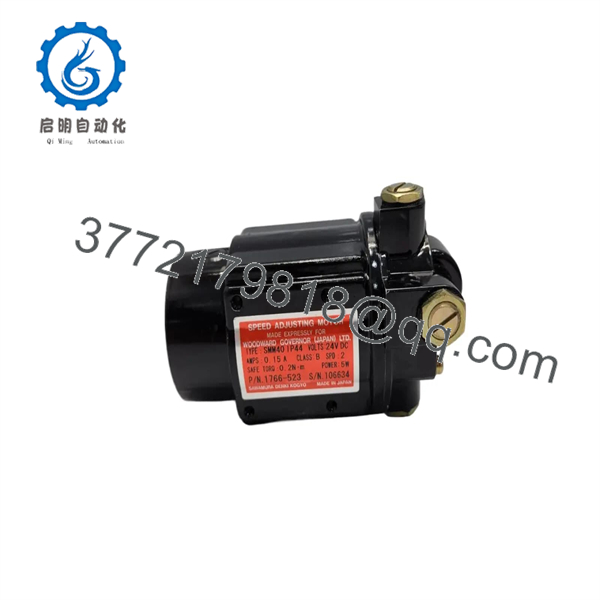
SMM40
6. Frequently Asked Questions (FAQ)
Q: What is the Woodward SMM40 used for?
A: It is a permanent-magnet motor that remotely adjusts the speed setting of Woodward UG, PSG, and SG governors so operators can match frequency or share load.
Q: Is the SMM40 still available new?
A: New OEM availability is limited. Most units on the secondary market are new surplus, used, or refurbished. It is a direct replacement for older S40, MM40, and MM4A motors.
Q: What voltage versions exist?
A: Nominal 24 Vdc is standard. Versions with internal rectifiers accept 110 Vac or 220 Vac supplies. Always match the nameplate voltage to your control system.
Q: Can I replace an older MM40 or S40 with an SMM40?
A: Yes. The is designed as a direct interchange for the earlier permanent-magnet speed-setting motors.
Q: What should I check before replacing the motor?
A: Confirm power is present at the motor terminals, verify the raise/lower control signals, check that the governor speed-setting shaft is free, and inspect the slip-clutch setting.
Q: Why do these motors fail in service?
A: Common causes include loss of power, slipped clutch, binding in the governor gear train, worn brushes/commutator (on older designs), or environmental exposure. The motor itself is often still good.
Q: What information should I provide when ordering?
A: Exact part number from the nameplate (e.g., 1766-523, 1765-825), voltage rating, speed setting, governor type (UG/PSG/SG), and photos of the existing motor labels.