WhatsApp: +86 16626708626
 Email:
  Phone: +86 16626708626
Description
Key Technical Specifications
| Parameter | Value |
|---|---|
| Manufacturer | Yaskawa |
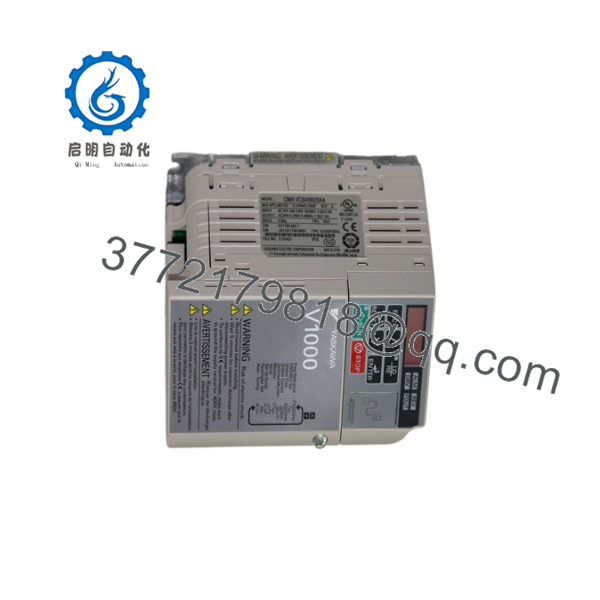
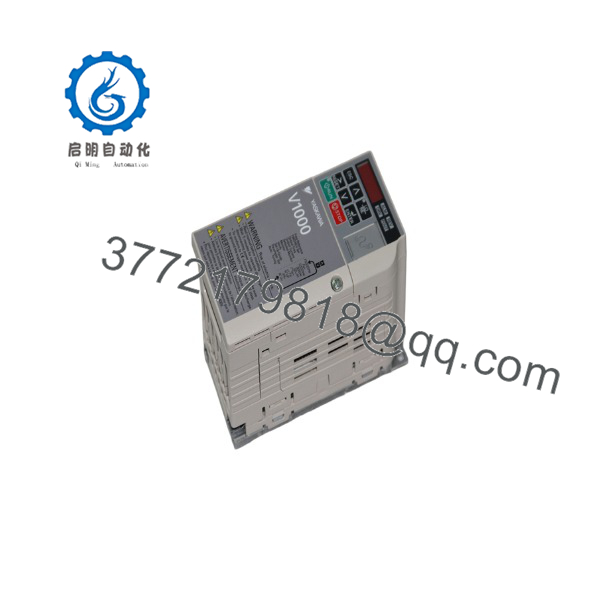
| Model | CIMR-VCBA0002BAA |
| Product Series | V1000 |
| Product Type | Compact AC Drive / Vector Inverter |
| Input Voltage | 200–240 VAC |
| Input Phase | 1-phase |
| HD Rated Output Current | 1.6 A |
| ND Rated Output Current | 1.9 A |
| Maximum Motor Power, HD | 0.25 kW |
| Maximum Motor Power, ND | 0.37 kW |
| Output Voltage | 3-phase AC |
| Output Frequency | 0–400 Hz |
| Motor Types | Induction motor, permanent magnet motor |
| Enclosure Rating | IP20 |
| Operating Temperature | −10 to +50°C |
| Mounting | Wall mounting |
| Programming | Keypad or PC |
| Connection | Screw terminals |
| Cooling | Air cooling / coldplate configuration |
| Overload, HD | 150% for 60 s |
| Overload, ND | 120% for 60 s |
| Safety Function | Safe Torque OFF inputs |
| Certifications / Compliance | UL, cUL, CE, RoHS, UKCA |
Yaskawa specifies the CIMR-VCBA0002BAA as a V1000 compact AC drive with 200 V-class single-phase input, 1.6 A HD output, 1.9 A ND output, and maximum motor capacities of 0.25 kW HD and 0.37 kW ND.
The published electrical specification gives a 0–400 Hz output-frequency range, IP20 protection, and compatibility with both induction and permanent-magnet motors.
Product Introduction & Supply Chain Strategy
The Yaskawa CIMR-VCBA0002BAA is a V1000 compact variable-frequency drive for small industrial motor applications. It accepts 200–240 VAC single-phase input and provides three-phase AC output, with open-loop vector control and support for permanent-magnet motor operation. Yaskawa also specifies Safe Torque OFF inputs for the V1000 platform.
For maintenance inventory, this is a sensible candidate for buffer stock when a plant still operates V1000 equipment. Yaskawa lists the model in its legacy-drive portfolio, and some component distributors identify it as withdrawn. Holding a New Surplus replacement can reduce emergency sourcing exposure and avoid unnecessary machine-control changes during an outage.
Installation & Configuration Guide
Stage 1: Pre-Installation — Preparation & Safety
- Apply plant lock-out/tag-out procedures before opening the drive enclosure.
- Disconnect the incoming AC supply and verify the absence of hazardous voltage.
- Allow the DC bus to discharge according to the Yaskawa V1000 technical manual.
- Use an appropriately rated multimeter to verify the DC bus is at a safe voltage.
- Photograph the existing drive terminals, control wiring, DIP-switch settings, and keypad parameters.
- Record the existing motor nameplate data.
- Confirm that the replacement is exactly CIMR-VCBA0002BAA.
- Verify that the incoming supply is within the 200–240 VAC single-phase specification.
- Wear appropriate ESD protection when handling the control electronics.
Stage 2: Removal
- Label all incoming power, motor, braking, and control conductors.
- Disconnect the wiring according to the approved electrical schematic.
- Do not pull directly on terminal blocks or control-board connectors.
- Remove the drive mounting hardware while supporting the unit.
- Inspect the enclosure for contamination, moisture, loose hardware, and evidence of overheating.
- Preserve the old parameter configuration before disposing of the removed drive.
Stage 3: Installation — Clone & Seat
- Mount the replacement CIMR-VCBA0002BAA in the same approved enclosure position.
- Maintain the clearances specified in the installation documentation.
- Reconnect the incoming single-phase supply and motor conductors according to the wiring diagram.
- Reproduce the original control-terminal wiring exactly.
- Re-enter the motor nameplate parameters rather than assuming factory defaults are suitable.
- Configure acceleration, deceleration, frequency limits, command source, and run-command source.
- Verify that the motor current does not exceed the selected drive rating.
- Confirm that protective earth connections are secure.
Stage 4: Power-On & Testing
- Inspect all terminals for loose strands, incorrect polarity, or short circuits.
- Energize the drive without immediately issuing a run command.
- Check the keypad for active alarms or fault codes.
- Verify the programmed motor data.
- Perform a low-speed test.
- Confirm motor rotation direction.
- Check output current and acceleration behavior.
- Test the emergency-stop and STO circuit where implemented.
- Run the machine through its normal operating sequence before returning it to production.
CIMR-VCBA0002BAA
CIMR-VCBA0002BAA
Firmware/Software Versions & Upgrade Notes
Recommended firmware: Use the firmware revision already validated for the plant’s existing application. The available Yaskawa product information confirms the model and associated technical documentation, but does not establish a specific firmware revision for every CIMR-VCBA0002BAA unit. Therefore, a specific firmware number should not be assumed.
Before swapping the drive:
- Record the existing drive’s firmware/software revision if available.
- Record all programmed parameters.
- Save the parameter configuration where the applicable keypad/software supports it.
- Record motor-control mode and motor identification/autotuning settings.
- Document installed communication options before replacement.
The platform supports optional communication interfaces including EtherNet/IP, PROFINET, EtherCAT, PROFIBUS, DeviceNet, CANopen, Modbus/TCP, CC-Link, and others. The exact communication option installed on the drive must be verified rather than inferred from the base model number.
Upgrade warning: Do not change firmware during a simple hardware replacement unless the application requires it and compatibility has been verified. A firmware change can alter parameter behavior, communications, or application compatibility. For a like-for-like spare replacement, matching the validated configuration is normally the lower-risk approach.
Frequently Asked Questions (FAQ)
1. What is the ?
It is a Yaskawa compact AC drive for small variable-speed motor applications. The model uses 200–240 VAC single-phase input and is rated at 1.9 A under normal-duty conditions.
2. What motor size can this drive handle?
Yaskawa specifies a maximum applicable motor output of 0.37 kW under ND conditions and 0.25 kW under HD conditions. The correct rating depends on the application’s duty profile and required overload capacity.
3. Is obsolete?
It is a legacy model. Yaskawa’s website places it under its legacy-drive portfolio, while TME identifies the specific product as withdrawn from its offer. That makes lifecycle planning important for plants with installed equipment.
4. Is this drive suitable for a permanent-magnet motor?
Yes. Yaskawa specifically lists both permanent-magnet motors and induction motors for the platform and describes open-loop vector control for PM motor operation.
5. Can the drive be hot-swapped?
Do not treat as a hot-swappable module. Disconnect and isolate the power supply, then verify the DC bus has discharged before removing the drive. The DC bus can remain hazardous after incoming power is removed.
6. Will the replacement retain my machine programming?
The motor itself has no application program. The drive contains configuration parameters that must be preserved or recreated. Before removing the original unit, document or back up its parameters and communication configuration.
7. Why purchase New Surplus instead of a lower-priced alternative?
For a legacy drive, the relevant comparison is not simply purchase price. A correctly identified New Surplus unit can reduce the engineering effort associated with changing the installed drive, rewiring control circuits, validating motor parameters, and troubleshooting compatibility. The exact condition and warranty should still be documented on the purchase order.