WhatsApp: +86 16626708626
 Email:
  Phone: +86 16626708626
Description
Key Technical Specifications
| Parameter | Value |
|---|---|
| Model / Suffix | AAI143-S50 (Analog Input Module, 4 to 20 mA, 16-channel, Isolated) |
| Input channels | 16, isolated (field-to-system isolation; not channel-to-channel) |
| Input signal | 4 to 20 mA DC |
| Allowable input current | 24 mA |
| Withstanding voltage | Input to system: 1,500 V AC, 1 minute (500 V AC when the KS1 dedicated cable is used) |
| Input resistance (power ON) | 270 Ω at 20 mA to 350 Ω at 4 mA |
| Input resistance (power OFF) | 500 kΩ or larger |
| Accuracy | ±16 µA |
| Temperature drift | ±16 µA / 10 °C |
| Data update period | 10 ms |
| Transmitter power supply | 19.0 V or higher at 20 mA; 25.5 V or less at 0 mA (current limit 25 mA) |
| 2-wire / 4-wire selection | Per channel, via setting pin on the module |
| Max current consumption | 230 mA at 5 V DC, 540 mA at 24 V DC |
| Dimensions (W × H × D) | 32.8 × 130 × 107.5 mm |
| Weight | 0.3 kg |
| External connection | Pressure clamp terminal block, MIL connector cable, or dedicated KS1 cable |
| Redundancy | Dual-redundant capable (two identical modules, adjacent odd/even slots, same node unit) |
| HART communication | Not available on the -S suffix. HART requires AAI143-H |
| Host node units | ANB10S/D, ANB11S/D (ESB/optical ESB), ANR10S/D (ER bus) |
| Host FCS | AFV30S/D, AFV40S/D, AFV10S/D, AFS30/40, AFG30/40, AFG81–84, AFF50S/D |
| Available option codes | /K4A00, /A4S00, /A4S10, /A4D00, /A4D10, /CCC01 |
Note on ambient temperature: the extended −20 to +70 °C rating and the ISA Standard G3 anti-corrosion coating belong to the “3” style code (AAI143-S53), not to the “0” basic type. If your cabinet sits in a sour-gas or high-ambient area, confirm the style code you actually need against the OEM GS sheet before you buy.
Product Introduction
The Yokogawa AAI143-S50 is a 16-channel isolated analog input module for CENTUM VP and CS 3000 FIO systems. It takes 4 to 20 mA signals from 2-wire or 4-wire transmitters — pressure, flow, level, temperature — and converts them into FCS process data.
The isolation is what sets it apart from the AAI141. With 1,500 V AC field-to-system withstand, it handles grounded or noisy field loops that a non-isolated card cannot. It also supplies 19.0 V minimum at 20 mA to 2-wire transmitters and supports dual-redundant operation.
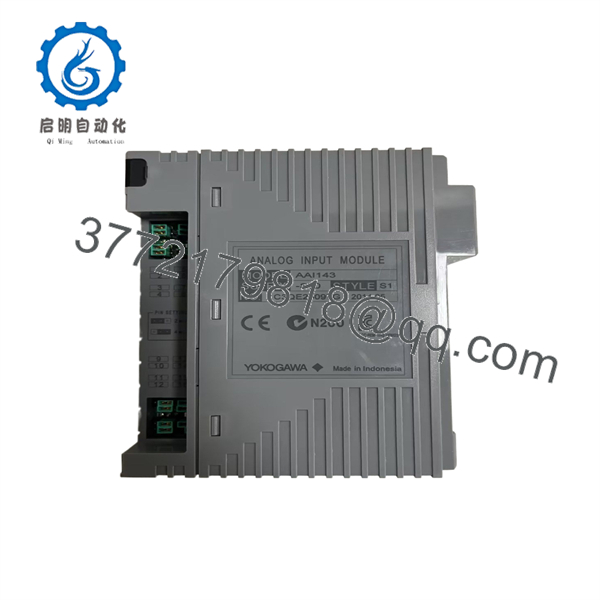
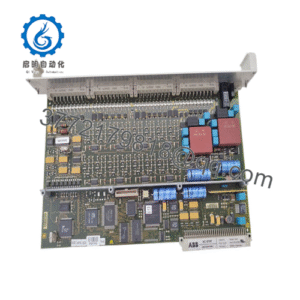
AAI143-S50
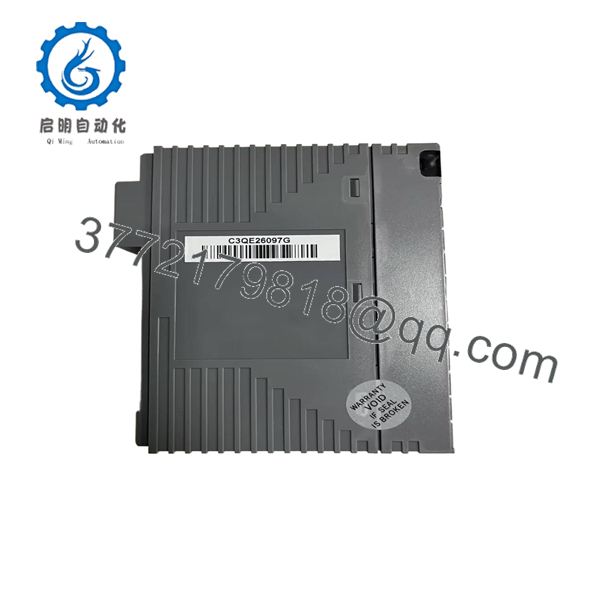
AAI143-S50
Troubleshooting Quick Reference
| Symptom | Possible Cause | Relevance to this Part | Quick Check Method | Recommendation |
|---|---|---|---|---|
| All 16 channels read bad / no data | Node unit power or ESB bus fault | ❌ Low | Check node unit power supply LEDs and ESB bus cable seating first | Card swap is rarely the fix. Verify the node unit and bus before pulling the module |
| One channel reads 0 mA, others fine | Field loop open, blown transmitter, or wiring | ⚠️ Medium | Break the loop and inject 12 mA with a calibrator at the terminal block | If the injected signal reads correctly, the card is fine — go look at the field |
| One channel reads low or drifts | Wrong 2-wire/4-wire setting pin, or accuracy drift | ✅ High | Inspect the per-channel setting pin on the module. Inject 4, 12, 20 mA and compare against ±16 µA spec | Correct the setting pin first. If drift persists across a calibration sweep, replace |
| Transmitter won’t power up on a 2-wire channel | Insufficient loop voltage or card power section fault | ⚠️ Medium | Measure open-circuit terminal voltage — expect 25.5 V or less at 0 mA, and 19.0 V minimum at 20 mA | Long cable runs eat voltage. Check wiring drop before blaming the card |
| Card not recognized in FCS / builder | Slot assignment, IOM definition mismatch, or bus address | ❌ Low | Check the IOM definition in the Standard Builder against the physical slot | Configuration issue nine times out of ten |
| Redundant pair won’t sync | Suffix code mismatch between the two modules | ✅ High | Read the labels on both cards — both must be identical model and suffix | An -S50 will not pair with an -H50. Match them exactly |
| Random comms dropouts, multiple channels | Ground loop or shield termination fault | ⚠️ Medium | Verify shields land at one end only; check for potential difference between field and cabinet ground | Isolation helps but doesn’t cancel a bad ground scheme |
One honest note: this card does not fail often. In most CENTUM VP callouts, the AI module turns out to be healthy and the real problem is a field transmitter, a loose terminal, or the power supply. Do the loop injection test before you order a replacement — it takes ten minutes and saves a lot of money.
If you’re still stuck, send us clear photos of the module label, the setting pins, and the FCS diagnostic screen. We’ll look at it with you.
Frequently Asked Questions
Q: What’s the actual difference between AAI143-S50 and AAI143-H50?
The -H carries the HART modem. That’s it, functionally — same 16 channels, same 4 to 20 mA, same isolation. But it matters. If your instrument techs pull HART variables or use a handheld through the loop, the -S50 will leave them blind. The -S50 only passes the analog value. Check your loop drawings before ordering; this is the single most common ordering mistake on this part number.
Q: Can I swap this into a slot that currently has an AAI141?
Physically, yes. Electrically, be careful. The AAI141 is non-isolated with a different input resistance (400 Ω at 20 mA versus 270 Ω here) and a different transmitter supply voltage (14.8 V minimum versus 19.0 V here). The higher supply voltage is usually a benefit, but you still need to update the IOM definition in the builder and re-verify your loop calculations. Don’t assume it’s a drop-in.
Q: Is it hot-swappable?
Yokogawa FIO modules are designed for online replacement in a dual-redundant pair — you pull the standby, insert the new one, let it sync. In a simplex configuration, pulling the card drops all 16 loops. That’s a process trip in most plants. Coordinate with operations and know which loops are on that card before you touch it. And when the module loses power, the current input loop goes open — plan for what that does downstream.
Q: Can I use this behind a Zener barrier for an intrinsically safe loop?
No. Yokogawa explicitly prohibits it for this module. Use an isolation barrier instead. This is stated in the general specification, not an opinion — getting it wrong compromises your IS certification.
Q: What does “New Surplus” mean, and why is it cheaper than buying from the factory?
New Surplus means factory-new, unused stock that came out of a cancelled project, a spare parts pool, or excess channel inventory — not from the OEM’s current order desk. Same part, same build, often still in the original sealed bag. It’s cheaper because it’s already sitting on a shelf and there’s no factory lead time attached to it. To be transparent: some units may have a dated carton or a scuffed label. We’ll tell you the condition before you pay, and we’ll send photos of the actual unit on request.
Q: Does the terminal block come with it?
Not automatically. The terminal block is a separate option code — /A4S00 (pressure clamp), /A4S10 (with surge absorber), /A4D00 and /A4D10 (dual versions for redundant pairs), or /K4A00 for the KS cable interface adapter. Tell us which one you need and we’ll quote it. If you’re replacing a card in an existing rack, you almost certainly already have the terminal block installed and only need the bare module.
Q: Will my configuration and tag data carry over to the new module?
Yes. The AI module holds no project configuration — everything lives in the FCS. What does live on the module is the physical per-channel 2-wire/4-wire setting pin. That’s hardware, and it will not carry over. ❗ Photograph the setting pins on the old card before you remove it, and mirror them exactly. A mismatched setting pin gives you a dead loop or a nonsense reading, and it’s the kind of thing that eats an afternoon because nobody thinks to look at it.
Q: What warranty do you offer?
One year from the ship date on new original units. Every module is bench-tested before it goes in the box — power-up on a genuine CENTUM VP rack, per-channel current injection at 4, 12, and 20 mA against a calibrated source, and an isolation check. QC report goes in the box. Test photos or video available on request before shipment.