WhatsApp: +86 16626708626
 Email:
  Phone: +86 16626708626
Description
3. Key Technical Specifications
| Parameter | Value |
|---|---|
| Channels | 16, isolated |
| Input Signal | 4 to 20 mA DC |
| Allowable Input Current | 24 mA max |
| Isolation | 1500 V AC between input and system (1 min) |
| Accuracy | ±16 µA |
| Data Update Period | 10 ms |
| Input Resistance (Power ON) | 270 Ω (at 20 mA) to 350 Ω (at 4 mA) |
| Input Resistance (Power OFF) | 500 kΩ or larger |
| Transmitter Power Supply | 19.0 V or higher (at 20 mA); 25.5 V or less (at 0 mA); 25 mA limit |
| Temperature Drift | ±16 µA / 10 °C |
| Current Consumption | Approx. 230 mA (5 V DC), 540 mA (24 V DC) |
| Weight | Approx. 0.3 kg |
| 2-wire / 4-wire Setting | Selectable per channel via setting pin |
| Redundancy | Supports dual-redundant configuration |
4. Product Introduction
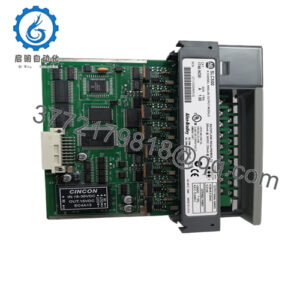
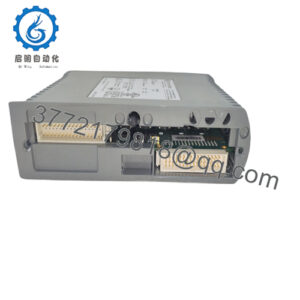
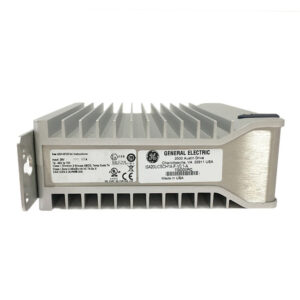
The Yokogawa AAI143-S50 is a 16-channel isolated analog input module for CENTUM VP and CS 3000 systems. It accepts standard 4–20 mA signals from field transmitters and provides channel-to-system isolation rated at 1500 V AC, making it suitable for installations where electrical isolation is required for noise immunity or safety.
Each channel can be independently configured for 2-wire or 4-wire transmitters, and the module supplies power to the field devices. It supports dual-redundant configurations for high-availability applications. The -S50 suffix indicates standard type, no explosion protection, and basic type.
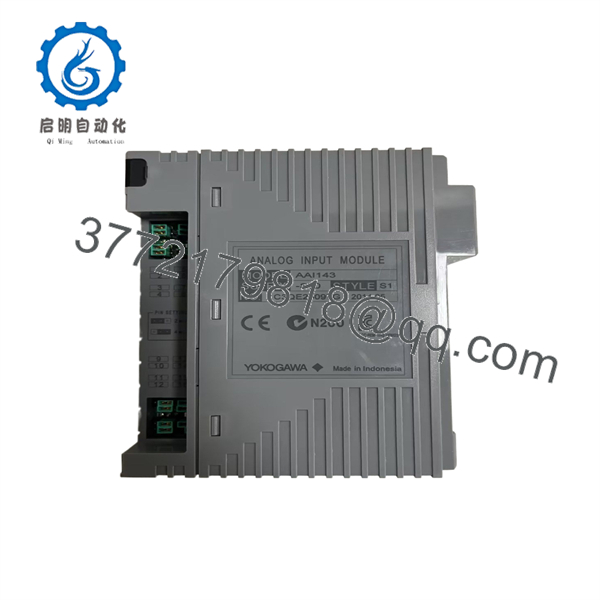
AAI143-S50
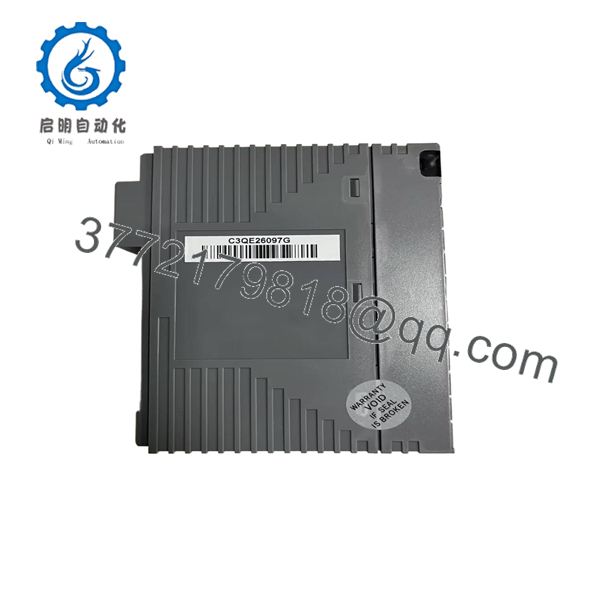
AAI143-S50
5. Troubleshooting Quick Reference
| Symptom | Possible Cause | Relevance to this Part | Quick Check Method | Recommendation |
|---|---|---|---|---|
| All channels read open / fault | Module not seated or power issue | High | Reseat module; check status LEDs and rack power | Verify seating and power before replacing |
| Single channel stuck or noisy | Field wiring, transmitter, or input circuit | Medium | Measure loop current; swap with known-good channel | Check field device and wiring first |
| Isolation-related faults | Ground loop or insulation breakdown | High | Inspect field grounding and measure isolation if needed | Correct grounding; replace module if isolation fails |
| Module not recognized by FCS | Wrong slot, configuration, or hardware fault | High | Check I/O configuration and module status in engineering tool | Match configuration; replace if still unrecognized |
| Accuracy offset or drift | Temperature effect or calibration issue | Medium | Compare measured vs. known reference current | Verify ambient conditions; replace if out of spec |
| Redundant pair mismatch | One module failed or config error | High | Compare both modules in the redundant pair | Replace the faulty module |
If the issue persists after these checks, collect module status details, loop measurements, and photos of the installation before contacting support.
6. Frequently Asked Questions (FAQ)
Q: What is the difference between AAI143-S50 and AAI141-H50?
A: AAI143-S50 provides channel isolation (1500 V AC). AAI141 is non-isolated (common ground) and the -H version includes HART. Choose AAI143 when isolation is required.
Q: Does the AAI143-S50 support HART?
A: The -S version is the standard (non-HART) type. For integrated HART communication, use the AAI143-H50 variant.
Q: Can this module be used in dual-redundant configuration?
A: Yes. It supports dual-redundant installation when the system and I/O configuration are set up for redundancy.
Q: How do I set 2-wire vs. 4-wire transmitters?
A: Each channel has a setting pin or switch to select 2-wire or 4-wire operation. Refer to the module hardware manual for the exact procedure.
Q: What terminal options are available?
A: Common options include pressure-clamp terminal blocks (e.g., /A4S00) or KS/MIL cable adapters. Confirm the terminal style matches your existing installation.
Q: What is the difference between New Surplus and Refurbished units?
A: New Surplus units are unused or factory-overstock modules. Refurbished units have been previously installed, cleaned, functionally tested (including isolation and accuracy checks), and verified. Both are tested before shipment.
Q: How are these modules tested before shipment?
A: Visual inspection, power-on self-test, analog accuracy verification across channels, isolation checks, and basic functional testing in a compatible CENTUM environment. Test reports and photos are available on request.