WhatsApp: +86 16626708626
 Email:
  Phone: +86 16626708626
Description
Key Technical Specifications
| Parameter | Value |
|---|---|
| Manufacturer | ABB |
| Model | DSTC456 |
| Product Type | Multiplexer Unit |
| System Family | ABB Master / Advant Master |
| Part Number | 5751017-L |
| Related Part Number | 5751017-L/2 |
| Application | Redundant bus |
| Input Voltage | 230 VAC +15% / -20% |
| Alternative Input Voltage | 120 VAC +10% / -15% |
| Input Frequency | 47–63 Hz |
| Power Consumption | 15 VA |
| Internal Fuse | 0.2 A |
| Approx. Dimensions | 108 × 58.5 × 198 mm |
| Approx. Weight | 1.0–1.1 kg |
| Country of Manufacture | Sweden |
| Product Revision Found | PR:02 |
| Exchange Number | EXC5751017-L |
| Fuse Reference | 3BSC770001R137 |
| Product Lifecycle | Legacy / discontinued platform |
The electrical data above is consistently reported by multiple listings for the 5751017-L version. A current secondary-market listing also gives the exchange number EXC5751017-L, dimensions of approximately 108 × 58.5 × 198 mm, and a weight of 2.36 kg; other listings report approximately 1 kg, so shipping weight and actual unit weight should not be treated as equivalent.
Product Introduction
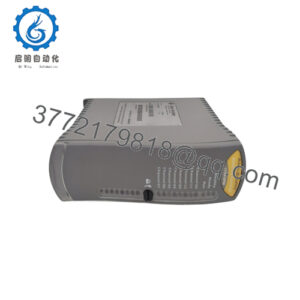
The ABB DSTC456 is a legacy ABB Master multiplexer unit used in redundant-bus architectures. The documented part number is 5751017-L, with 5751017-L/2 also appearing in ABB Master spare-parts catalogs and current secondary-market listings. Its published supply specification is 120 or 230 VAC, 47–63 Hz, with 15 VA consumption.
The module is intended for installations where redundant bus communication requires the corresponding ABB Master multiplexing hardware. It should not be confused with the nearby DSTC452 modem or DSTC454 LDB modem family members. ABB spare-parts documentation distinguishes DSTC452 as a modem and DSTC456 as a multiplexer.
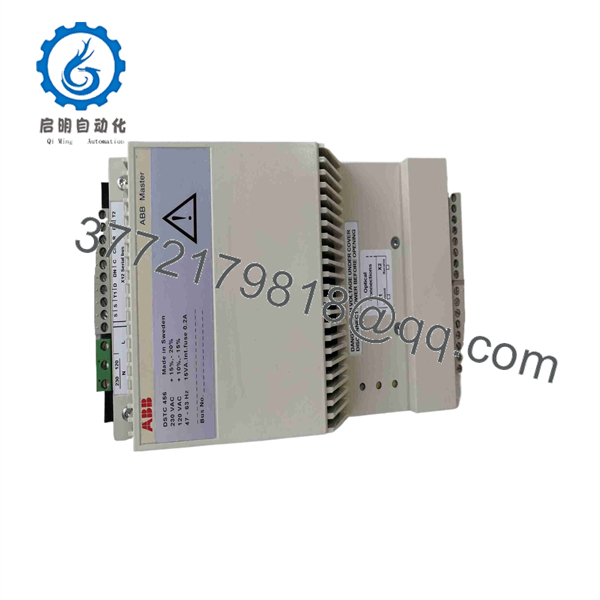
DSTC456
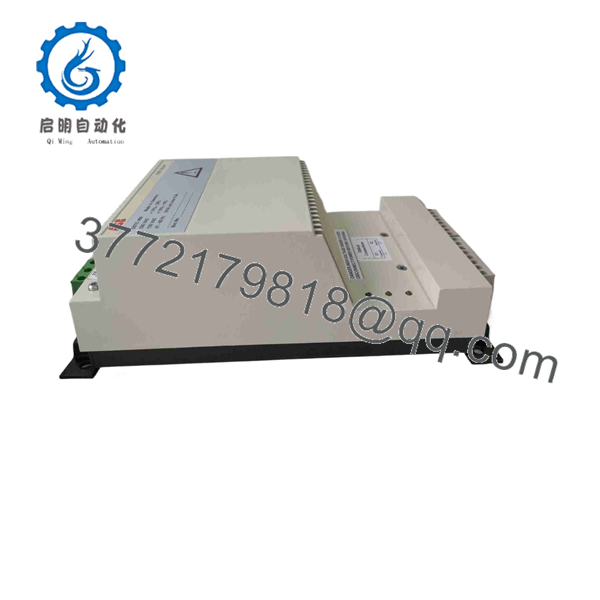
DSTC456
Installation & Configuration Guide
Stage 1 — Pre-Installation Preparation
- Verify the complete identification on the existing unit: DSTC456 / 5751017-L.
- Check whether the installed unit is marked PR:01, PR:02, or another revision.
- Confirm whether the replacement requirement is for the 5751017-L or 5751017-L/2 variant.
- Photograph all cable connections, terminal positions, jumpers, and cabinet mounting details.
- Back up the relevant ABB Master/Advant Master configuration and document the redundant-bus topology.
- Apply the plant’s lockout/tagout procedure and isolate the 120/230 VAC supply.
- Verify absence of hazardous voltage with an appropriately rated meter before touching the module.
Stage 2 — Removing the Old Module
- Confirm the unit is completely de-energized.
- Label each connected cable before removal.
- Disconnect the bus and power connections without pulling on cable conductors.
- Remove the mounting hardware securing the DSTC456.
- Withdraw the unit carefully from the cabinet.
- Inspect connectors, terminals, wiring, and the mounting area for overheating, corrosion, loose contacts, or insulation damage.
- Check the internal fuse condition and investigate any upstream fault that may have caused it to open.
Stage 3 — Installing the New Module
- Compare the replacement with the removed unit, including DSTC456, 5751017-L, revision marking, connector arrangement, and physical dimensions.
- Confirm that the supply voltage matches the installed system: 120 VAC or 230 VAC, as applicable.
- Mount the unit securely without stressing the enclosure or PCB.
- Reconnect the power wiring according to the original ABB system documentation.
- Reconnect the redundant-bus connections exactly as documented.
- Verify cable shielding, grounding, and separation from high-voltage or high-noise conductors.
- Confirm the internal fuse specification before energization; do not install a higher-rated fuse as a workaround.
- Check the redundant-bus path for correct topology before closing the cabinet.
Stage 4 — Power-On & Testing
- Perform a final wiring and polarity inspection.
- Confirm the cabinet protective earth and module grounding are intact.
- Energize the under the approved ABB Master commissioning procedure.
- Verify that the module receives the correct AC supply and does not exhibit abnormal heating or noise.
- Check communication status on both redundant bus paths.
- Verify that the ABB Master/Advant Master system recognizes the expected bus devices.
- Test redundant-path operation under controlled conditions where the plant procedure permits it.
- Monitor communication diagnostics for repeated bus errors, intermittent node loss, or failover problems.
- If communication fails, check supply voltage, fuse condition, bus wiring, termination/topology, and the corresponding redundant path before replacing additional modules.
Frequently Asked Questions (FAQ)
Q1: What is the ABB ?
The is an ABB Master multiplexer unit associated with redundant-bus applications. ABB spare-parts references identify 5751017-L as the part number.
Q2: What is the ABB part number for ?
The commonly documented part number is 5751017-L. ABB Master parts lists and secondary-market documentation also identify 5751017-L/2 as a related designation.
Q3: What input voltage does use?
Published specifications list 230 VAC +15% / -20% or 120 VAC +10% / -15%, at 47–63 Hz, with a power consumption of approximately 15 VA. Verify the actual nameplate before connecting power.
Q4: Is the same as DSTC452?
No. ABB Master parts references identify DSTC452 / 5751017-A as a modem, while is identified as a multiplexer. They should not be substituted based only on the similar model numbers.
Q5: Is still a current ABB product?
It belongs to the legacy ABB Master/Advant Master hardware family. Current market availability is primarily through specialist automation-spare suppliers and refurbished/used inventory. For example, Classic Automation currently lists a as used/refurbished inventory, while other suppliers list used 5751017-L units.
Q6: What should be verified before purchasing a ?
Verify , 5751017-L, the revision marking, supply-voltage configuration, connector arrangement, and whether the required unit is the 5751017-L or 5751017-L/2 version. Physical condition is also important because many units on the secondary market are used or refurbished.
Q7: What is the main replacement risk with this module?
The primary risk is treating the model name alone as sufficient. is part of a legacy redundant-bus architecture, so the replacement must match the installed bus topology, supply configuration, revision, and associated ABB Master hardware. A visually similar DSTC-series module is not automatically interchangeable.