WhatsApp: +86 16626708626
 Email:
 Phone: +86 16626708626
Description
Core Product Summary
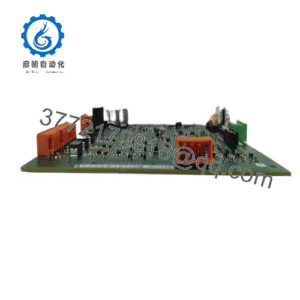
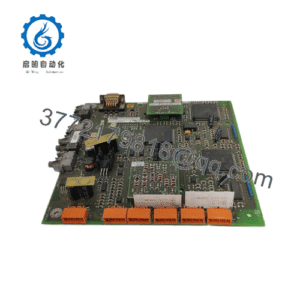
ABB PM856K01 is a processor unit kit in the AC 800M controller family. Its PM856 processor executes the controller firmware and application program, while the TP830 baseplate provides power, network, serial, and expansion connections. The PM856 has 8 MB SDRAM and 2 MB flash PROM for firmware storage; the SDRAM capacity is total controller memory, not a statement of available application memory.
The controller connects directly to S800 I/O through ModuleBus and supports up to twelve CEX-Bus communication modules. Its baseplate provides two RJ45 Ethernet connections and two RJ45 serial connections, with COM4 reserved for the configuration-tool connection. The DIN-rail assembly suits modular control cabinets where processing, I/O, and communication interfaces are selected separately. PM856 is a single-CPU controller; Ethernet connectivity must not be confused with processor redundancy.
Key Technical Specifications
| Parameter | Specification |
|---|---|
| Manufacturer | ABB |
| Kit designation | PM856K01 |
| Product type | Processor unit kit |
| Controller family | AC 800M |
| Processor unit | PM856 |
| Baseplate | TP830 |
| Total SDRAM | 8 MB |
| Firmware-storage memory | 2 MB flash PROM |
| Nominal supply | 24 V DC |
| Ethernet connections | Two RJ45 ports, CN1 and CN2 |
| Serial connections | Two RJ45 ports, COM3 and COM4 |
| COM3 function | RS-232C with modem-control signals |
| COM4 function | Isolated configuration-tool connection |
| I/O connections | Electrical and optical ModuleBus |
| Communication expansion | Up to twelve CEX-Bus modules |
| CPU configuration | Single CPU; processor redundancy is not supported |
| Mounting | Horizontal DIN rail |
| Package weight | Approximately 1,100 g |
Memory, interfaces, supply, mounting, and package-weight data apply to the PM856K01 hardware configuration. The CEX-Bus limit is specifically documented for PM856.
Engineering Selection Highlights
- 8 MB total SDRAM → distinguish total installed memory from the memory available to the application after firmware and system resources are allocated.
- Direct S800 I/O connection → use the electrical ModuleBus for a local I/O cluster and optical ModuleBus where additional I/O clusters are required.
- Up to twelve CEX-Bus modules → select separate communication interfaces for the required network or fieldbus rather than assuming every protocol is built into the processor.
- TP830 baseplate → the baseplate carries the principal external connections and Ethernet hardware identity, making it an important part of the controller assembly.
- Dedicated COM4 configuration connection → retain access to this port for configuration and initial firmware loading when the CPU is empty.
- Single-CPU architecture → two Ethernet ports do not provide a redundant processor arrangement.
- 24 V DC supply → size the cabinet supply for the processor and connected expansion hardware, not the processor alone.
System Compatibility & Integration Requirements
| Item / Dependency | Verified Compatibility or Requirement | Practical Note |
|---|---|---|
| Controller platform | AC 800M | PM856 forms the processing element of a modular controller. |
| Processor baseplate | TP830 | Carries power, Ethernet, serial, ModuleBus, and CEX-Bus connections. |
| Local S800 I/O | Electrical ModuleBus; up to twelve units in one cluster | The built-in electrical ModuleBus does not support redundant I/O modules. |
| Additional S800 I/O | Optical ModuleBus; up to seven additional clusters, each with up to twelve units | Optical expansion provides a separate connection path from the local electrical cluster. |
| Communication expansion | Up to twelve CEX-Bus modules | The required protocol depends on the selected interface module and control-software support. |
| Engineering | Control Builder | Controller firmware and the application are loaded and configured separately from hardware installation. |
| Initial firmware loading | COM4 when the CPU is empty | COM4 is the isolated configuration-tool port. |
| Memory backup | Internal battery; optional SB821 or SB822 external backup units | Backup supports RAM and the real-time clock during loss of supply. |
| CPU redundancy | Not supported by PM856 | Do not specify PM856K01 for a paired hot-standby CPU arrangement. |
The connection and backup arrangements are documented for the AC 800M processor configuration covering PM856; the twelve-module communication-expansion limit is model-specific.
Dimensions, Mounting & Connection Notes
The PM856 processor and TP830 baseplate mount on a horizontal DIN rail. The baseplate remains attached to the rail and carries most external connections, while the processor assembly attaches to it. The documented PM856K01 package weight is approximately 1,100 g.
Connection points include CN1 and CN2 for Ethernet, COM3 for RS-232C communication with modem-control signals, and isolated COM4 for configuration. Electrical ModuleBus and CEX-Bus connectors are located on the baseplate; the processor also provides an optical ModuleBus connection for S800 I/O expansion.
The AC 800M hardware is open equipment and requires installation in a non-public location. CEX-Bus baseplates must not be manipulated in a powered, running system; the modules on the affected segment must be removed before changing or removing its baseplate.
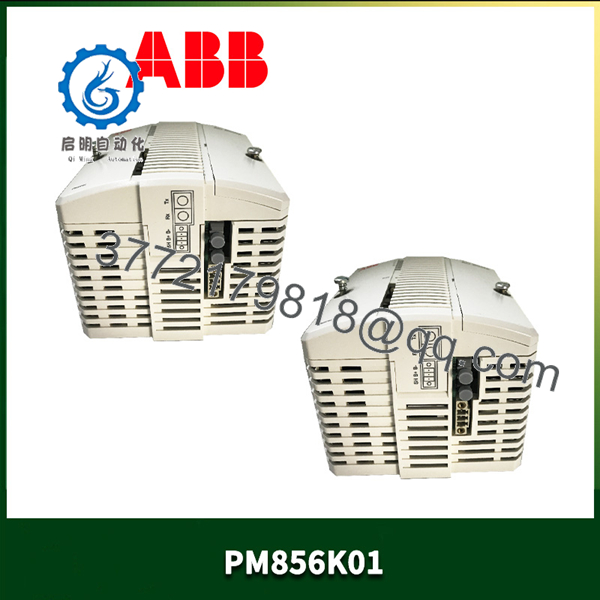
PM856K01
Detailed Product Overview
The PM856K01 is best understood as a controller assembly rather than an isolated CPU board. The PM856 contains the processing and memory resources, while the TP830 baseplate provides the connection infrastructure. This division matters during cabinet design and maintenance because the processor designation alone does not describe the complete installed controller.
Memory is a significant identification detail. PM856 has 8 MB SDRAM and 2 MB flash PROM for firmware storage. The SDRAM holds the running firmware, system configuration, and application, so the full installed capacity is not available exclusively for user logic and data. Application sizing should therefore use the memory allocation for the relevant control-software release rather than treating “8 MB” as a usable-program-memory figure.
The I/O architecture offers two distinct paths. Electrical ModuleBus connects a local S800 I/O cluster directly to the baseplate. Optical ModuleBus permits additional clusters beyond that local connection. These interfaces provide system connectivity; they do not mean that the processor itself contains analog or digital field channels. The selected S800 I/O modules determine those signal characteristics.
Communication expansion follows a similar modular approach. PM856 supports up to twelve CEX-Bus modules, allowing interface selection to follow the network requirements. A fieldbus or industrial-network protocol associated with the AC 800M platform should not automatically be described as a built-in PM856 port: many connections require a separate communication interface.
The distinction between network and processor redundancy is particularly important. The TP830 provides two Ethernet ports, but PM856 does not support the paired processor arrangement available on specified higher-capacity AC 800M CPUs. A design requiring hot-standby CPU operation therefore has a different hardware requirement from a design requiring two network connections.
Software remains a separate integration dependency. Control Builder is used to load firmware and create the controller application, and an empty CPU requires initial firmware loading through COM4. Hardware installation, firmware compatibility, and application configuration are separate commissioning tasks; the kit designation does not establish a preloaded software version.
Applications & System Role
PM856K01 provides the processing core of an AC 800M control station. With the appropriate control software and application, the controller can operate as a standalone process controller or perform local control tasks within a networked automation system. Its CPU memory holds the executable firmware, controller configuration, and application program.
The architecture separates processing from field connections. S800 I/O handles the connection to process signals through ModuleBus, while CEX-Bus communication modules add interfaces to other networks and subsystems. A relevant technical-fit scenario is a single-CPU control station requiring local S800 I/O and selected communication interfaces—not a safety controller or redundant CPU pair inferred from the wider AC 800M family.
FAQ
What is ABB PM856K01?
ABB PM856K01 is an AC 800M processor unit kit using the PM856 processor and TP830 baseplate. It provides the processing core and connection infrastructure for a modular controller.
How much memory does PM856 have?
PM856 has 8 MB SDRAM and 2 MB flash PROM for firmware storage. The SDRAM is shared by runtime firmware, controller configuration, and application resources.
Does PM856K01 connect directly to S800 I/O?
Yes. It connects directly through electrical ModuleBus and provides optical ModuleBus for additional S800 I/O clusters. The local electrical cluster supports up to twelve I/O units.
How many CEX-Bus modules does PM856 support?
PM856 supports a maximum of twelve CEX-Bus modules. The selected modules determine the additional communication interfaces available to the controller.
Does PM856 support redundant CPUs?
No. PM856 is not one of the AC 800M processors supporting paired CPU redundancy. Its two Ethernet ports must not be interpreted as a redundant-CPU capability.
What are COM3 and COM4 used for?
COM3 is an RS-232C port with modem-control signals. COM4 is an isolated configuration-tool port and is used for initial firmware loading when the CPU is empty.
What power supply does PM856K01 require?
The controller uses a nominal 24 V DC supply. System power planning must account for the processor and the connected hardware configuration.
How is controller memory backed up?
A battery maintains RAM and the real-time clock during a supply interruption. The hardware supports an internal battery and optional SB821 or SB822 external backup units.