WhatsApp: +86 16626708626
 Email:
  Phone: +86 16626708626
Description
Key Technical Specifications
| Parameter | Value |
|---|---|
| Manufacturer | Allen-Bradley / Rockwell Automation |
| Model | 509-FOD-XXX |
| Product Type | NEMA full-voltage non-reversing starter |
| NEMA Size | Size 5 |
| Poles | 3 |
| Phase | 3-phase |
| Continuous Current | 270 A |
| Maximum Voltage | 600 VAC |
| Control Voltage | 110 VAC at 50 Hz / 120 VAC at 60 Hz |
| Motor Starter Type | Direct-on-line (DOL) |
| Overload Relay | Eutectic alloy |
| Enclosure | Open type |
| Motor Rating | 75 HP at 230 V, 3-phase |
| Auxiliary Contacts | 1 N.O. reported for the 509-FOD-XXX configuration |
| Power Terminal Wire | 4 AWG to 500 MCM |
| Power Terminal Torque | 375 in-lb |
| Operating Position | Vertical |
| Mechanical Life | 5,000,000 operations |
| Temperature | Up to 65 °C |
| Lifecycle | Discontinued |
Rockwell Automation identifies 509-FOD-XXX specifically as a NEMA Full Voltage Non-Reversing Starter and records its discontinuation date as April 17, 2012.
For the corresponding 509-FOD configuration, Rockwell lists Size 5, 115–120 V control, open construction, eutectic alloy overload protection, 270 A continuous current, and 75 HP at 230 V three-phase.
Product Introduction
The Allen-Bradley 509-FOD-XXX is a NEMA Size 5, three-phase, full-voltage non-reversing motor starter designed for direct-on-line motor control. The configuration uses a 110/120 VAC control coil and a eutectic alloy overload relay, with a reported continuous current rating of 270 A.
This is a legacy Bulletin 509 starter, not a modern electronic motor starter. Its main value today is maintaining existing Allen-Bradley motor-control installations where the original contactor and overload arrangement must be matched closely. Rockwell officially discontinued the 509-FOD-XXX family in 2012.
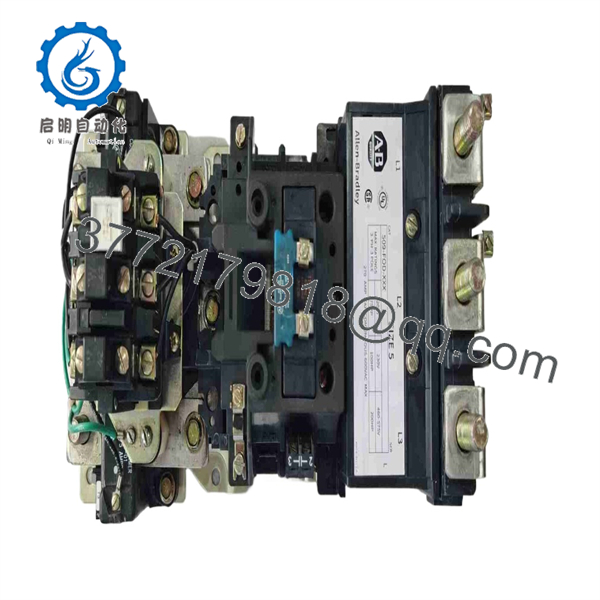
509-FOD-XXX
Installation & Configuration Guide
Typical replacement time: 30–60 minutes, excluding troubleshooting and motor testing.
Stage 1: Pre-Installation Preparation
⚠️ Safety First
- Notify operations and obtain an approved maintenance window.
- Stop the motor using the normal shutdown sequence.
- Lock out and tag out the motor starter and upstream power source.
- Verify absence of voltage with a properly rated multimeter.
- Allow control components to discharge.
- Confirm the motor cannot start from a remote control station.
Tools Required
- ESD-safe work practices
- Insulated screwdriver set
- Digital multimeter
- Wire labels
- Smartphone/camera
- Torque wrench suitable for the terminal requirements
Data Backup
Before disconnecting the old starter:
- Photograph the complete starter.
- Record the full catalog number and any suffixes.
- Photograph overload-relay settings.
- Document incoming line terminals.
- Document motor terminals.
- Record control-voltage wiring.
- Record auxiliary-contact wiring.
- Record the existing motor overload setting.
⚠️ Do not rely on wire color alone. Old Bulletin 509 installations can contain field modifications.
Stage 2: Removing the Old Starter
- Verify zero voltage at the line terminals.
- Verify the control circuit is de-energized.
- Photograph all connections.
- Label each conductor.
- Disconnect line-side wiring.
- Disconnect motor-side wiring.
- Disconnect control and auxiliary wiring.
- Remove the starter from its mounting hardware.
- Inspect the cabinet and wiring for heat damage.
Estimated time: 15–25 minutes.
Stage 3: Installing the New Starter
- Verify the replacement is 509-FOD-XXX or an approved equivalent configuration.
- Confirm the coil voltage matches the existing control circuit.
- Confirm the starter’s current and motor ratings.
- Install the starter vertically.
- Connect the three incoming phases.
- Connect the three motor outputs.
- Reconnect the control circuit.
- Reconnect auxiliary contacts.
- Install or verify the specified overload relay.
- Set the overload according to the motor nameplate and applicable electrical code.
Rockwell specifies pressure-type power terminals and a 375 in-lb terminal torque for the 509-FOD configuration; verify the applicable documentation for the exact revision before applying torque.
Self-Checklist
- Coil voltage verified
- Line terminals identified
- Motor terminals identified
- Overload rating verified
- Auxiliary contacts verified
- Terminal torque checked
- Grounding/bonding restored
- Starter mechanically secured
Stage 4: Power-On & Testing
- Keep the motor mechanically safe for initial testing.
- Energize the control circuit.
- Verify contactor pickup.
- Confirm the contactor drops out when the start command is removed.
- Check overload operation.
- Energize the motor circuit.
- Jog the motor briefly where permitted.
- Verify motor rotation.
- Measure operating current on all phases.
- Confirm current remains appropriate for the motor nameplate.
- Test the stop circuit.
- Test the overload trip circuit.
- Return the motor to normal operation.
⚠️ If one phase has abnormal current, stop immediately. Check the power contacts, terminations, overload configuration, and motor circuit before continuing.
Frequently Asked Questions (FAQ)
1. What is the Allen-Bradley 509-FOD-XXX?
It is a Bulletin 509 NEMA Size 5 full-voltage non-reversing motor starter. It is designed for three-phase direct-on-line motor starting and uses an AC control coil with overload protection.
2. Is 509-FOD-XXX still manufactured?
No. Rockwell Automation lists 509-FOD-XXX as discontinued on April 17, 2012. It was assigned an engineering-replacement category rather than remaining an active catalog product.
3. What control voltage does it use?
The documented configuration uses 110 VAC at 50 Hz and 120 VAC at 60 Hz. Rockwell also specifies an operating range of approximately 85–110% for the applicable Series L coil.
4. What is the current rating?
The associated 509-FOD configuration is rated at 270 A continuous, with a service-limit current of 312 A. These values should not be interpreted as permission to exceed the motor, conductor, overload, or application ratings.
5. Does 509-FOD-XXX include an overload relay?
The 509-FOD family is documented with a eutectic alloy overload relay. However, the 509-FOD-XXX variant and other catalog suffixes can represent different factory configurations, so verify the exact nameplate before ordering a replacement.
6. What does the XXX suffix mean?
XXX is part of the catalog designation, and Rockwell maintains separate entries such as 509-FOD-XXX-17. That specific variant is described as a Size 5, 115–120 V, open-type starter with provision for field installation of an overload relay.
Do not assume every product carrying the 509-FOD-XXX base designation has identical accessories or overload configuration.
7. Can I replace it with a newer Allen-Bradley starter?
Potentially, but this is an engineering replacement, not necessarily a drop-in mechanical substitution. Check:
- Coil voltage
- Motor full-load current
- Short-circuit coordination
- Overload technology
- Auxiliary contacts
- Enclosure dimensions
- Terminal arrangement
- Control wiring
- NEMA/IEC application requirements
For an existing production machine, photograph the installed 509-FOD-XXX nameplate and wiring before selecting the replacement.