WhatsApp: +86 16626708626
 Email:
 Phone: +86 16626708626
Description
Core Product Summary
The Baumer UNDK 30P3712/S14 is a rectangular ultrasonic proximity sensor in the UNDK 30 series. It provides non-contact object detection using ultrasonic echo measurement and is configured with a PNP break-function (NC) switching output.
The sensor covers a scanning range of 60 to 300 mm and operates at a 400 kHz ultrasonic frequency. Its potentiometer allows the switching distance to be adjusted, while the synchronization output supports coordinated operation with compatible sensors. The UNDK 30P3712/S14 connects through an M12 connector, is supplied from 12 to 30 V DC, and has a polyester housing with IP67 protection.
Key Technical Specifications
| Parameter | Value |
|---|---|
| Brand / model | Baumer UNDK 30P3712/S14 |
| Product type | Ultrasonic proximity sensor |
| Series | UNDK 30 |
| Scanning range | 60–300 mm |
| Ultrasonic frequency | 400 kHz |
| Output function | PNP break function (NC) |
| Supply voltage | 12–30 V DC |
| Residual ripple | Less than 10% of supply voltage |
| Supply current | Less than 30 mA |
| Maximum switching current | 200 mA |
| Voltage drop | 2 V DC maximum |
| Hysteresis | 4% of scanning-range far limit |
| Response time, on/off | 25–50 ms maximum |
| Repeatability | 0.5 mm maximum |
| Temperature drift | 0.18% of scanning-range far limit per K |
| Synchronization output | Yes |
| Adjustment | Potentiometer |
| Status indication | Green LED |
| Connection | M12 connector |
| Housing material | Polyester |
| Protection class | IP67 |
| Operating temperature | -25 to +60 °C |
Engineering Selection Highlights
- The UNDK 30P3712/S14 belongs to Baumer’s UNDK 30 ultrasonic proximity-sensor family, so it is intended for switching applications rather than continuous analog distance measurement.
- Its 60–300 mm scanning range makes it suitable where the target must be detected within a defined near-to-mid-distance window.
- The PNP break-function output means the load is de-energized when the sensor detects an object; control-system input logic must be selected accordingly.
- The synchronization output allows coordination with compatible sensors, which is relevant where multiple ultrasonic sensors operate close together.
- Potentiometer adjustment lets the switching point be set during commissioning and helps suppress interference from a background object.
- The M12 connector supports a detachable cable arrangement, simplifying sensor replacement and cabinet wiring.
- The IP67 polyester housing and -25 to +60 °C operating range define the environmental envelope for installation planning.
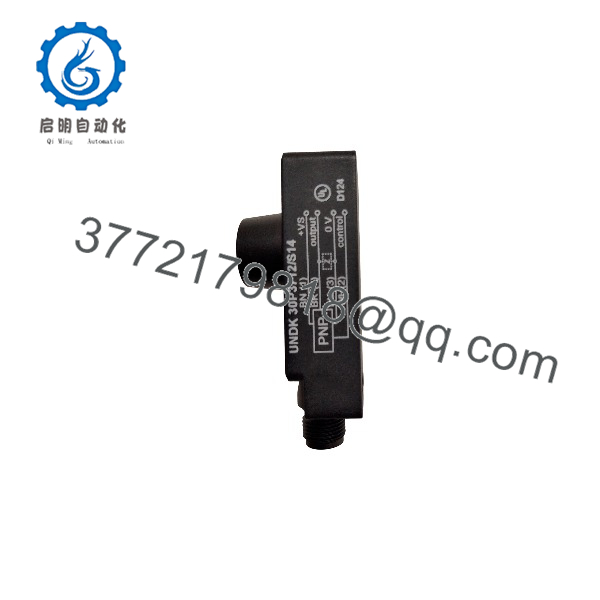
UNDK 30P3712/S14
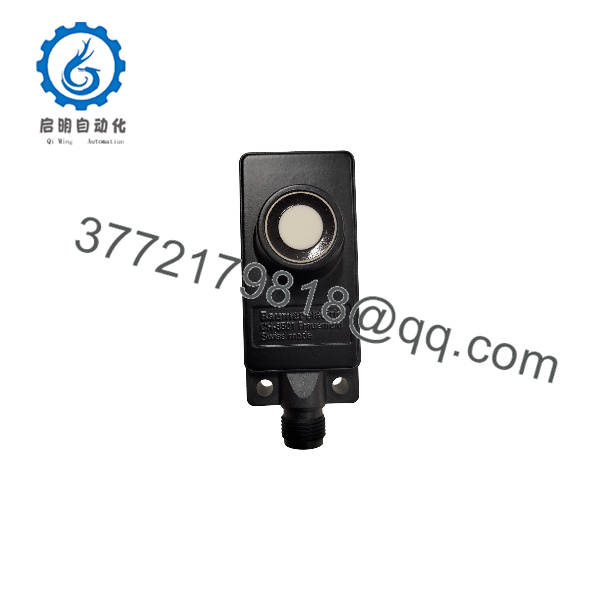
UNDK 30P3712/S14
System Compatibility & Integration Requirements
| Item / Dependency | Verified Compatibility or Requirement | Practical Note |
|---|---|---|
| Output interface | PNP break function (NC) | Connect to a controller input that accepts a PNP switching signal and interprets NC behavior correctly. |
| Supply voltage | 12–30 V DC | Use a DC supply within this range; residual ripple must remain below 10% of supply voltage. |
| Connection | M12 connector | Use a mating M12 sensor cable with the appropriate conductor arrangement for power, output, and synchronization functions. |
| Synchronization | Synchronization output provided | Coordinate operation when multiple compatible ultrasonic sensors are installed near one another. |
| Adjustment | Potentiometer | Set the required switching distance during commissioning. |
| Mounting form | Rectangular housing | Plan panel or bracket mounting around the rectangular UNDK 30 housing format. |
Dimensions, Mounting & Connection Notes
- Housing format: rectangular ultrasonic proximity sensor.
- Housing material: polyester.
- Connection: M12 connector.
- Protection class: IP67.
- Operating temperature: -25 to +60 °C.
- Switching distance is set with the integral potentiometer.
- The green LED provides switching-state indication and adjustment assistance.
Detailed Product Overview
The Baumer UNDK 30P3712/S14 is a compact rectangular ultrasonic proximity sensor designed for non-contact switching tasks in industrial machinery and control systems. It belongs to the UNDK 30 product family and uses reflected ultrasonic energy to detect an object within its 60–300 mm scanning range. Unlike a capacitive or optical proximity sensor, its detection principle is based on ultrasonic echo timing, so the switching decision is not dependent on the target’s color or transparency.
The model designation identifies the central electrical configuration: P indicates a PNP output, 3 indicates a break function (NC), and /S14 identifies the M12 connector version. This matters during integration because the output changes state in the opposite direction from a normally open sensor. A PLC or relay input must therefore be configured to recognize the de-energized condition as the detected state.
The sensor operates from a 12–30 V DC supply and provides a maximum switching current of 200 mA. Its potentiometer sets the response distance, allowing the user to define the detection point and reduce the influence of objects located behind the intended target. The green LED gives immediate feedback on switching state and assists with adjustment.
A synchronization output is included, which is useful when several ultrasonic sensors are installed close enough that their acoustic signals could interfere. Coordinating sensor operation helps prevent cross-talk in multi-sensor installations.
The UNDK 30P3712/S14 has a polyester housing, IP67 ingress protection, and a -25 to +60 °C operating range. Its M12 connection supports a detachable cable, which can simplify installation, maintenance, and replacement. For selection, the principal checks are the required detection distance, PNP NC input compatibility, available DC supply quality, M12 cabling, and whether synchronization is needed in the final sensor arrangement.
Applications & System Role
In an automation architecture, the UNDK 30P3712/S14 functions as a discrete object-presence sensor. It emits an ultrasonic signal, receives the echo from a target, and changes the state of its PNP NC output when the detected distance falls within the adjusted sensing window.
Because ultrasonic detection does not depend on target color or transparency, the sensor is technically suited to detection tasks where optical sensors may be constrained by transparent, reflective, or visually low-contrast targets. Its defined 60–300 mm range, potentiometer-based distance setting, and synchronization output make it appropriate for localized presence detection, object positioning within a switching window, and installations where several ultrasonic sensors must be coordinated.
FAQ
What is the Baumer UNDK 30P3712/S14?
It is a Baumer UNDK 30 series rectangular ultrasonic proximity sensor with a PNP break-function (NC) switching output and M12 connector.
What detection range does it cover?
Its scanning range is 60–300 mm.
What type of output does the UNDK 30P3712/S14 provide?
It provides a PNP break-function output, also described as normally closed (NC).
What supply voltage does it require?
It requires a 12–30 V DC supply with residual ripple below 10% of the supply voltage.
How is the switching distance set?
The switching distance is adjusted with the sensor’s integral potentiometer.
Does it include synchronization?
Yes. The sensor includes a synchronization output for coordinated operation in suitable multi-sensor installations.
What connector does it use?
It uses an M12 connector.
What environmental protection does it provide?
The sensor has an IP67 polyester housing and is rated for operation from -25 to +60 °C.