WhatsApp: +86 16626708626
 Email:
 Phone: +86 16626708626
Description
Core Product Summary
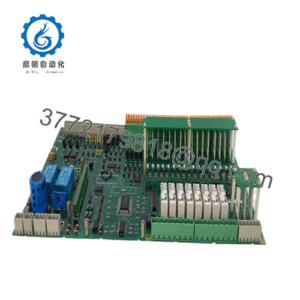
The Delta Tau Turbo PMAC2 CPU board is the 3U-format EuroCard processor board at the heart of the Turbo PMAC2 motion control architecture. Built around a Motorola DSP56303 digital signal processor as its standard CPU (component U1), it executes the PMAC2 real-time motion, PLC, and servo-control firmware that drives multi-axis automation systems.
The board is designed to be deployed two ways: assembled with piggyback accessory boards to form a “Turbo Stack,” or connected through a 3U rack backplane to rack-mounted accessory cards to form a UMAC Turbo (Universal Motion and Automation Controller) system. Within a UMAC rack, the Turbo PMAC2 CPU creates a full PMAC controller that is completely capable of standalone operation. Standard communication is over an RS-232/422 serial interface, with multiple boards daisy-chainable for synchronized multi-controller installations.
Key Technical Specifications
| Parameter | Value |
|---|---|
| Manufacturer | Delta Tau Data Systems (now Omron Delta Tau) |
| Product | 3U Turbo CPU Board (3U Turbo PMAC2) |
| Part-number family | 3xx-603382-xHxx |
| Board format | 3U EuroCard |
| Processor (standard) | DSP56303 CPU IC (location U1) |
| Standard communication | Serial interface only (RS-232/RS-422) |
| Multi-board synchronization | RS-232 daisy-chain interconnect between multiple Turbo PMAC2-3U boards |
| Base-address configuration | 12 DIP switches on block S1 (PC/104 bus base address) |
| System roles | CPU board for UMAC Turbo rack system or Turbo Stack configuration |
| Standalone operation | Supported (full PMAC controller when configured as UMAC Turbo) |
| Bus power | In bus configurations, logic supplies come through the bus connector from the bus power supply |
Detailed Product Overview
The Turbo PMAC2 CPU board is the computing element of one of the most widely deployed programmable multi-axis controller families in industrial motion control. The PMAC2 architecture separates the CPU — the board described here — from the axis interface circuitry that connects to amplifiers, encoders, and motor flags. This division is deliberate: the same CPU board can be scaled from a compact piggyback stack to a full rack-based UMAC system simply by changing which accessory boards accompany it, protecting the investment in application software as machine requirements grow.
Two deployment configurations are defined by the manufacturer. In the Turbo Stack configuration, the CPU board is assembled with piggyback accessory boards into a self-contained controller. In the UMAC Turbo configuration, the board plugs into a 3U rack backplane alongside rack-mounted accessory cards — axis interface boards, I/O cards, communications boards — forming a modular rack system. The UMAC is available with either of two CPU boards, Turbo PMAC2 or MACRO Station; selecting the Turbo PMAC2 CPU yields a “UMAC Turbo,” a full PMAC controller completely capable of standalone operation.
At the center of the board is the DSP56303 digital signal processor, fitted as component U1 in the standard configuration. This processor executes the PMAC2 firmware stack: motion program interpretation, the servo-loop and phase-loop computations for each axis, and the asynchronous PLC (programmable logic control) programs that handle machine sequencing, I/O management, and safety monitoring independently of motion execution. Firmware is stored in on-board flash memory, with a label on the U10 flash IC indicating the firmware version loaded at the factory.
Communication on the standard board is by serial interface. The serial connector supports both RS-232 and RS-422 signaling, and the same connector is used to daisy-chain multiple Turbo PMAC2-3U boards for synchronized multi-controller systems — a capability used when one machine requires coordinated motion beyond a single controller’s channel count or physically distributed controllers. Higher-level communications (Ethernet, USB) are added via accessory boards such as the ACC-54E, which provides USB/Ethernet connectivity to the 3U CPU.
When the board operates in a bus configuration, its logic power supplies come automatically through the bus connector from the bus power supply; in that mode the on-board power terminal block is not used. Board-level configuration is handled through DIP switches and jumpers: the 12-switch S1 block sets the board’s base address on the PC/104 bus, and jumper E12 permits the analog and digital circuit reference voltages to be tied together when analog circuits are not being isolated from digital circuits.
AUX-options expand the board further, including an auxiliary RS-232 serial port (option 9T) brought out on a J8 IDC 10-pin header suitable for flat-cable connection to a DB-9. As with all PMAC-family products, the board contains static-sensitive components and must be handled accordingly; for industrial use the manufacturer requires the controller to be protected from hazardous or conductive materials by installation within an industrial electrical cabinet or industrial PC.
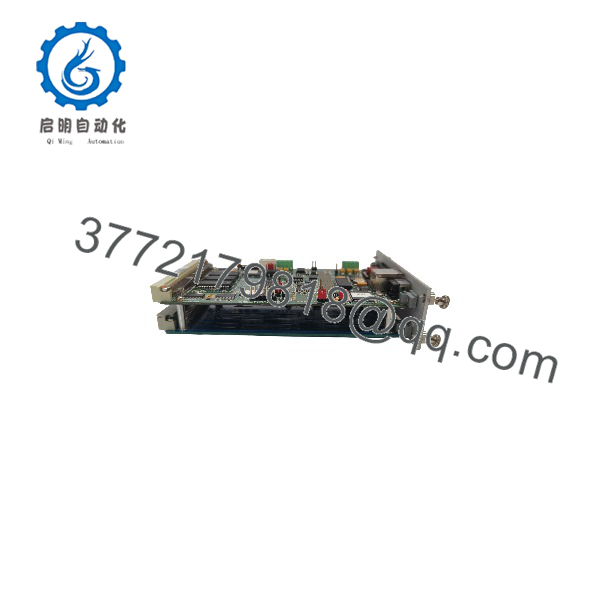
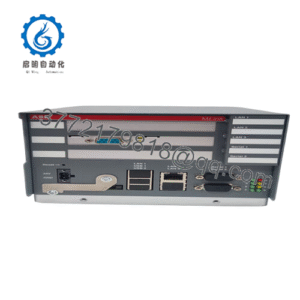
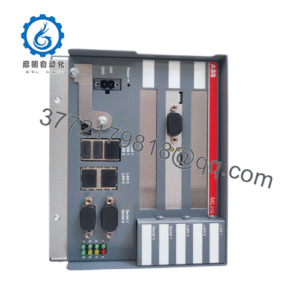
PMAC2 CPU
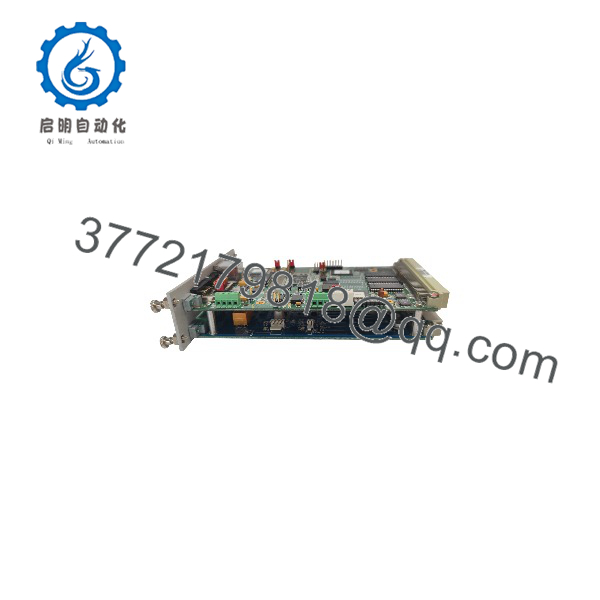
PMAC2 CPU
System Compatibility & Integration Requirements
| Item / Dependency | Verified Compatibility or Requirement | Practical Note |
|---|---|---|
| Chassis format | 3U EuroCard rack (UMAC) or piggyback Turbo Stack assembly | Configuration must match the accessory-board set used |
| Alternative UMAC CPU | UMAC also offered with MACRO Station CPU board | Not interchangeable in software role; MACRO Station requires a PMAC2 controller commanding it over the ring |
| Communications (standard) | RS-232 / RS-422 serial | Both modes supported on the standard connector |
| Multi-controller sync | RS-232 daisy-chain between multiple 3U boards | For coordinated multi-controller machines |
| Ethernet / USB | Via accessory board (e.g., ACC-54E USB/Ethernet board) | Not on the standard CPU board |
| Power (bus configuration) | Logic power from bus power supply via bus connector | Do not use the on-board terminal block in bus configurations |
| Address setup | 12 DIP switches (block S1) set PC/104 base address | Must be set before installation |
| Analog/digital reference | Jumper E12 ties analog and digital reference voltages | ON unless analog circuits are isolated from digital |
| Environment | Install in industrial electrical cabinet or industrial PC | Manufacturer requirement for industrial applications |
| Handling | Static-sensitive components | Standard ESD discipline required |
Dimensions, Mounting & Connection Notes
| Item | Value |
|---|---|
| Board format | 3U EuroCard |
| Mounting | 3U rack slot via backplane connectors (UMAC), or piggyback stack assembly |
| Power connection | Bus connector (bus configuration); on-board terminal block only in standalone-stack configurations |
| Serial connection | On-board serial port (RS-232/422); DB-9 adapter via flat cable (e.g., ACC-3L) |
| Auxiliary serial (option 9T) | J8 IDC 10-pin header |
| Configuration | S1 DIP switch block (base address), jumper E12 (reference voltage tie) |
| Firmware indicator | Label on U10 flash memory IC shows factory firmware version |
FAQ
What is the Delta Tau PMAC2 CPU board?
It is the 3U-format Turbo PMAC2 processor board — part-number family 3xx-603382 — that executes PMAC2 motion, servo, and PLC firmware in Turbo Stack and UMAC Turbo motion control systems.
What processor does it use?
The standard board is fitted with a DSP56303 digital signal processor as component U1.
In which systems can this board be used?
It assembles with piggyback accessory boards to form a Turbo Stack, or connects through a 3U rack backplane to rack-mounted accessories to form a UMAC Turbo system. The same CPU design also appears in other Turbo PMAC2 form factors (PCI, VME, PC/104) with different bus interfaces.
Can it operate standalone?
Yes. When configured as a UMAC Turbo, the Turbo PMAC2 CPU board creates a full PMAC controller completely capable of standalone operation, with serial communication to a host only required for setup and programming.
How does the board communicate?
The standard board provides an RS-232/RS-422 serial interface. Ethernet and USB connectivity are added through accessory boards such as the ACC-54E.
Can multiple CPU boards be synchronized?
Yes. The serial connector can be used to daisy-chain multiple Turbo PMAC2-3U boards for synchronized multi-controller operation.
How is the board configured?
Base address on the PC/104 bus is set with the 12 DIP switches of block S1, and jumper E12 controls whether the analog and digital reference voltages are tied together. Firmware version is indicated on a label at the U10 flash memory IC.
How is the board powered?
In bus (rack) configurations, logic power comes through the bus connector from the system power supply; the on-board terminal block is used only in non-bus stack configurations.