WhatsApp: +86 16626708626
 Email:
 Phone: +86 16626708626
Description
3. Key Technical Specifications
- Sensor inputs: Two independent differential inputs for eddy-current measuring chains (galvanically isolated)
- Compatible sensors: EPRO PR 642X series
- Input impedance: ≥ 100 kΩ
- Input voltage range: –1 V to –23 V DC (typical)
- Signal frequency range: 0.017 Hz to 70 Hz (approx. 1.02 to 4200 rpm)
- Signal voltage range: Selectable within 0–400 mVpeak (min) to 0–8000 mVpeak (max)
- Sensor supply: Nominal –26.7 V DC per channel; typical 20 mA, max 35 mA; short-circuit and open-circuit protected
- Measurement modes: Peak-to-peak, minimum/maximum
- Control inputs: Common logic inputs for mode selection, alarm locking, measuring-range multiplier
- Key-pulse input: One pulse per revolution (24 V logic)
- Interfaces: RS-232 (configuration and data readout); RS-485 (connection to MMS 6850 or host systems)
- Outputs: Configurable alarm (optocoupler) and analog outputs (current/voltage options depending on configuration)
- Self-test: Electronic circuits and transducers
- Power: Supplied via MMS 6000 system backplane (redundant supply capability in system context)
- Form factor: Eurocard / DIN 41494 style module (typical width 30 mm / 6 TE)
4. Product Introduction
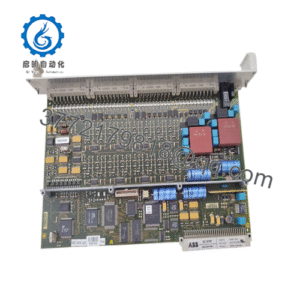
The EPRO MMS6220 is a dual-channel eccentricity monitor belonging to the MMS 6000 machine monitoring family. It processes relative radial shaft displacement signals from eddy-current sensors of the PR 642X series and evaluates them as peak-to-peak or minimum/maximum values.
Designed for turbine and rotating-equipment protection systems, the module supplies continuous eccentricity data, stores characteristic values from the last run-up or run-down, and communicates via RS-232 and RS-485. It is used to build reliable protection and diagnostic loops that help extend machine life and improve operational safety.
5. Troubleshooting Quick Reference
| Symptom | Possible Cause | Relevance to this Part | Quick Check Method | Recommendation |
|---|---|---|---|---|
| No valid eccentricity reading | Sensor gap incorrect or probe fault | ✅ High | Measure gap voltage at sensor input; confirm it is within linear range (typically near –10 V target) | Adjust probe gap or replace sensor/cable |
| Constant full-scale or zero reading | Open/shorted sensor cable or failed sensor supply | ✅ High | Check sensor supply voltage (–26.7 V nominal) and input signal with multimeter/oscilloscope | Verify wiring and sensor integrity before replacing monitor |
| Alarms trigger incorrectly during run-up | Measuring-range multiplier or limit settings incorrect | ✅ Medium | Review configuration via RS-232 software; confirm multiplier and limit values | Adjust limits and multiplier for run-up/run-down conditions |
| Communication failure on RS-485 | Address conflict, baud-rate mismatch, or bus wiring | ✅ Medium | Check RS-485 termination, polarity, and node address | Correct network settings; test with known-good cable |
| Module fails self-test | Internal electronics or transducer fault | ✅ High | Observe status indicators and read diagnostic messages via configuration software | Replace the module after confirming external sensors and power are good |
| Intermittent readings | Ground loop or noise on sensor cable | ✅ Medium | Inspect shield grounding (single-point preferred) and cable routing | Improve shielding and grounding practices |
If the fault cannot be isolated, capture photos of the module, wiring, gap voltages, and any diagnostic screenshots, then contact technical support with the full model string.
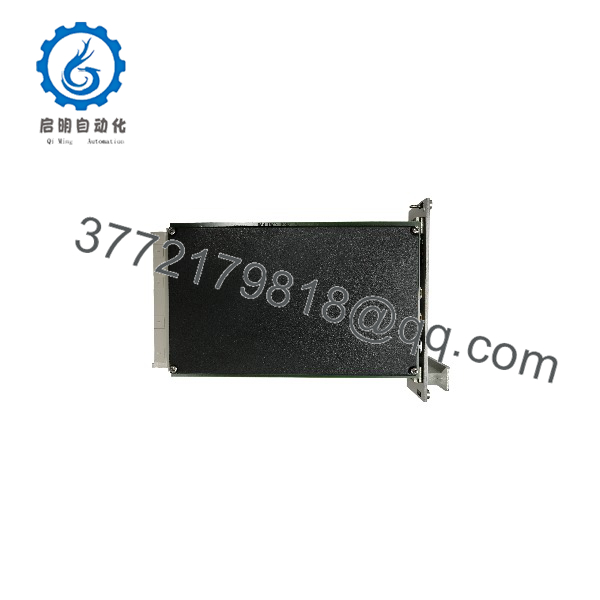
MMS6220
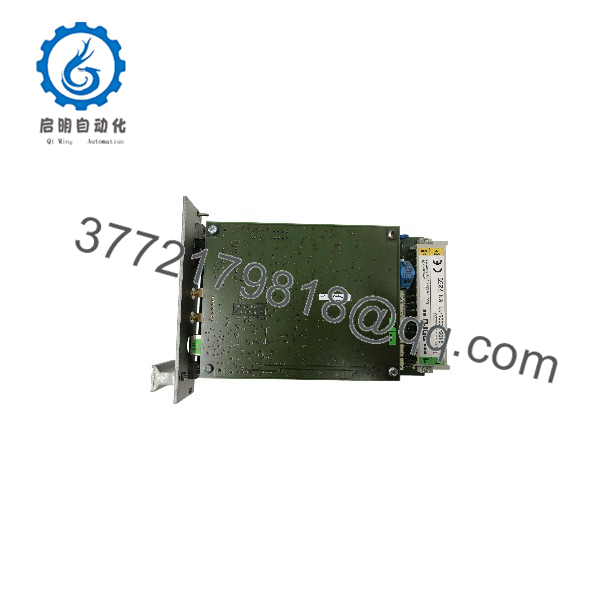
MMS6220
6. Frequently Asked Questions (FAQ)
Q: What does the MMS6220 actually measure?
A: It measures shaft eccentricity (relative radial displacement) using eddy-current sensors. It evaluates the signal as peak-to-peak or min/max values and is primarily used in turbine protection and condition-monitoring systems.
Q: Which sensors are compatible?
A: Official compatibility is with the EPRO PR 642X series eddy-current sensors. Confirm the exact probe and converter combination against the original system documentation.
Q: Can the MMS6220 be used as a stand-alone unit?
A: It is designed as part of the MMS 6000 system and is normally powered and integrated via the system backplane. Stand-alone use is limited and requires proper power and configuration arrangements.
Q: How do I configure the module?
A: Configuration and data readout are performed via the RS-232 interface using the manufacturer’s configuration software. RS-485 is used for connection to the MMS 6850 analysis system or higher-level hosts.
Q: Why is this module still requested if the MMS 6000 platform is older?
A: Many installed turbine and rotating-equipment trains still rely on the MMS 6000 family. New Surplus MMS6220 modules allow continued operation and maintenance without a full system replacement.
Q: Does the module store historical data?
A: Yes. It records and stores characteristic values from the last run-up or run-down sequence for later readout and analysis.
Q: What condition and warranty apply?
A: We supply New Original / New Surplus stock. Units are inspected for basic functionality. Standard coverage is a 1-year warranty against defects. Provide the full model MMS6220 (and any revision or order number such as 9100-00009 if available) when ordering or requesting support.