WhatsApp: +86 16626708626
 Email:
  Phone: +86 16626708626
Description
Key Technical Specifications
| Parameter | Specification |
| Number of Axes | 4 Axes (configured for step/direction or \pm 10 V analog servo) |
| Communication Interfaces | Ethernet 10/100Base-T, RS-232 (up to 19.2 kbaud) |
| Servo Loop Update Rate | 62.5 µs per axis (high-speed processing mode) |
| Position Command Modes | Point-to-point, Jogging, Linear/Circular Vectoring, Electronic Gearing, Contour Mode |
| Digital Inputs | 8 uncommitted inputs (optoisolated, 5–24 V DC) |
| Digital Outputs | 8 uncommitted outputs (optoisolated, 5–24 V DC, 20 mA sinking) |
| Analog Inputs | 8 uncommitted analog inputs (12-bit ADC, \pm 10 V) |
| Encoder Feedback Inputs | Up to 12 MHz quadrature encoder rate (differential RS-422 or single-ended) |
| Power Supply Requirement | +5 V DC, \pm 12 V DC or single +24 V DC (depending on option card/power board) |
| Program Memory | Non-volatile flash memory for DMC programming language (1000 lines x 80 chars) |
| Array Variables | 8000 array elements across 30 arrays |
| Operating Temperature | 0°C to +70°C |
Product Introduction
The Galil DMC-9940 is a high-performance 4-axis standalone motion controller engineered for complex, multi-axis motion profiling without requiring a dedicated PC host during real-time operation. Capable of driving both step-and-direction drives and \pm 10 V analog servo amplifiers simultaneously across all 4 channels, the DMC-9940 excels in high-speed pick-and-place automation, precision CNC tables, semiconductor handling, and custom packaging equipment.
Equipped with dual communication interfaces (Ethernet 10/100Base-T and RS-232), the DMC-9940 supports deterministic multi-axis linear interpolation, 2D circular vectoring, electronic gearing, and custom user-programmed Galil DMC command scripts stored directly in its internal non-volatile memory. Its rigid control loop architecture processes encoder feedback at rates up to 12 MHz with sub-100 microsecond loop execution, providing stable positioning control even under variable mechanical loads.
Quality Control & SOP Inspection Guidelines
Each Galil DMC-9940 board passes through a rigid multi-point verification protocol in our test lab prior to inventory allocation:
- Inbound Traceability & Mechanical Inspection:
- Serial number cross-check against OEM manufacturing logs to confirm genuine Galil manufacture.
- Thorough optical check of 100-pin high-density interconnect connectors, terminal headers, and surface-mount components for bent pins, thermal discoloration, or solder fatigue.
- Power Rail & Current Draw Audit:
- Bench supply connected to verify onboard voltage regulators (+5 V, +12 V, -12 V) under static conditions.
- Initial boot current measured to rule out shorted capacitors or overloaded internal gate arrays.
- Communication Handshake & Firmware Verification:
- Establish connection via RS-232 serial link using Galil Suite / Galil Tools software at 19,200 baud.
- Establish ping and socket connections over 10/100Base-T Ethernet port (XQ / ^R^S queries).
- Record firmware build string and audit non-volatile flash memory integrity.
- Live 4-Axis Loop & I/O Simulation:
- Controller interfaced to 4-axis test rig equipped with quadrature optical encoders and servo amplifiers.
- Executed multi-axis vector motion scripts (
VP,CR,BG) with active PID loop tuning (KP,KI,KDparameters). - Exercised all 8 digital inputs, 8 digital outputs, and 8 analog input channels against reference voltage calibrators and load banks.
- ESD Packaging & Report Archiving:
- Unit sealed inside an anti-static ESD shield bag with desiccant pack.
- Custom foam packaging applied for shipping protection. Test report generated and attached to documentation.
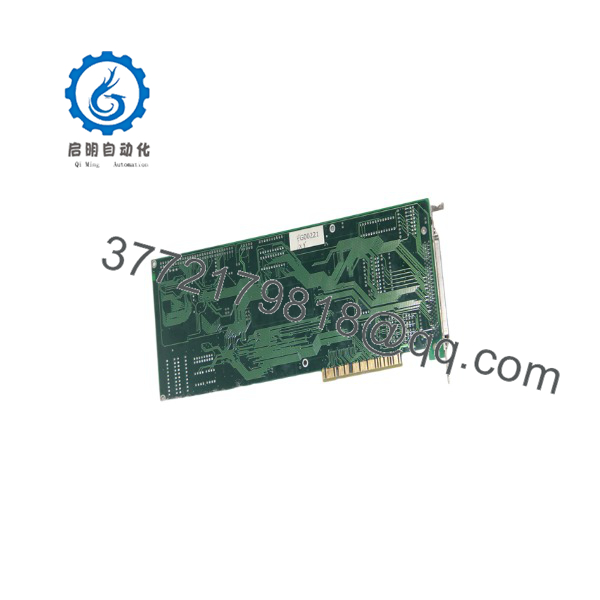
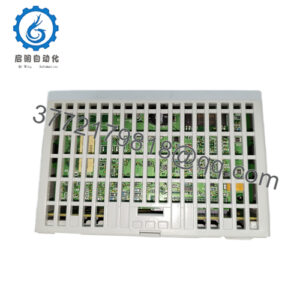
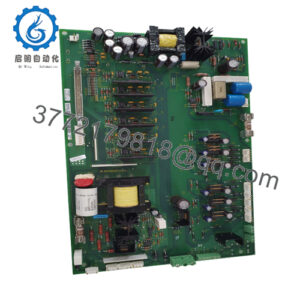
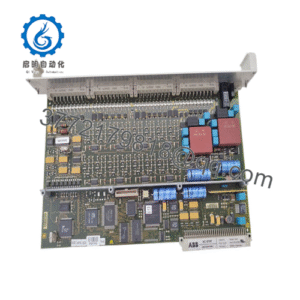
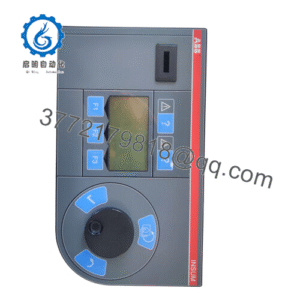
DMC-9940
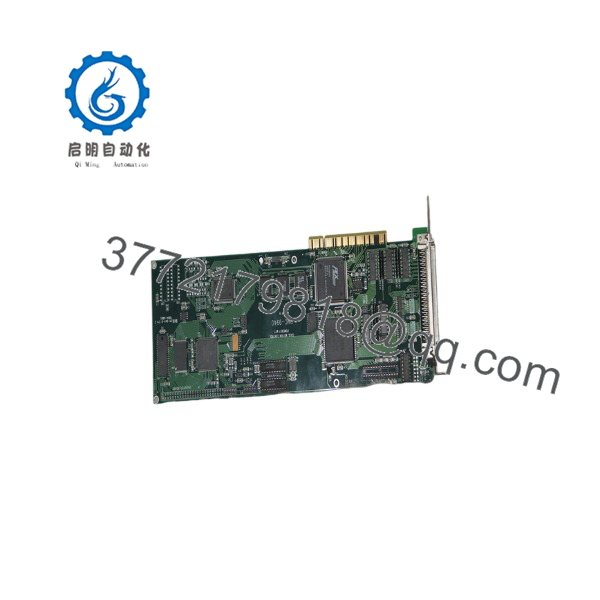
DMC-9940
Technical Pitfall & Field Survival Guide
❗ 1. Ground Loops & Differential Encoder Shielding:
Galil controllers are highly sensitive to electrical noise introduced through ground loops on feedback lines. When wiring encoders to high-density connectors, always use twisted-pair shielded cables for A+, A-, B+, B-, I+, and I- differential signals. Tie cable shielding to ground at the controller chassis end ONLY. Floating the shield or grounding it at both ends allows motor drive switching noise to corrupt encoder counts, leading to Position Error (TC 3) system shutdowns.
❗ 2. Analog Command Voltage Noise vs. Servo Instability:
When controlling analog servo amplifiers with the \pm 10 V command signals (terminals M_X, M_Y, M_Z, M_W), ensure the amplifier’s input signal ground shares a common low-impedance path with the Galil signal ground. An offset of even 50 mV between drive ground and controller ground will cause continuous axis drift or violent PID hunting on startup.
❗ 3. Executing Firmware Flash Updates over Serial/Ethernet:
Interrupting power or losing connection during a firmware update (UP command) corrupts the onboard bootloader, requiring factory-level JTAG recovery. Always use a stable Ethernet connection on an isolated network switch (avoid Wi-Fi or USB-to-Serial adapters) when flashing controller firmware or uploading dense DMC scripts.
❗ 4. Connecting Inductive Loads to Optoisolated Digital Outputs:
The onboard digital outputs are rated for max 20 mA sinking current. Direct connection to unsuppressed relay coils or solenoid valves will immediately destroy the output optocouplers due to inductive flyback voltage. Always install flyback diodes (e.g., 1N4007) across inductive DC loads external to the card.
Troubleshooting Quick Reference
| Symptom | Possible Cause | Relevance to DMC-9940 | Quick Check Method | Recommendation |
| Cannot communicate via Ethernet | IP address mismatch or subnet mismatch | ✅ High | Send IA ? or query serial port using MG _IA to verify IP address |
Use Galil IP Assign Utility over serial or reset network settings using internal DIP switch / jumper. |
TC 3 Error Code (Position Error) |
Excessive lag between command position and encoder feedback | ✅ High | Issue TE command to read position error; check motor tuning |
Re-tune PID loop (KP, KI, KD); check for mechanical binding or slipping encoder couplings. |
Axis runaway on enable (SERVO HERE) |
Encoder polarity inverted relative to motor command output | ✅ High | Check encoder count direction using TP while manually turning motor shaft |
Invert encoder polarity setting using CE command or swap motor drive command wires (\pm 10 V). |
| Inputs reading incorrect states | Optoisolator common wire (INCOM) not powered | ⚠️ Medium | Measure DC voltage between INCOM and input pin (+5 to +24 V DC) | Wire +24 V DC external supply to INCOM terminal to power the optocoupler bank. |
| Erratic step motor execution / missing steps | Step pulse active edge mismatch or improper pulse width | ⚠️ Medium | Check drive step/dir input specifications against Galil default pulse widths | Adjust step pulse timing settings using KS command to match motor drive optocoupler response times. |
Note: If diagnostic commands yield unexpected results, capture the output of TS (tell switches) and TC (tell code) commands and contact our engineering team for assistance.
Frequently Asked Questions (FAQ)
Q: Can the DMC-9940 run motion programs automatically on power-up without a PC connected?
A: Yes. The features non-volatile flash memory for storing Galil DMC programs. By placing an #AUTO label at the top of your stored program script, the controller automatically executes the code upon receiving power, operating as a completely standalone unit without any host PC connected.
Q: Can I run a mix of stepper drives and servo drives on the same card?
A: Yes. Each of the 4 axes can be independently configured using the MT command. You can set Axis A and B for servo control (MT 1) utilizing \pm 10 V analog outputs, and Axis C and D for stepper control (MT -1 or MT 2) generating step-and-direction pulse trains.
Q: What is the difference between the and other legacy Galil DMC card series?
A: The belongs to Galil’s standalone architecture featuring dedicated onboard processing power, integrated non-volatile program execution, and built-in Ethernet/RS232 ports. Unlike bus-based cards (like PCI or ISA formats that require a host PC chassis), the 9940 is a self-contained controller suited for mounting inside an industrial electrical enclosure.
Q: How do I backup the existing motion control program before replacing a damaged ?
A: Connect to the existing controller using Galil Suite, Galil Tools, or a serial terminal program (like TeraTerm). Issue the upload command UL to stream the complete DMC program stored in the flash memory back to your PC text file. You can then download this exact file (DL command) into the replacement board.
Q: What warranty coverage applies to your New Surplus and Refurbished units?
A: Every Galil controller supplied by our facility comes backed by a comprehensive 1-year replacement warranty. If any channel or I/O bank experiences a hardware fault under normal operating conditions within 12 months, we provide an immediate advance exchange unit from active inventory to keep your line running.