 WhatsApp: +86 16626708626
 Email:
  Phone: +86 16626708626
Description
Key Technical Specifications
| Parameter | Value / Specification |
| Manufacturer | General Electric (GE) |
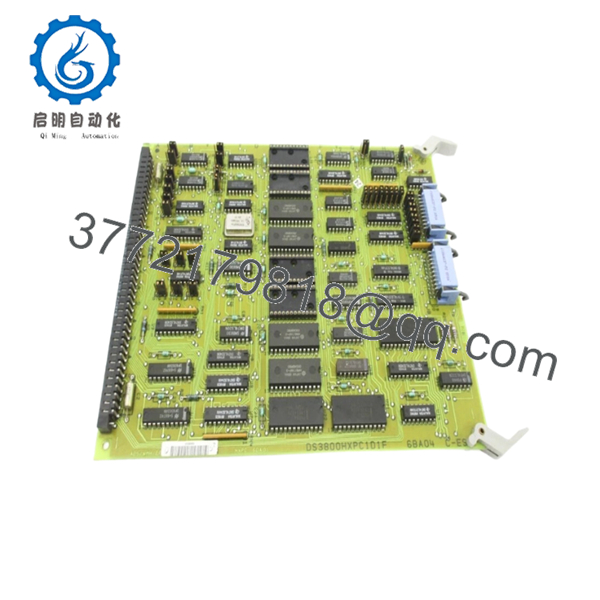
| Part Number | DS3800HXPC1D1F |
| System Series | Speedtronic Mark IV Control System |
| Board Type | Power Auxiliary / Pulse Control Board (HXPC) |
| Revision Level | 1D1F (Incorporates revision D optimization and factory F updates) |
| Circuit Function | Gate pulse drive conditioning and auxiliary power rail management |
| Isolation Rating | Optocoupler-isolated digital and gate drive sections |
| Onboard Hardware | High-inductance pulse transformers, power resistors, and test point arrays |
| Operating Temp | 0 to +60°C (32 to 140°F) |
| Form Factor | Multi-layer heavy-duty PCB for card-rack or chassis mounting |
Product Introduction & Supply Chain Strategy
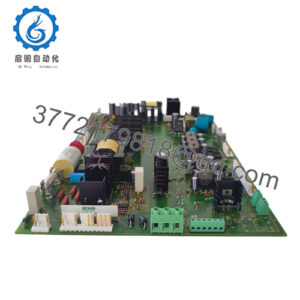
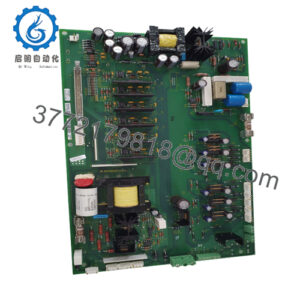
The GE DS3800HXPC1D1F is a specialized power auxiliary and pulse control board utilized within the Speedtronic Mark IV turbine control ecosystem. It is primarily tasked with conditioning auxiliary power distribution lines and managing the firing pulses required for thyristor or excitation circuits in power plant automation.
Procuring this module as a New Surplus unit is a critical risk-mitigation strategy for facilities running legacy systems. Because the Mark IV series is discontinued, relying on second-hand or poorly repaired cards introduces severe asset vulnerability. Maintaining a reliable buffer stock of un-energized, brand-new components eliminates the lead-time variability of emergency market hunting, reducing your Total Cost of Ownership (TCO) and shielding operations from $100,000+ daily downtime losses.
Installation & Configuration Guide
Stage 1: Pre-Installation (Prep & Safety)
- Isolate all high-voltage and low-voltage power sources to the Mark IV control panel using standard lock-out/tag-out (LOTO) safety protocols. Verify that all auxiliary transformer feeds are completely dead.
- Put on a grounded anti-static wrist strap and connect it to the unpainted chassis ground point.
- Use a high-resolution camera to document the existing board configuration, noting all jumper wire links, wire-wrap points, and the precise orientation of power cables.
Stage 2: Removal
- Carefully unthread any heavy-gauge power wiring from the screw terminals, ensuring each wire tag is clearly legible.
- Unclip any ribbon cables or multi-pin terminal blocks by pulling straight back from the board.
- Unscrew the retention mounting hardware holding the board to the chassis standoffs. Lift the card straight out, taking care not to drag the rear components across metal framing. Place the card into an ESD-safe bag immediately.
Stage 3: Installation (Clone & Seat)
- Remove the new surplus DS3800HXPC1D1F card from its anti-static packaging.
- Mirror all jumper blocks and physical configuration configurations from the old board onto the new board exactly, using your reference photo.
- Position the card onto the chassis standoffs. Securely fasten the retention screws to a torque specification of 0.5 Nm. Reconnect all low-voltage ribbon cables and terminate the power wiring to the proper screw terminals, ensuring solid, low-resistance connections.
Stage 4: Power-On & Testing
- Conduct a visual inspection to confirm no loose hardware, washers, or stray copper strands are trapped near the power resistors or pulse transformers.
- Re-energize the auxiliary circuits and measure the voltage at the dedicated onboard test points using a calibrated digital multimeter to ensure internal regulation is correct.
- Verify that the primary processing rack detects the card and that no excitation, pulse-generation, or auxiliary power faults are logged at the engineering station terminal.

- DS3800HXPC1D1F
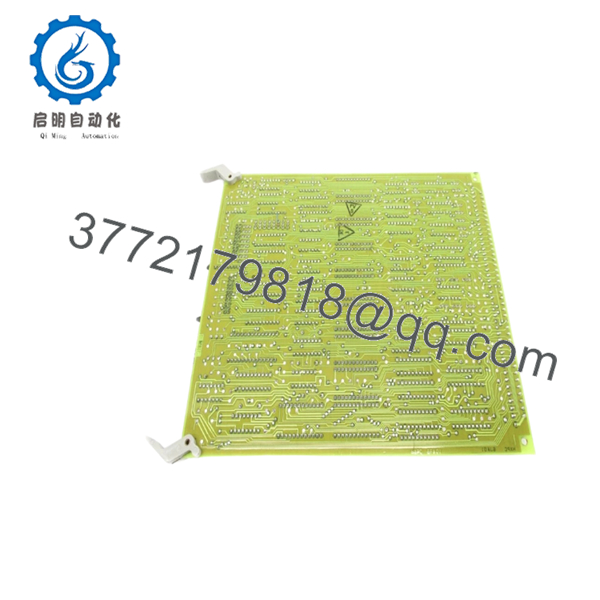
- DS3800HXPC1D1F
Firmware/Software Versions & Upgrade Notes
The DS3800HXPC1D1F features a specific functional revision matrix dictated by the “1D1F” suffix. This indicates an advanced hardware revision level that integrates improved component tolerances and enhanced thermal dissipation paths around the power components compared to earlier 1A, 1B, or 1C designs.
This board functions as a hardware-level power execution layer and does not possess programmable microcode or flash memory. However, its gate timing behavior and component tolerances are engineered to interface with specific revisions of the master computation architecture. When substituting older versions (e.g., 1A or 1B) with this 1D1F card, consult your system configuration documents to ensure that any field-installed external resistor modifications are either matched or accounted for in the loop tuning parameters.
Frequently Asked Questions (FAQ)
Is this board brand new, and why is it cheaper than the original factory list price?
Yes, this is a Brand New Surplus unit. It is not used, not pulled from a decommissioned plant, and not refurbished. All modules undergo rigorous quality verification to ensure OEM-level reliability. The price is below the original factory list price because we source unissued, spare inventory allocations from capital project surpluses and climate-controlled storage facilities globally. This lets us pass substantial savings on to your procurement budget while maintaining 100% genuine new condition.
What are the specific risks of using a refurbished board for turbine control?
Refurbished control cards pose a severe risk to high-availability power generation assets. Surface cleaning and basic repairs cannot fix internal component degradation, such as dried-out electrolytic capacitors or micro-fractures in the traces caused by thermal cycling. A refurbished card might work during a bench test but fail three months later under full thermal loads, causing a turbine trip, emergency shutdown, and catastrophic secondary costs that dwarf the initial savings.
Does the DS3800HXPC1D1F support hot-swapping while the turbine is running?
No. The GE Mark IV system architecture does not allow hot-swapping on power auxiliary or pulse control tiers. Pulling or inserting this board while the rack or field loops are energized will cause heavy electrical arcs, component damage, immediate circuit faults, and an instant emergency shutdown (ESD) of the turbine asset.
Will the board require programming or software loading out of the box?
No. The DS3800HXPC1D1F is a hardware-driven auxiliary module. It relies on physical jumpers, hardware components, and incoming signals to execute its functions. It does not carry programmable flash application memory, so it is ready for deployment once the onboard physical jumper profiles are matched to your old card.
What kind of warranty and quality certification comes with this module?
Every single DS3800HXPC1D1F shipped passes through a strict inbound and outbound quality control checklist. This involves anti-counterfeit serial verification, physical trace tracking, and static testing. Because of this high standard, we back this New Surplus product with a comprehensive 2-year warranty, which is twice the industry standard for surplus components.