 WhatsApp: +86 16626708626
 Email:
  Phone: +86 16626708626
Description
3. Key Technical Specifications
| Parameter | Value |
| Input Type | Analog Signals (4-20 mA, 0-10 V DC, Thermocouple) |
| Output Type | Parallel Digital Data to Mark IV Backplane |
| Resolution | High-precision 12-bit or 16-bit conversion (Revision dependent) |
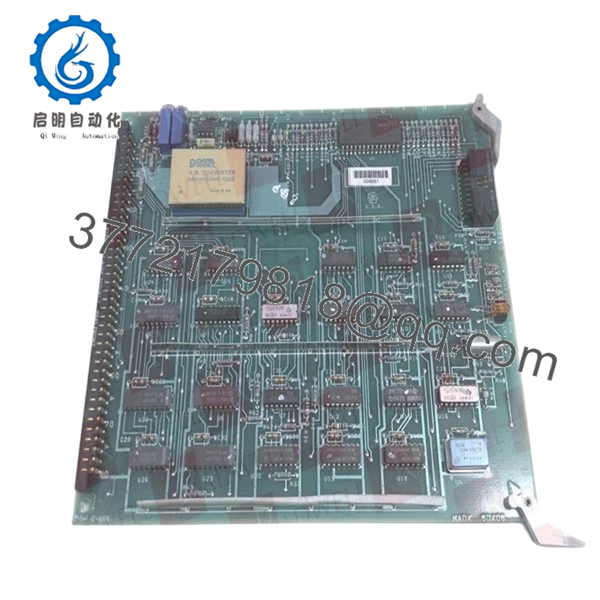
| Board Architecture | Through-hole PCB with discrete logic and ICs |
| Power Requirements | +5 V DC, +/-15 V DC provided by the rack power supply |
| Test Points | Onboard TP loops for calibration and signal monitoring |
| Calibration | Manual potentiometer adjustments for zero and span |
| Connectors | Edge-card gold-plated fingers and ribbon header |
4. Product Introduction & Supply Chain Strategy
The GE DS3800NADA is a fundamental component of the Mark IV Speedtronic turbine control system, responsible for the critical interface between physical field sensors and the digital control logic. It translates analog voltages and currents from pressure transducers, thermocouples, and flow meters into the digital language required for the system’s central processors. Without the high-fidelity conversion provided by the NADA board, the turbine’s governing system cannot accurately respond to environmental or operational changes.
From a supply chain perspective, the DS3800NADA is an “insurance” component. As these systems move deeper into their extended life phase, the precision resistors and analog-to-digital converter ICs on used boards begin to drift, leading to calibration errors and “nuisance trips.” Procuring a New Surplus unit is the most effective way to eliminate signal noise and drift issues. By securing New Surplus stock, you avoid the high Total Cost of Ownership (TCO) associated with troubleshooting mysterious analog faults caused by aging, refurbished hardware.
5. Installation & Configuration Guide
Stage 1: Pre-Installation (Prep & Safety)
Power down the Mark IV cabinet following LOTO safety protocols. Use a grounded ESD wrist strap. Document the current potentiometer settings and check for any custom jumpers on the existing board. Ensure you have a calibrated multimeter for post-installation checks.
Stage 2: Removal
Gently disconnect the ribbon cable from the front of the board. Loosen the retaining screws and pull the DS3800NADA straight out of the rack guides. Be careful not to touch the gold edge connectors with bare skin, as oils can cause oxidation and signal loss over time.
Stage 3: Installation (Clone & Seat)
Slide the new DS3800NADA into the rack slots, ensuring it is perfectly aligned with the backplane connector. Apply firm, even pressure until the board is fully seated. Secure the retaining screws and reattach the ribbon cable.
Stage 4: Power-On & Testing
Restore power to the rack. Use the onboard test points to verify the 5 V and 15 V rails are stable. You may need to perform a “Zero and Span” calibration using the onboard potentiometers to match the board to your specific field sensors. Verify the digital readings at the operator workstation to confirm signal accuracy.

- DS3800NADA
6. Firmware/Software Versions & Upgrade Notes
- Hardware Logic: This is an analog-heavy board and typically does not contain programmable EPROMs. Its behavior is dictated by hardware jumper settings and potentiometer calibration.
- Interchangeability: The DS3800NADA is designed to be a direct replacement for various NADA iterations. However, always check the revision letter (e.g., A, B, C) to ensure compatibility with your specific I/O termination blocks.
- Drift Warning: When installing a new board, do not assume factory calibration will perfectly match your 20-year-old field instrumentation. Always verify the analog loop integrity after the swap.
7. Frequently Asked Questions (FAQ)
What does “NADA” stand for in the GE naming convention?
While GE part numbers are alphanumeric, “NADA” in the Mark IV series specifically denotes the Analog-to-Digital conversion functionality. It is the primary “input” gate for the control system.
Why should I avoid refurbished DS3800NADA boards?
Analog components like capacitors and precision operational amplifiers have a finite lifespan. Refurbished boards often have components that are near the end of their lifecycle, leading to “signal wandering” where the reading fluctuates even when the field input is steady. New Surplus provides the stability required for sensitive turbine control.
Is this board hot-swappable?
No. Removing or inserting any Mark IV board while the rack is powered can cause electrical arcs that may damage the backplane or corrupt the data in the central processor. Always power down the core before service.
How do I calibrate this board?
Calibration is performed using the onboard potentiometers and monitoring the test points with a precision voltmeter. We recommend following the specific GE Mark IV maintenance manual for your turbine model to find the exact voltage-to-unit conversion ratios.
Can this board be used in a Mark V system?
No. The DS3800 series is built for the Mark IV architecture. Mark V systems use the DS200 series, which features a completely different physical form factor and communication bus.